
Last year I spread leaves around some oak trees near the entrance of the arboretum. I was hoping to reduce the amount of grass growing there and prepare the site for planting some hound’s tongue seeds this fall.
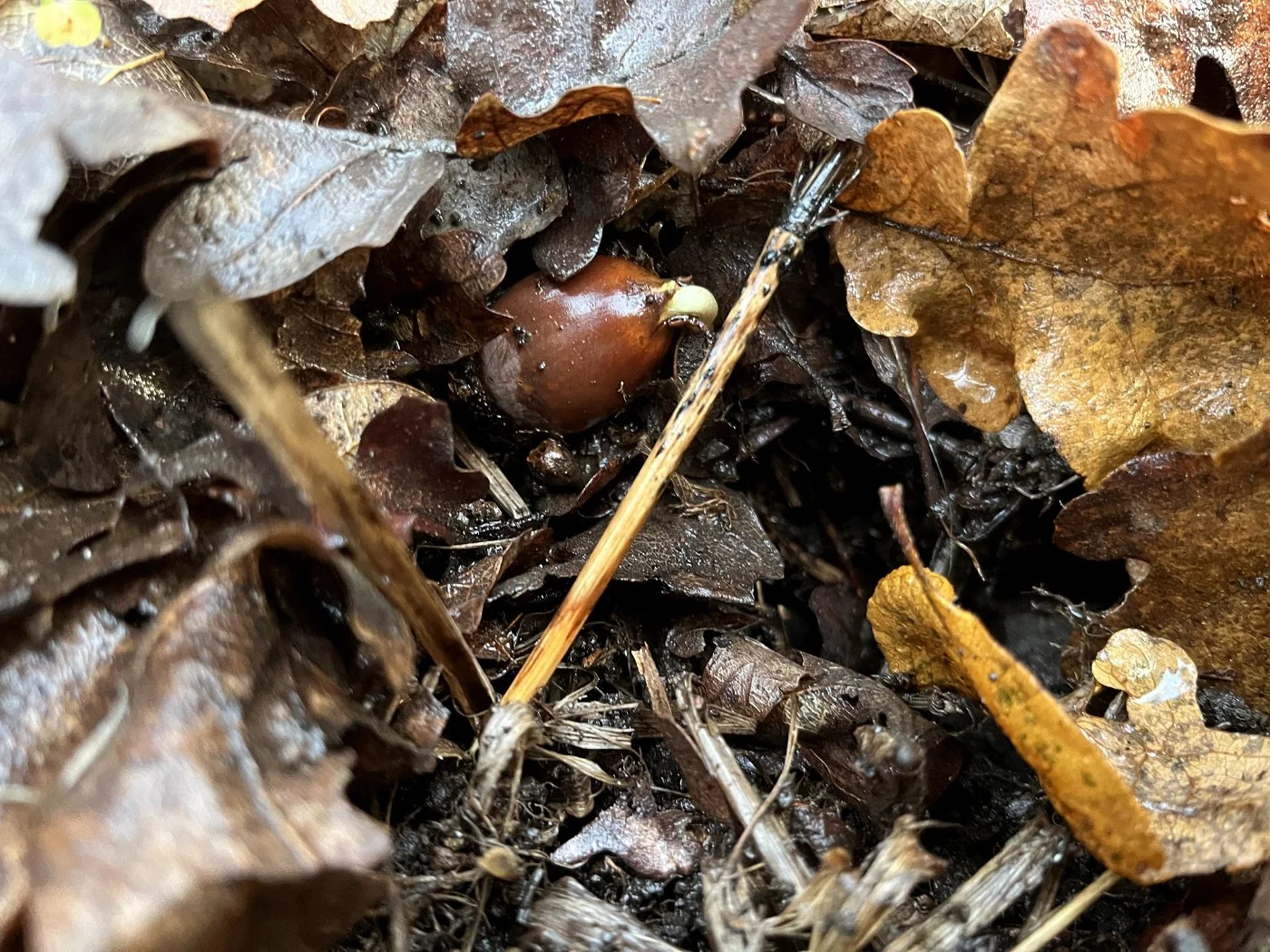
So, I collected some hound’s tongue seeds this summer and recently I went to plant them. While pulling up some grass in the area before I planted my seeds, I found an acorn that had sprouted.
In late summer or fall, acorns fall to the ground and here in Oregon that usually coincides with the return of the rain. When an optimal amount of moisture is reached, they will germinate. The acorn first sends down a taproot that helps anchor the tree and reach deep into the soil for moisture and nutrients. From here, it will wait until spring.
In the spring, the acorn will send up a sprout and develop into a seedling approximately six inches tall with its first few leaves. The first year the oak tree focuses most of its energy into establishing its root system. In the Nature of Oaks by Doug Tallamy he says, “In fact, after their first year, a seedling oak may have up to 10 times more root mass than the biomass of leaves and shoots above ground.” Since oak trees grow extensive root structures, it is important that their roots are able to grow without being obstructed by barriers such as roads, sidewalks, parking lots, etc. This broad root system helps the oak trees survive drought conditions like what we experience during the summer here in the Willamette Valley.
Oak Savannas once spread out across much of the Willamette Valley where it thrives in a climate of warm, sunny, dry summers and the mild, wet winters. They can live to be 500 years old.
Resources
Oregon White Oak (Quercus Garryana) | Oregon Wood Innovation Center. https://owic.oregonstate.edu/oregon-white-oak-quercus-garryana. Accessed 24 Nov. 2026.
Tallamy, Douglas W. The Nature of Oaks: The Rich Ecology of Our Most Essential Native Trees. Timber Press, 2021.