
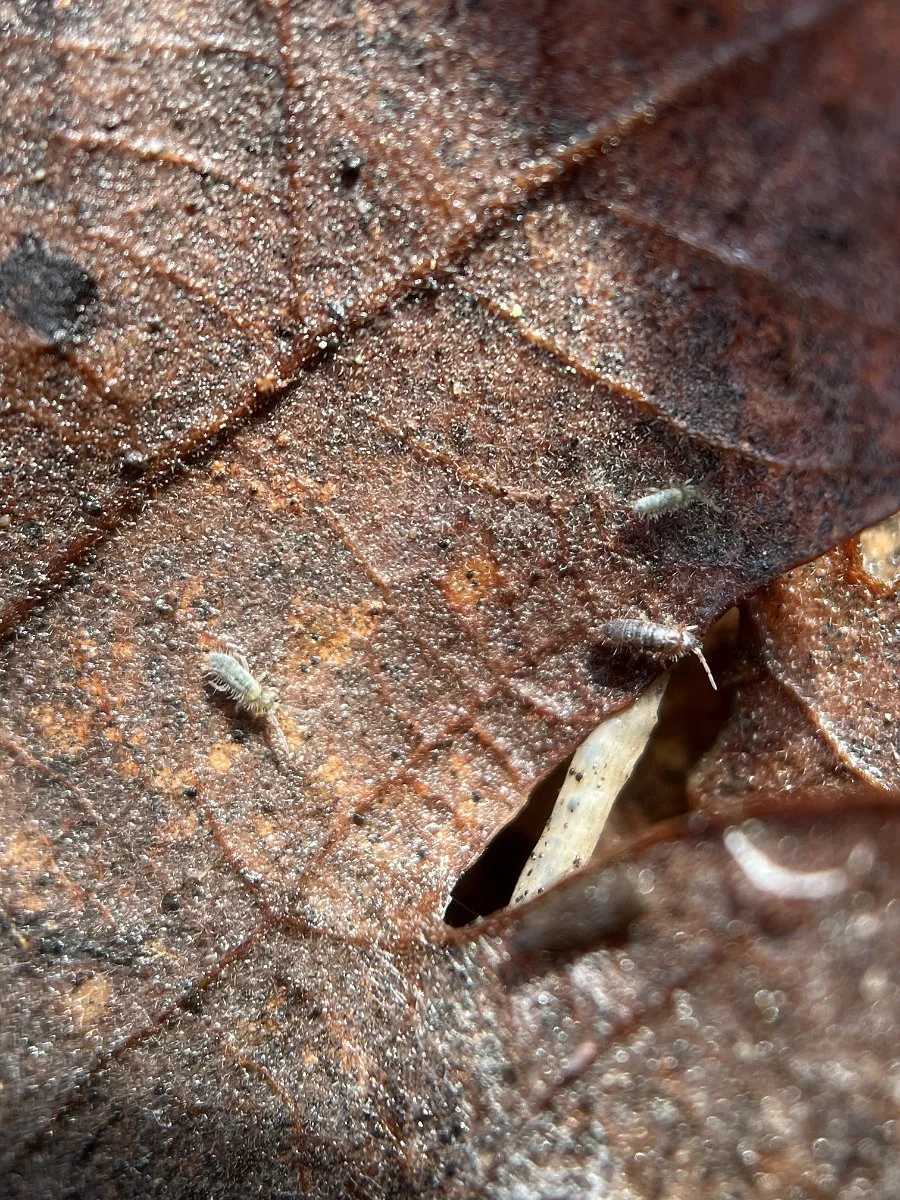
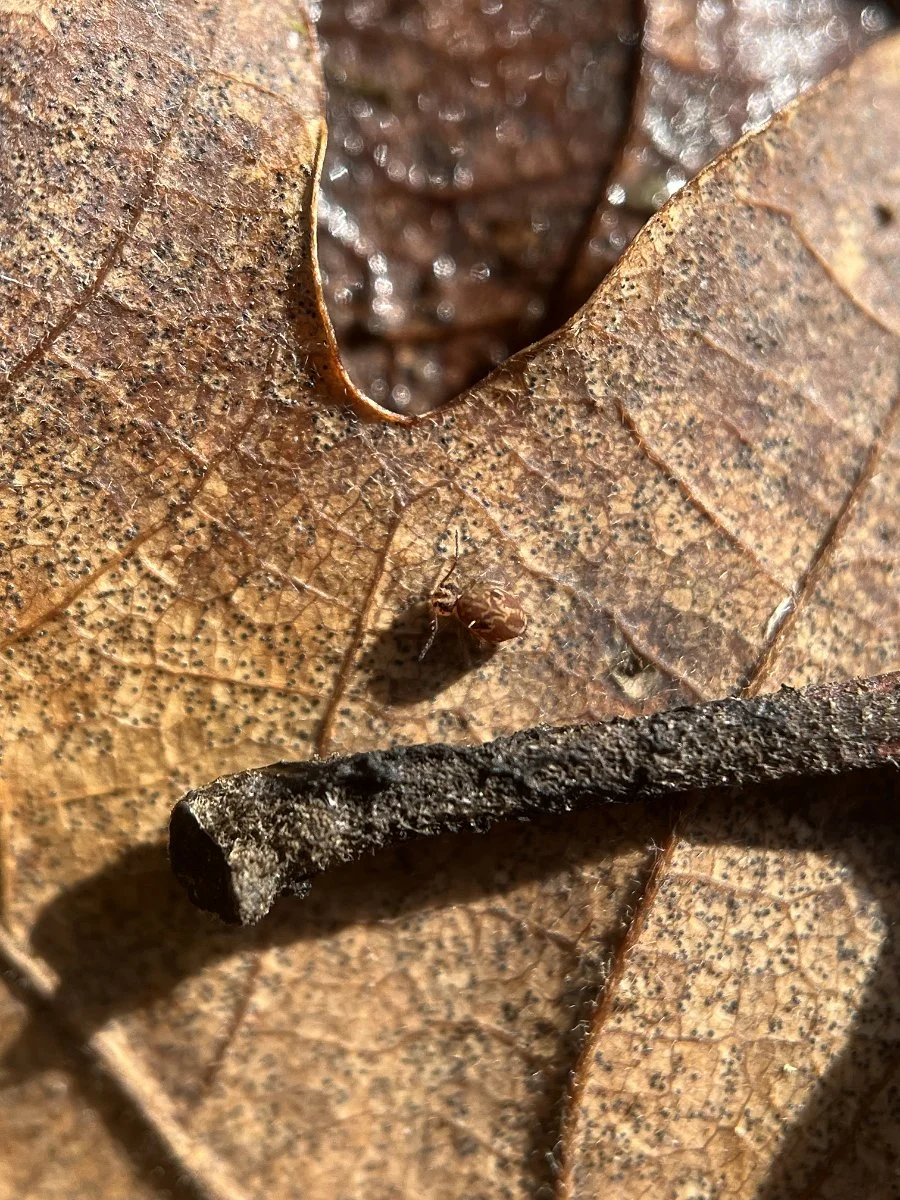
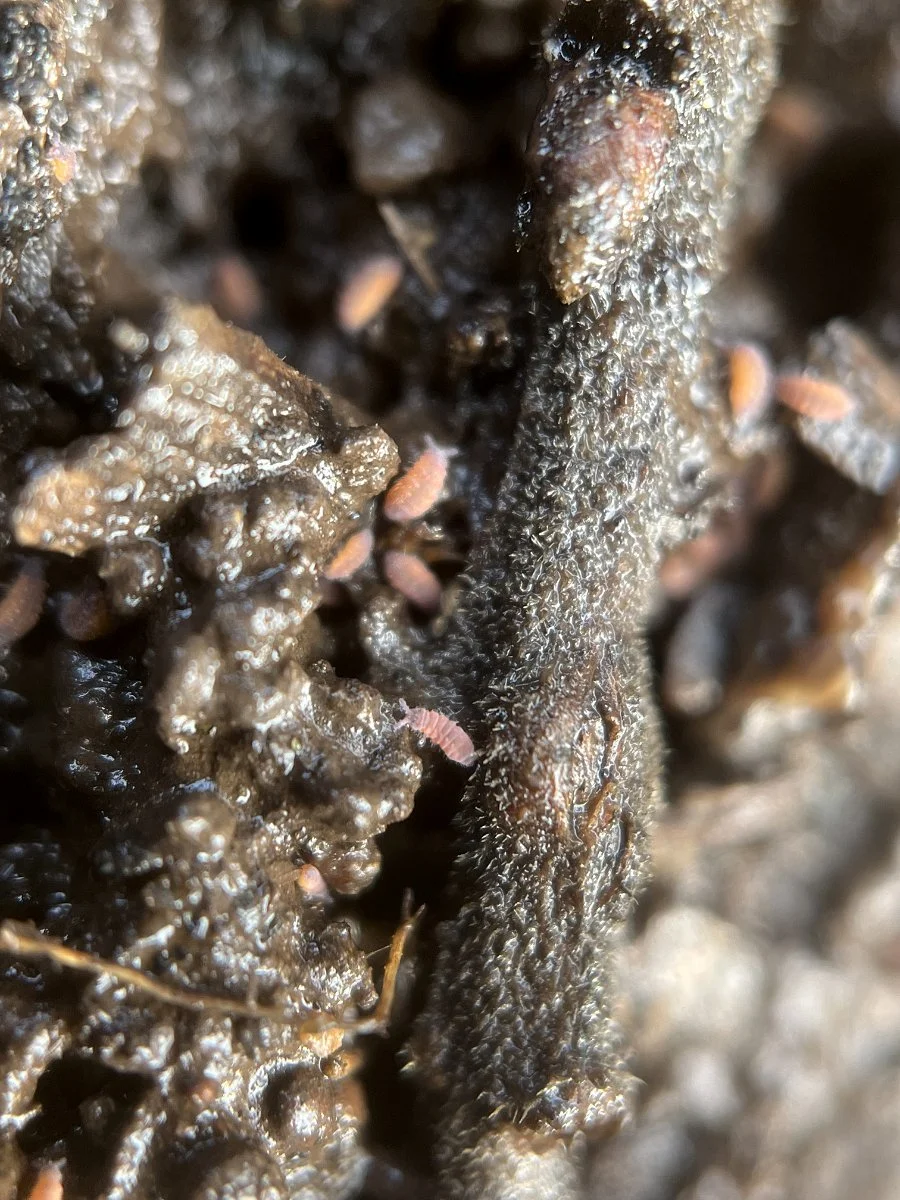
The winter sky is low. I feel like I have to duck under the shallow ceiling of amorphous, gray clouds as I walk around the arboretum. If the sun peaks through, it is just above the brim of my hat. In the hibernal landscape, I found an amazing “spring” hiding under a bed to put some bounce in your step to help alleviate any winter blues.
Beneath the oak trees, a patchwork of brown leaves blanketing the ground creates the perfect home for springtails! Oak leaves are high in tannins and lignin which causes them to decay at a slower rate. It can often take years for them to break down. This insulative bed of leaves helps regulate moisture and temperature creating a favorable home for many creatures in the leaves and the ground below. These leaves also add a layer of protection from potential predators by giving them a place to hide.
The other day I knelt down at the edge of the leaves and peeled back the top layer. I was immediately greeted by a lively burst of springtails emanating forth in every direction. A unique characteristic to most springtails is a forked tail-like structure called a furcula. It is folded underneath their abdomen and held in place by a latch called the tenaculum. When the tenaculum is released, the furcula quickly flips open. This acts as a spring as it pushes downward against a surface, launching the springtail into the air to hopefully evade predators.
Springtails are important detritivores. They primarily feast on decaying organic matter which cycles nutrients back into the ecosystem. In addition, as they burrow and wiggle around in the soil eating and searching for food, their small tunnels help build the soil microstructure. Along with decaying organic matter, they eat fungi, algae, and bacteria.
Springtails are tiny arthropods that until recently were considered insects. Around the year 2000, they were reclassified in the class Collembola. They are similar to insects but along with DNA testing, they have characteristics such as internal mouth parts and unique structures like a tube-like collophore and the aforementioned furcula that play a role in separating them out into the class Collembola.
They are one of the most abundant arthropods in the soil mesofauna and one of the most interesting. The other day I found what appears to be three different kinds in and under the oak leaves out at the arboretum. I am going to continue researching and exploring these wonderful creatures and I hope this small introduction inspires you to do the same.
Happy New Year!
Sources
“All about Springtails (Collembola).” A Chaos of Delight, https://www.chaosofdelight.org/collembola-springtails. Accessed 7 Jan. 2026.
Class Collembola – ENT 425 – General Entomology. https://genent.cals.ncsu.edu/insect-identification/class-collembola/. Accessed 7 Jan. 2026.
“Springtails.” Missouri Department of Conservation, https://mdc.mo.gov/discover-nature/field-guide/springtails. Accessed 7 Jan. 2026.
Springtails | Colorado State University Extension Website. 20 June 2025, https://extension.colostate.edu/resource/springtails/.