
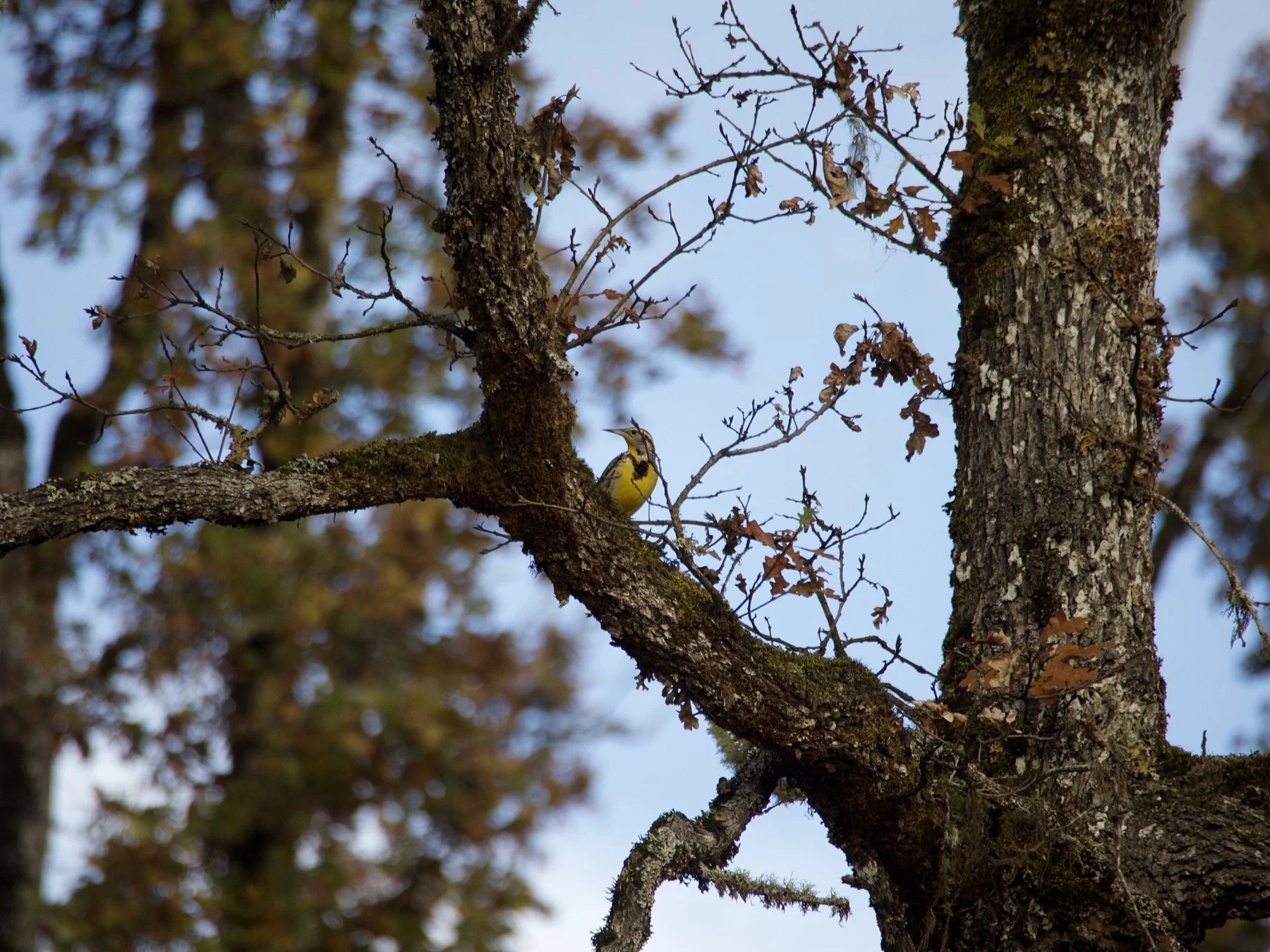
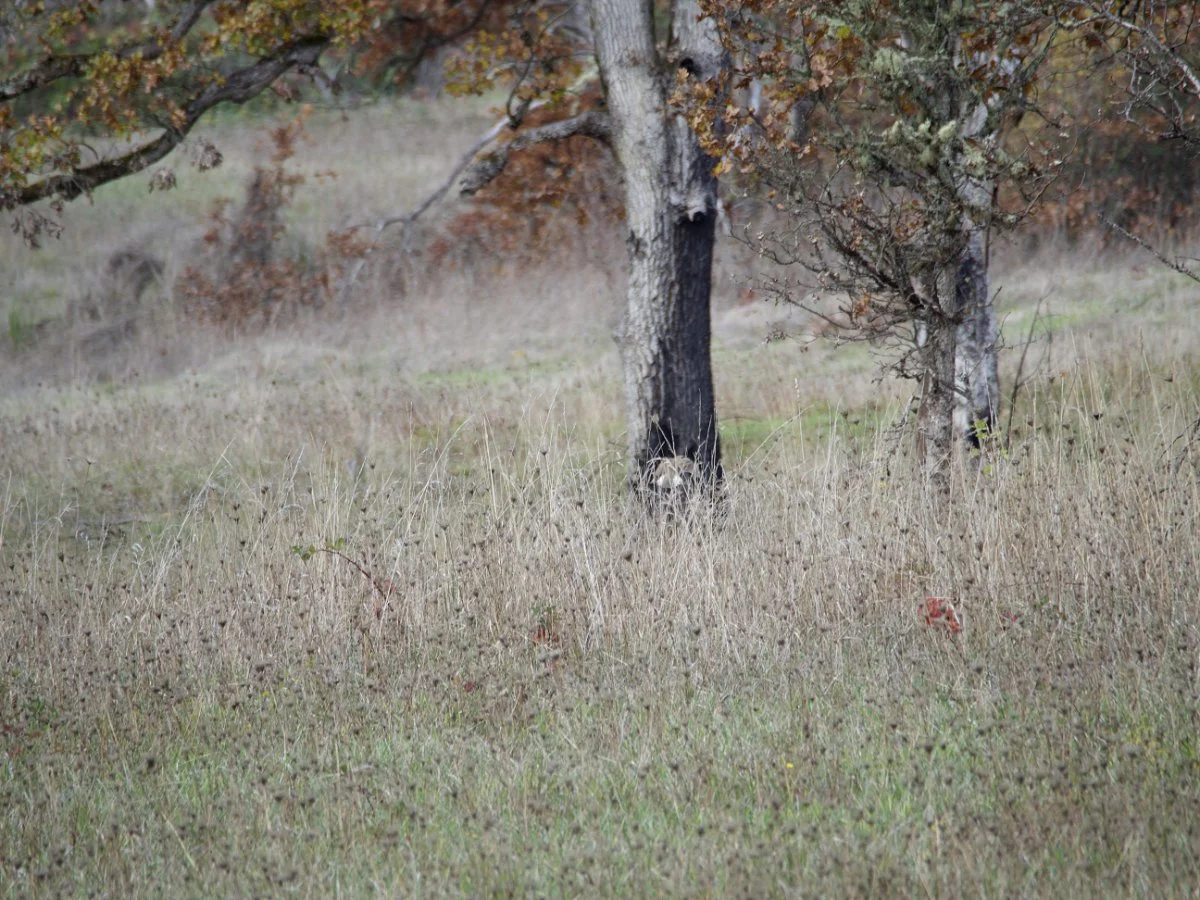
There is a large meadow on the east side of Mt. Pisgah with a small creek running through it that carries rainwater off the hillside down to the Coast Fork of the Willamette river. Thickets of buckbrush fill in the slope as it rises out of the meadow with oaks scattered around the hillside. These layers create good habitat for a diversity of birds. One that I found over there this fall was the Western Meadowlark, the state bird of Oregon.
As I walked along the trail, I flushed a few hidden in the tall grass. Some flew up into to the lower limbs of nearby oak trees. From their perch in the tree, I could easily see their bright, yellow breast with a bold, dark ‘V.’ Some of them settled back down further up the hillside. As they flew over the meadow, their flight consisted of alternating short, rapid wing beats with glides as they flew just above the top of the grass. As they descended back onto the ground, their tail fanned out revealing a flash of white from their outer tail feathers. The upper side of their bodies are a mottled pattern of brown, black and buff, which allows them to easily disappear into the meadow.
As you may have noticed, meadowlarks have a pointed, stout bill that aids them in a foraging method called gaping. It inserts its bill into thick grass or the ground and then open its bill. This pries apart the grass or ground to reveal seeds or insects hidden underneath.
Western Meadowlarks are messengers of beauty and wonder. They have a melodious, warbling song that embodies the spirit of the West—vast landscapes and open skies. I hope you have had the opportunity to hear one sing.
On its website, The Cornell Lab of Ornithology had this fact that I thought you might include in some cocktail party conversation during your holiday celebrations: “John James Audubon gave the Western Meadowlark its scientific name, Sturnella (starling-like) neglecta, claiming that most explorers and settlers who ventured west of the Mississippi after Lewis and Clark had overlooked this common bird.” Honestly, I think Audubon flubbed this one. This bird’s Latin name could be changed to something that appropriately reflects its spirit and beauty.