
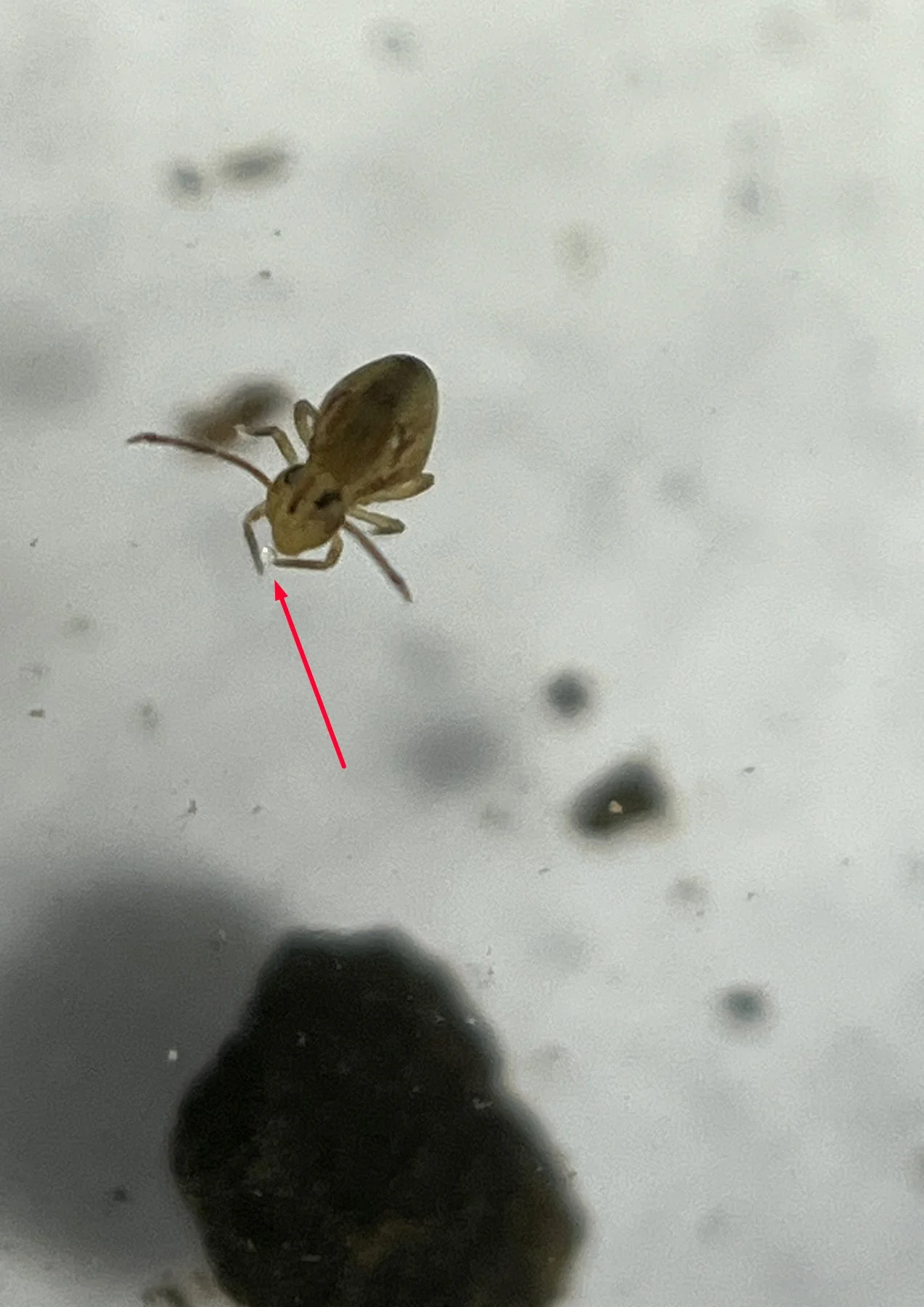
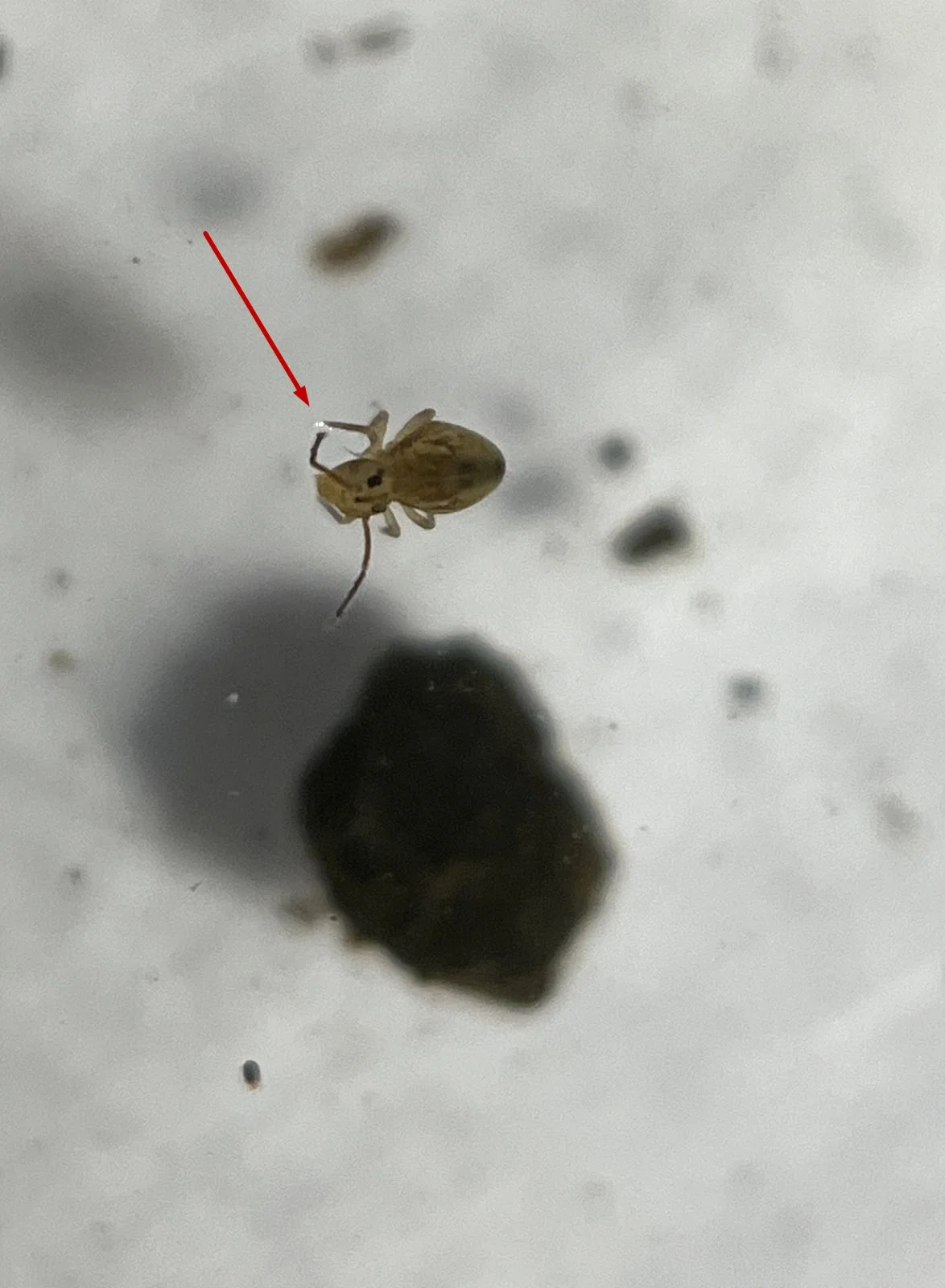
The other day I soaked some moss in a small dish for about 20 minutes to really hydrate the moss and energize a very tiny creature that lives in the moss called a waterbear. After soaking, I lightly stirred and shook the moss out in the dish and placed it under a microscope. While inspecting the dish for waterbears, I came across a springtail on the surface of the water that had been washed out of the moss into the dish. While watching it, I noticed that it was moving around on the top of the water tilting back and forth. I saw a bubble appear at its mouth and it retrieved it with one of its legs. It then proceeded to rub the bubble on its antennae and its head. It continued to produce more bubbles and groom its entire body. Occasionally it would attempt to spring away, but landed back into the dish. I would reposition it under the microscope and before too long it would start grooming again. Fascinating!
Springtails live in the moist environment created by the layer of leaves I spoke about in the previous post. Upon a little research, I found that they have a fluid bubble that they bathe with to keep themselves clean, especially their antennae which are their sensory organs. The fluid bubble is also necessary to waterproof themselves to help keep from drying out.
The springtail’s scientific name Collembola refers to their two inflatable tubes known as Collophores located on the underside of the first segment of the abdomen. They help in bathing by reaching the hard to reach places. They can also stick it to the ground to flip themselves over if they end up on their back after springing through the air. I found a small segment of a BBC documentary series called Life in the Undergrowth narrated by David Attenborough that talked about springtails. Click here to watch. It’s about two and half minutes long. This part about springtails was great, and I am looking forward to watching the whole series.
Springtails are important beings to a healthy ecosystem and have such interesting lives. They live right under our feet, but mostly go unseen and are out of our awareness. There can be up to 10,000 springtails in one cubic foot! I would love to see the environment where that many springtails are living so densely populated.
Nature is an inexhaustible source of wonder. I hope to see you out there!
Sources
“BBC One - Life in the Undergrowth, Invasion of the Land, Little Leapers.” BBC, 22 June 2009, https://www.bbc.co.uk/programmes/p003km37.
“Springtails.” Texas A&M AgriLife Extension Service, https://agrilifeextension.tamu.edu/library/gardening/springtails/. Accessed 13 Jan. 2026.
Today, Entomology. “The Collophore Helps Put the Spring in Springtails.” Entomology Today, 27 Aug. 2015, http://entomologytoday.org/2015/08/27/the-collophore-helps-put-the-spring-in-springtails/.