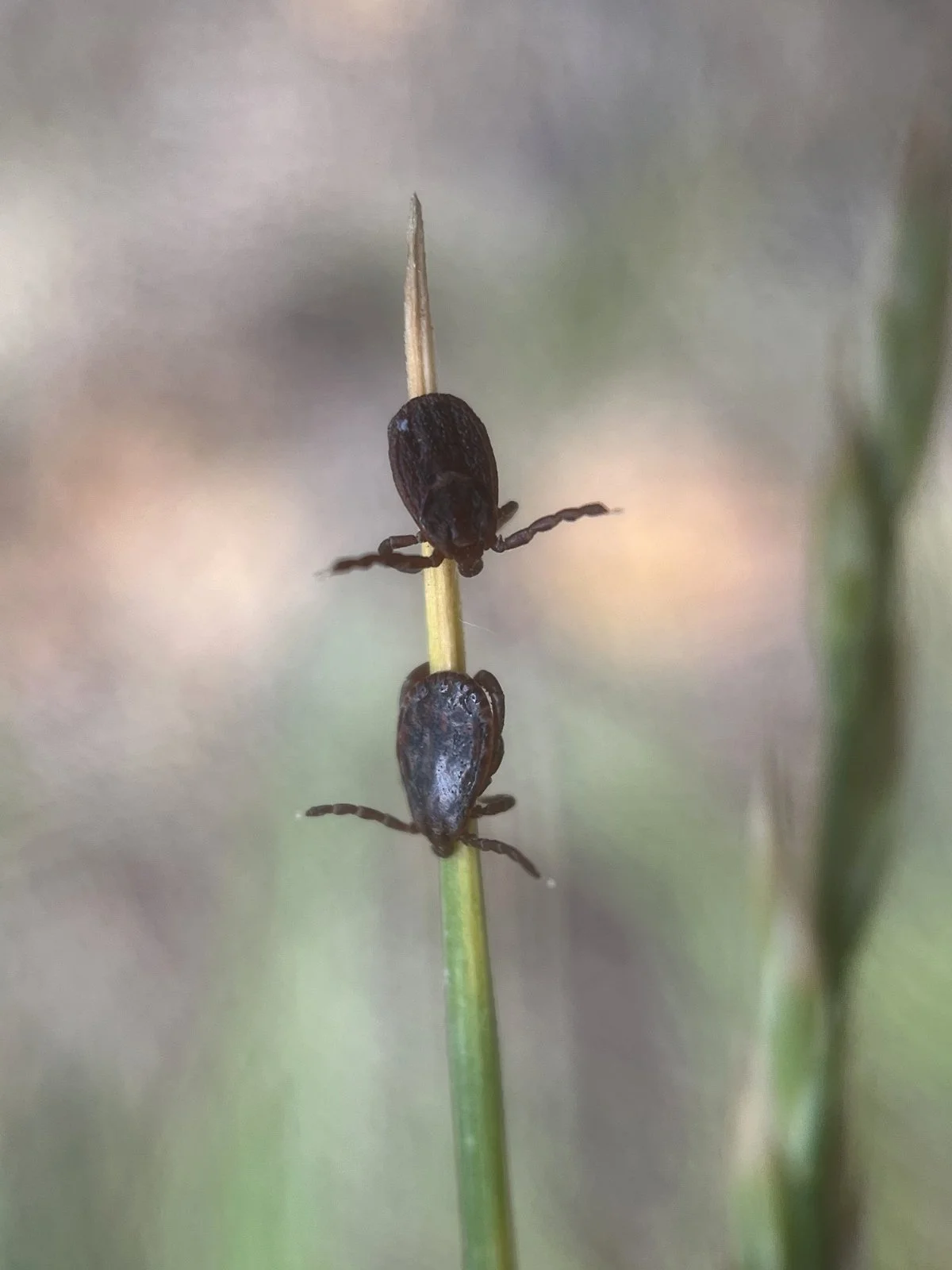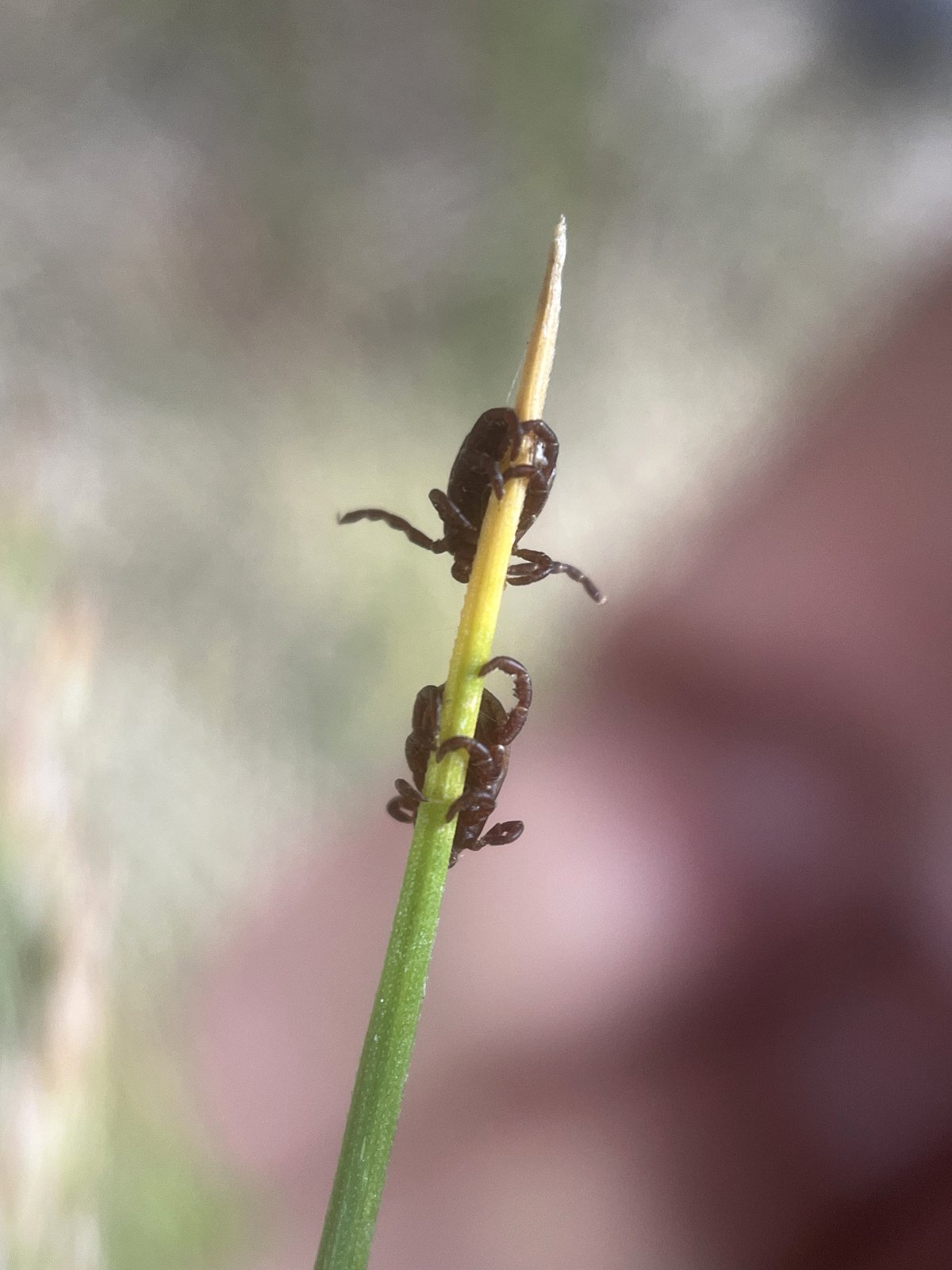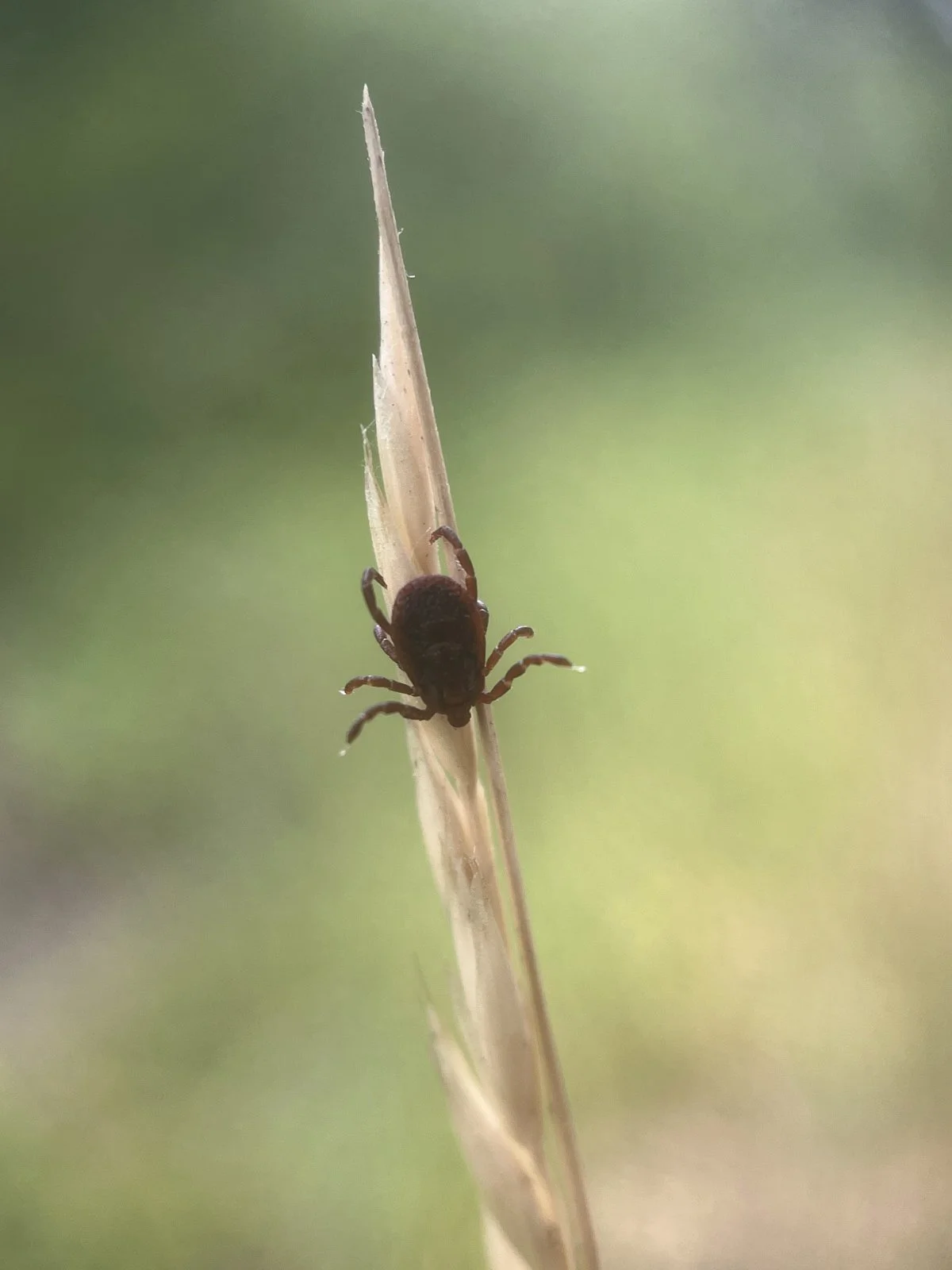
Patrick and I went out birding for a little while last Sunday evening and while we were walking down the road that goes out to the quarry, I saw a tick on the tip of a grass stalk sticking out over the road. Then Patrick saw one. Then I found another one. And so it went for the next 100 feet or so until we had counted 25! That was enough to give us a little bit of the creepy crawlies and we decided that was enough scanning the tips of grass stalks for ticks and went back to birding.
I was certainly amazed out how many there were and how all of them had found their way to the tip of vegetation at the edge of the road where they could easily latch on to a dog or to someone’s pant leg as they brushed against the grass. They were all facing head down at the tip and most of them had their front legs spread out ready to grab on to their next host, hopefully it wasn’t me and Patrick. I learned that this behavior of crawling out to the tip of vegetation, spreading their front legs, and waiting for a host to come by is called questing.
Ticks go through 4 stages: egg, larva, nymph, and adult. A female tick lays her eggs in the fall in leaf litter most likely near animal trails so the newly hatched larva can easily find a host when they hatch. I read varying figures on how many eggs a female tick will lay. Depending on the species it can vary from one to three to five thousand. That seems like a ton of eggs to me for such a small creature. This completes her life cycle so after laying eggs, she will die. When the egg hatches and the larva emerge,it only has six legs. I imagine that it would take magnification to observe this because the larva are about the size of a grain of sand. At this stage the tiny larva will feed on its host and can become infected with the bacteria that cause Lyme disease. After feeding on its host, the larva will detach and overwinter in leaf litter and molt into nymphs in the spring. At this stage they have eight legs, are as small as a poppy seed, and will find another host to continue their life cycle. Because they are so small and difficult to detect at this phase, a number of websites reported that the nymph stage is primarily responsible for the transmission of Lyme disease. After feeding on their host, they will again detach, continue to develop, molt into adults by that fall, and mate. Then the female will lay eggs to start the life cycle over again. Adding it all up and depending on the species, the life cycle of tick takes two to three years to complete. I was surprised that it takes so long.
Ticks fall into two categories: hard ticks and soft ticks. This one is a hard tick. In attempting to identify this tick, I learned that identifying ticks isn’t as easy as I thought. So at this point, I am not sure which species this one is.
On the Dechutes County government website it has this to say about tick species in Oregon: “About 20 species of hard ticks are found in Oregon, but only four are known to prey on humans: western black-legged tick, Rocky Mountain wood tick, American dog tick and Pacific Coast tick.
The western black-legged tick is the only known carrier of Lyme disease in Oregon. The other known vectors of Lyme disease in the United States are the deer tick in the eastern part of the country and the eastern black-legged tick in the southeast.” That said, the other ticks can carry the bacteria that causes Rocky Mountain spotted fever.
Ticks and the diseases they transmit are a serious concern. It is important to do research on how to prevent ticks from getting on you by do things like avoiding high tick areas or treating your clothes with repelents. It is also essential to do tick checks and know how to remove them properly. It is also necessary to know how to kill ticks that might be on your clothes after a hike in order to stay safe once you are back home.
I always recommend that you do research into to ticks or any subject I write about to learn more. I try to make my blog informative and inspiring, but I keep most entries short and there is always far more to know and investigate into any subject than I present. I put some online resources that I read below.
Thank you for taking time to read my blog and your interest in becoming more connected to the word around us.
Resources
CDC. “Tick Lifecycles.” Ticks, 11 May 2026, https://www.cdc.gov/ticks/about/tick-lifecycles.html.
“Oregon Hard Tick ID.” Columbia Drainage Vector Control District, https://www.cdvcd.org/oregon-hard-tick-id. Accessed 13 June 2026.
The Tick Lifecycle – Lyme & Tick-Borne Disease Testing & Statistics. https://www.ticklab.org/blog/2020/12/01/the-tick-lifecycle/. Accessed 13 June 2026.
Ticks and Tick Prevention | Deschutes County, OR. https://www.deschutescounty.gov/773/Ticks-and-Tick-Prevention. Accessed 13 June 2026.
Veterinarian, ADEC Office of the State. Tick Identification | AK Dept. of Environmental Conservation. https://dec.alaska.gov/eh/vet/ticks/tick-identification/. Accessed 13 June 2026.