
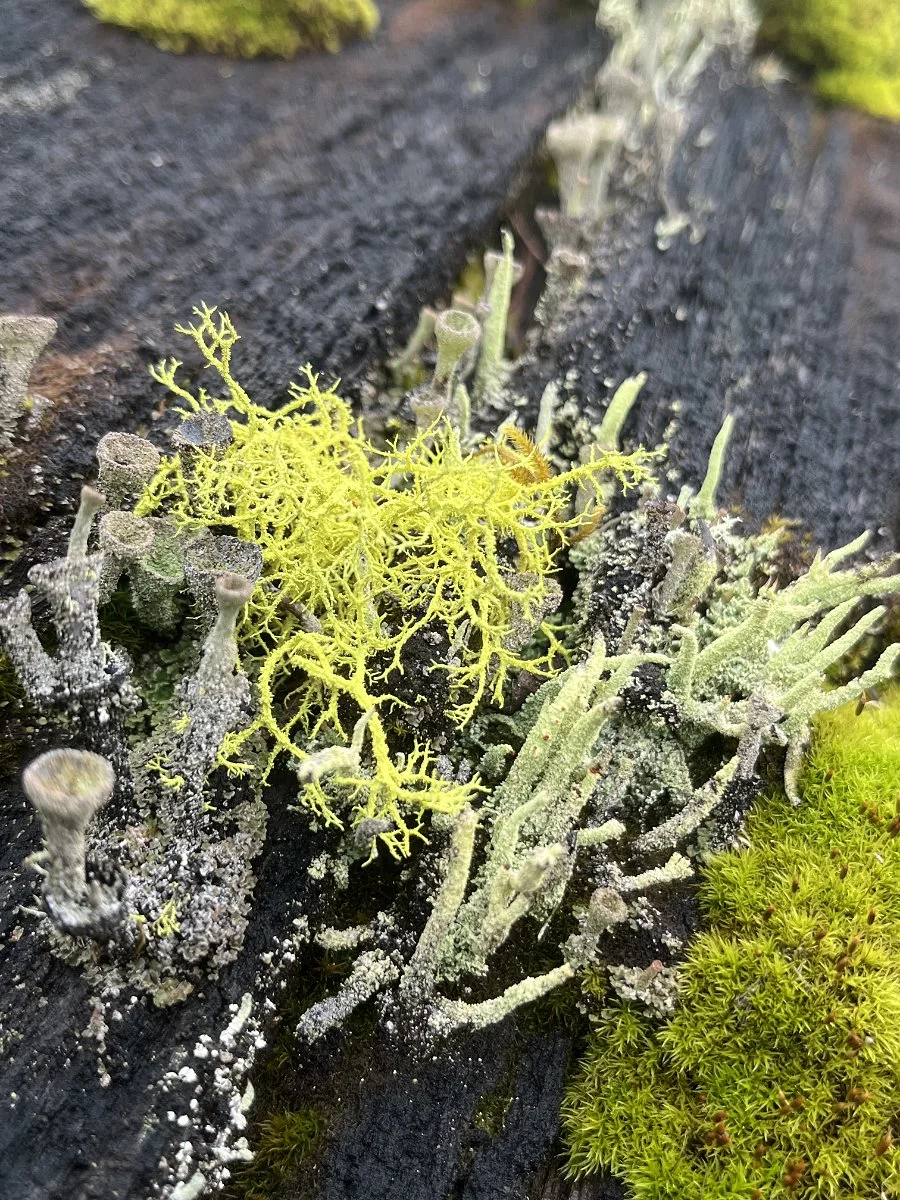
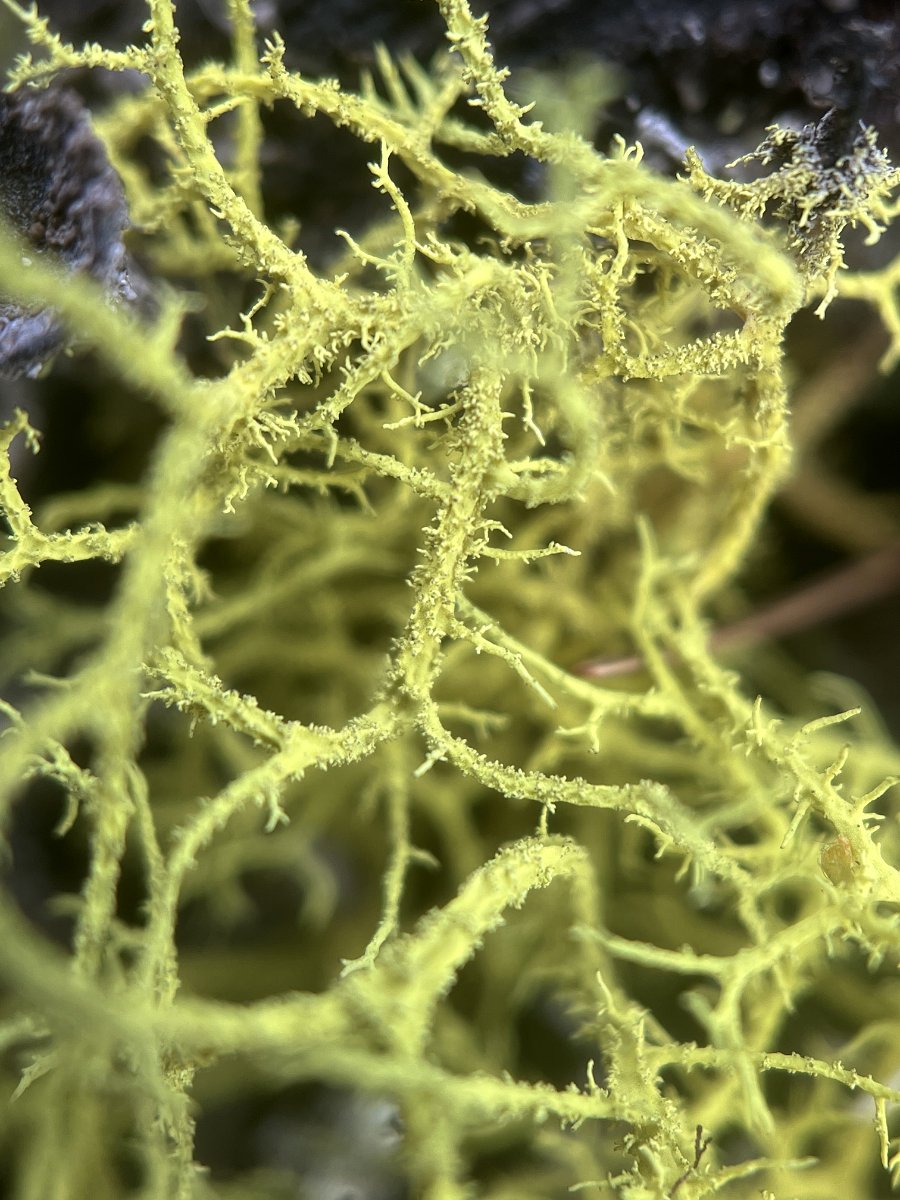
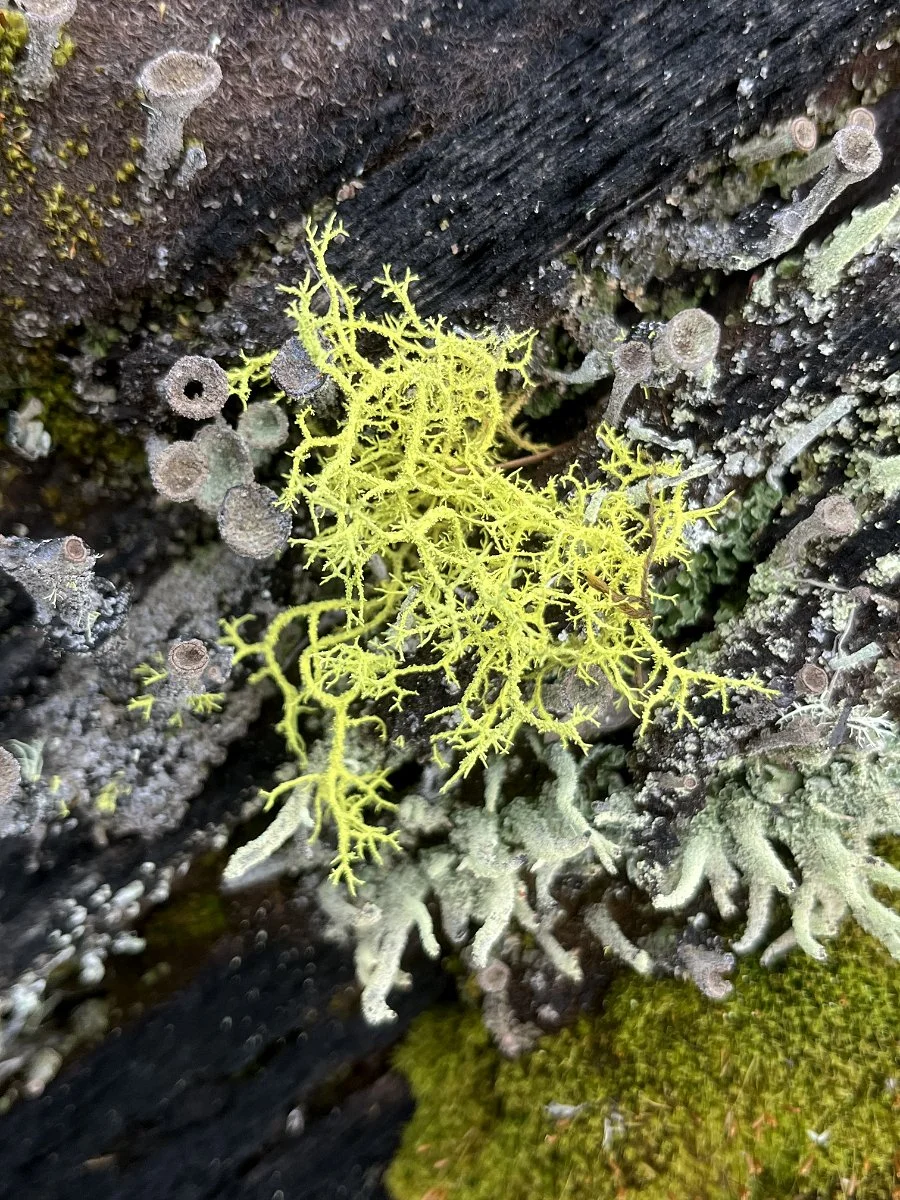
I took a photo of this brightly colored yellow-green llichen and iNaturalist identified it as a wolf lichen. I wondered if the color of the lichen resembled the color of a wolf’s eye or its eye shine seen at night. Or perhaps wolves were known to use it as food to gain vital nutrients or medicine in some way. Or perhaps it was somehow used in courtship and pair bonding. I didn’t know and my imagination was filled with wonder and curiosity.
The Latin name of this lichen is Letharia vulpina. Letharia translates to “lethal or deadly” and vulpina translates to “fox.” From the results of DNA testing this lichen was split into two species to include Letharia lupina. Lupina translates to “wolf.” It is lethal to foxes and wolves because of the bright yellow pigment in the thallus known as vulpinic acid, which is toxic to meat eaters. I read that in Northern Europe in the 1750’s this lichen was ground into a powder and sprinkled on meat or mixed into fat with ground glass and put into dead animal carcasses to poison and kill wolves and foxes too as the Latin name suggests. That is where the name wolf lichen originates. The only association with wolves and this lichen is humans using it as a poison to kill them! This name has to be changed. Many peoples and cultures revere wolves, foxes, and other members of the Canidae family like coyotes, myself included. They are beautiful, sovereign creatures that share and call the earth their home and are important in supporting the balance of nature.
The part that also struck me as interesting is that with some lichens like this one, I forget that it has a photobiont inside that is photosynthesizing because it isn’t green at all. The cortex of some lichens contain pigments like the bright yellow vulpinic acid of Letharia vulpina. These pigments serve as a sunscreen for the photobiont against excessive UV radiaton from the sun. Some lichen pigments also contain antimicrobial properties that protect it from bacteria and other fungi. I also learned on a lichen walk out at the arboretum that this antimicrobial property deters the growth of surrounding moss from overtaking it.
The cortex of many lichens also change color in response to moisture. For example, when the cortex of Lobaria pulmonaria becomes hydrated, it becomes translucent revealing the photobiont inside and the lichen turns green. When Lobaria pulmonaria dries out, the cortex becomes opaque to protect the photobioant inside and the lichen turns brown or gray color. See my post: Rehydrating Lichen 01/30/23.
I hope that you are enjoying the lengthening daylight and all of the birdsong and spring flowers. Nature is an inexhaustible source of wonder. I hope to see you out there.
Resources
“Letharia Vulpina Complex (Wolf Lichens).” 10,000 Things of the Pacific Northwest, 4 Dec. 2020, http://10000thingsofthepnw.com/2020/12/04/letharia-vulpina-complex-wolf-lichens/.
Mirus, Rachel Sargent, and The Center for Northern Woodlands Education. “Lichen Colors Offer Protection.” The Center for Northern Woodlands Education, 20 Dec. 2021, https://northernwoodlands.org/outside_story/article/lichen-colors.