
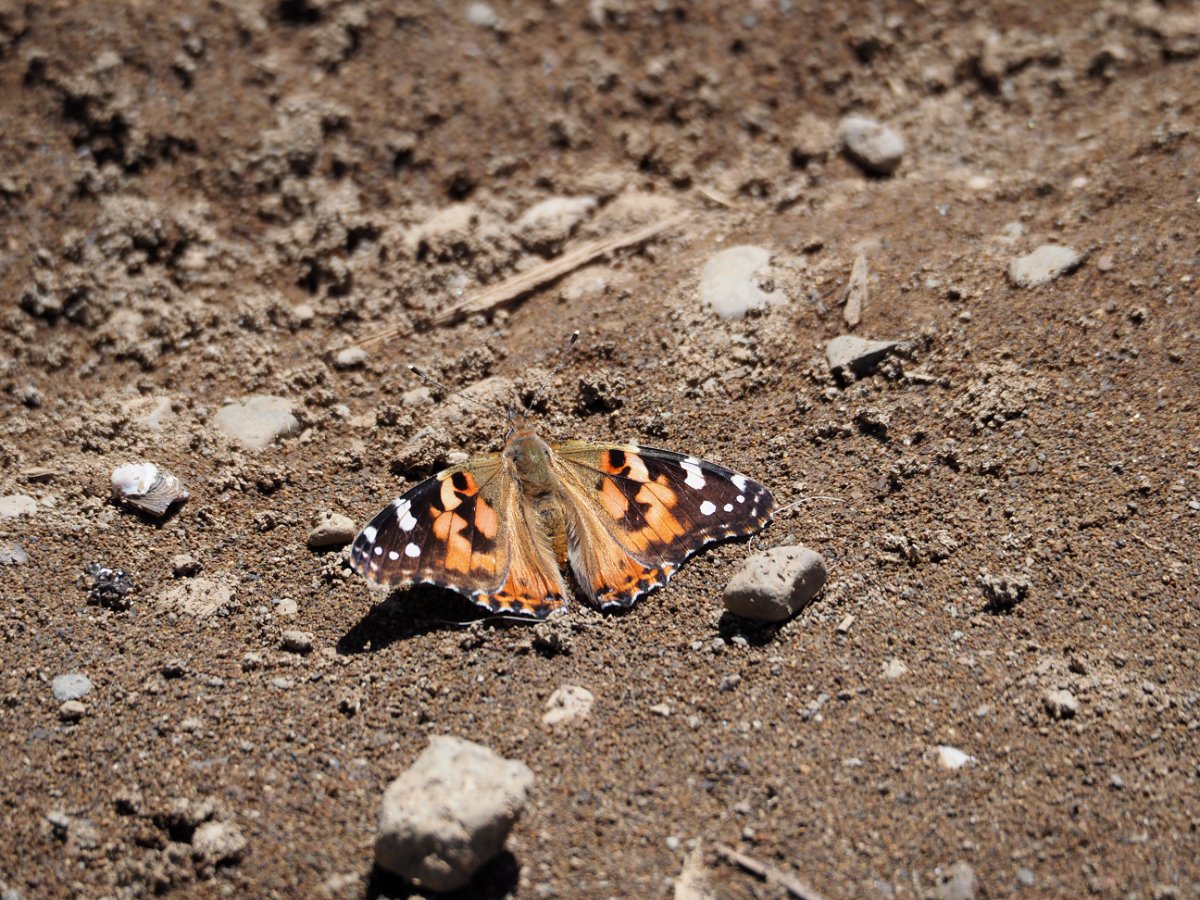
This butterfly is beautiful!
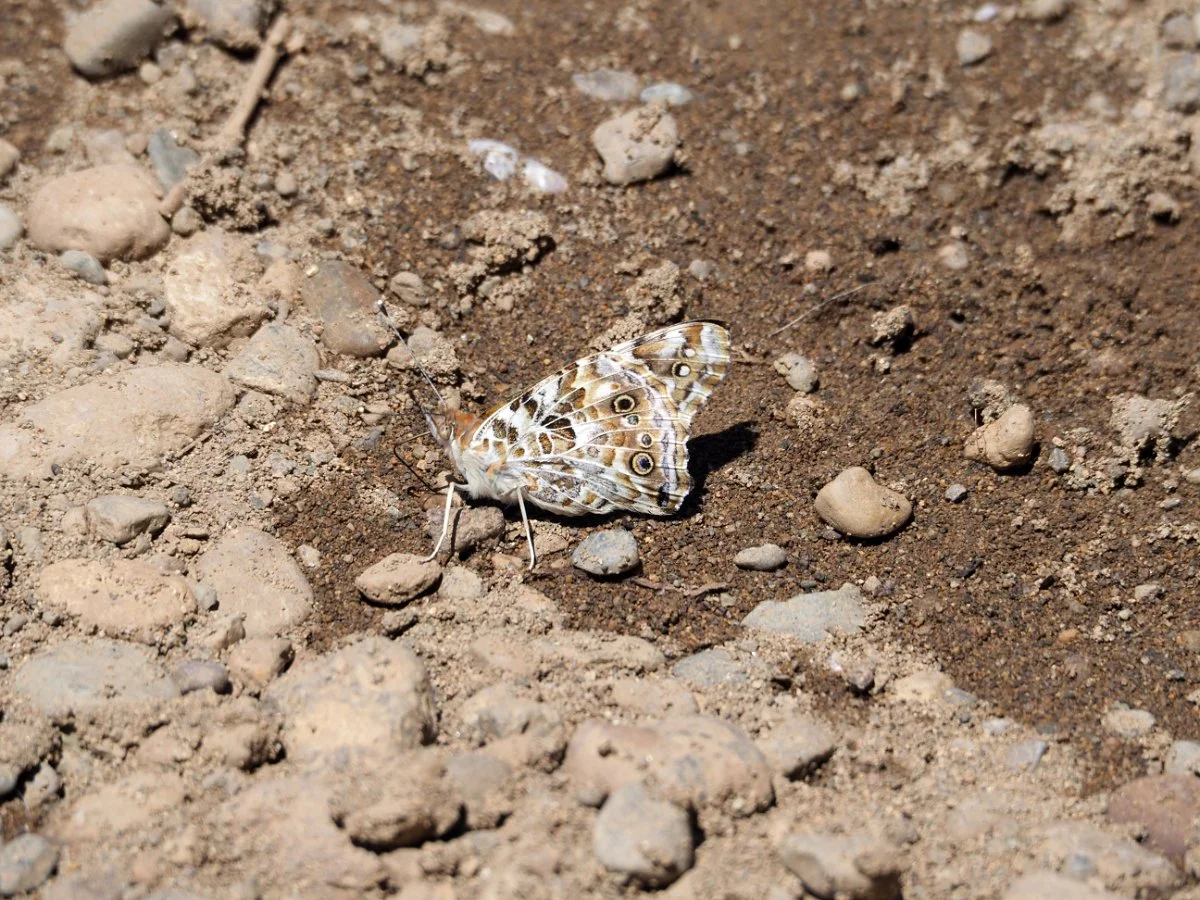
Its body is a shimmering sandy-gold that slightly spills out onto its wings. From there, the top of the wings are a pattern of warm blacks and oranges with white spots. It gives its upper body the appearance of dappled sunlight on the ground. The underside of the wing has a more checkered pattern with a subdued coloration of light browns and whites. When it folded its wings together behind its body, the underside resembled the mottled drying of the sandy shore as it sloped away from the water. I imagine these earth tones and patterns help camouflage it to protect it from predators.
This butterfly is tricky!
The underside of the hind wing also has conspicuous eyespots to deter predators. First, it is thought that the eyespots mimic the eyes of predators, thus discouraging an attack from a real predator. Second, it might cause a predator to to go for the wrong end—the butterfly might lose part of its wing, but it will escape with its life.
This butterfly is amazing!
Let me start off by saying that this butterfly has a migratory behavior that is multigenerational. What this means is that as they make their annual migration north following wildflower blooms in the spring, they will complete their lifecycle multiple times as they journey north and return back to their wintering grounds. So, as this wonderful creature fans out across North America, the map to navigate back to its wintering ground is somehow passed on to the next generation. On Art Shapiro’s website he writes, “Apparently the entire North American population winters near the US-Mexico border, breeding in the desert after the winter rains generate a crop of annual Malvaceous, Boraginaceous and Asteraceous hosts. The resulting butterflies migrate north.” On the website of The Natural History Museum of The University of Colorado Boulder it states that “it takes about 6 generations for the Painted Lady’s round trip journey from Mexico to Canada and back.” This is incredible and gets even more incredible!
This butterfly is the most widely distributed butterfly in the world and it has the farthest known butterfly migratory route. From its wintering grounds in tropical Africa, it undertakes an unbelievable, multigenerational 9,000-mile round trip to the Arctic Circle and back!
After reading about the miraculous journey of this butterfly, my imagination was awakened. Its coloration and pattern really struck me differently. Its golden body is a comet. The orange of its wings is fire emanating outwards as it zooms across the sky. The white dots on a background of black are trailing embers mixing in with the stars of the mysterious depths of the universe.
As always, I try to inspire you to do more research and learn more on anything that I write about and to go out in nature to experience it.
Nature is an inexhaustible source of wonder. I hope to see you out there.
Resources
Mahr, Susan . “Painted Lady Butterfly, Vanessa Cardui.” Wisconsin Horticulture, https://hort.extension.wisc.edu/articles/painted-lady-butterfly-vanessa-cardui/. Accessed 16 July 2026.
Shapiro, Art. “Vanessa Cardui | Art Shapiro’s Butterfly Site.” Ucdavis.Edu, 2025, https://butterfly.ucdavis.edu/butterfly/vanessa/cardui. Accessed 16 July 2026.
“Painted Lady Butterfly.” Museum of Natural History, 24 June 2020, https://www.colorado.edu/cumuseum/2020/06/24/painted-lady-butterfly. Accessed 16 July 2026.
“Painted Lady Migration Secrets Revealed.” Butterfly-Conservation.Org, https://butterfly-conservation.org/news-and-blog/painted-lady-migration-secrets-revealed. Accessed 16 July 2026.