
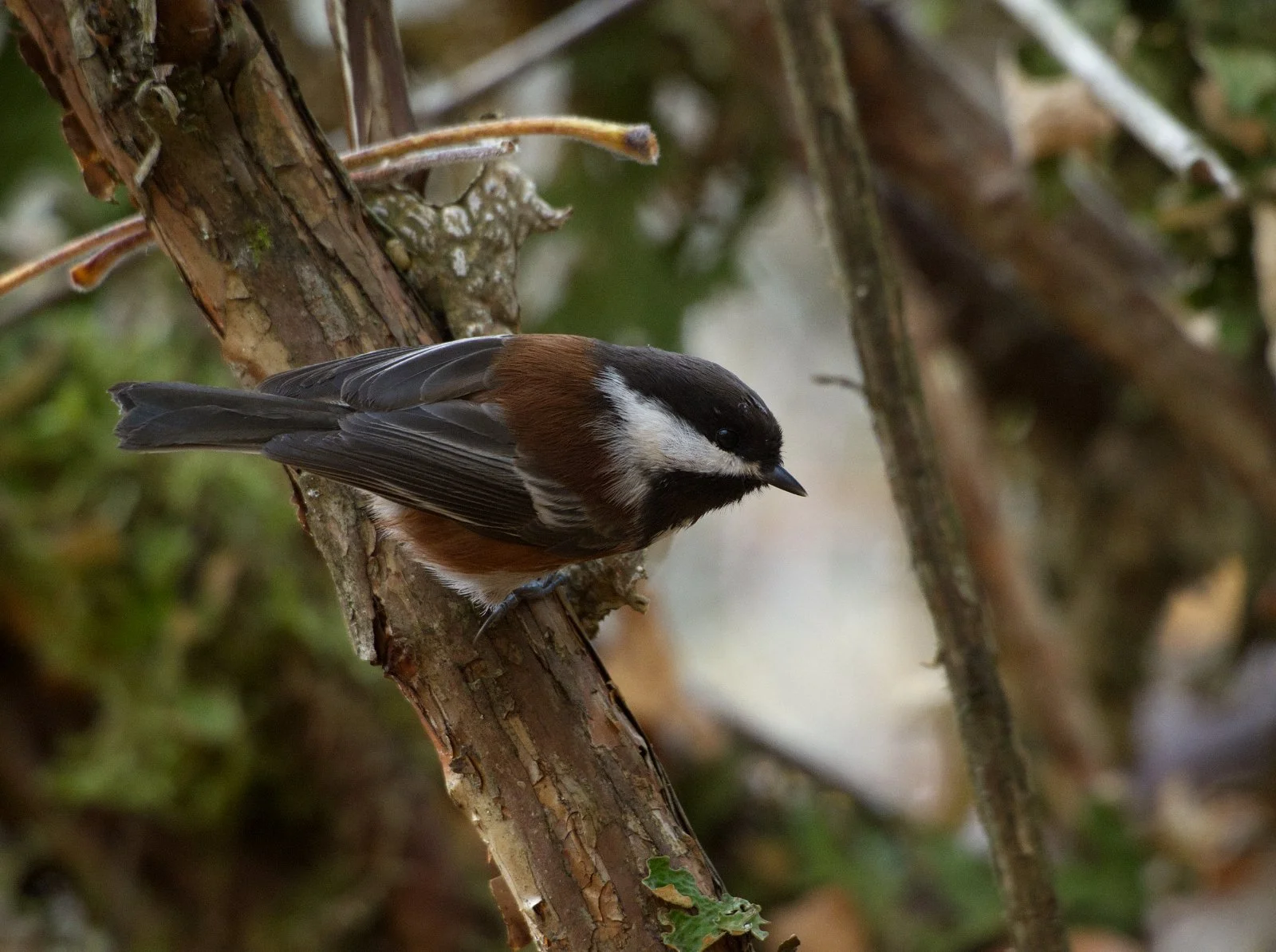
Yesterday, I was walking along the Pond Lilly trail and came across a mixed flock of birds flitting through the pacific nine bark, red osier dogwood, willow and Oregon ash. They were excitedly investigating and gleaning insects from the bark, moss, lichen and leaves. I noticed a few aphids drifting around in the air and wondered if they were still finding them as a food source that I wrote about a few weeks ago.
In the mix of birds was the beautiful chestnut-backed chickadee. It is similar to the black-capped chickadee, but as its name suggests, its back is chestnut-colored as well as its flanks below the wings.
Besides its difference in color, the chestnut-backed chickadee has different vocalizations than the black-capped chickadee. Peterson’s Field Guide to Birds of Western North America describes its voice as “hoarser and more rapid than black-capped chickadee, e.g., sick-a-see-see.” and the chestnut-backed doesn’t have the black-capped chickadee’s “clear whistle, fee-bee-be or fee-bee, first note higher.”
Here’s a link to their vocalizations on
All About Birds by Cornell:
Chestnut-backed Chickadee song & call.
Black-capped Chickadee song & call.
They are a bird of the west coast forests. They range from Alaska all the way down the coast of California where it begins to run east-west at Point Conception. They are also found in parts of inland forests of Idaho, Montana, and the province of Alberta, Canada. Check out the map on All About Birds.
The chestnut-backed chickadee can regularly be seen and heard out at the arboretum. Look and listen for them in the mixed flocks of small songbirds that pal around together over the winter.
Nature is an inexhaustible source of wonder. Thanks for reading. I hope to see you out there!