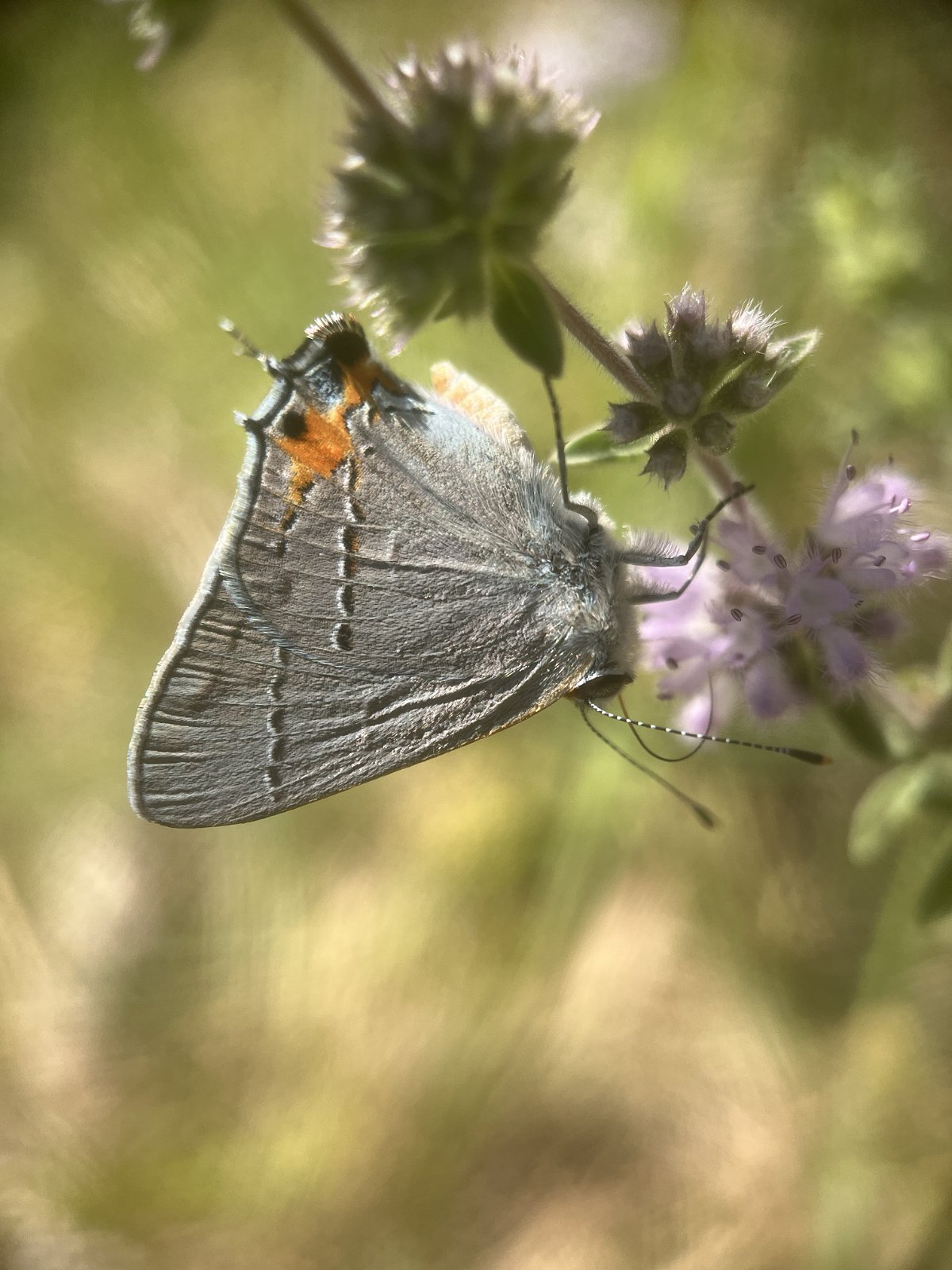
Out by the quarry an aromatic, perennial plant with small violet flowers flourishes along the roadside. Pennyroyal, Mentha pulegium, is native to Europe, North Africa, and the Middle East and gray hairstreak butterflies love to nectar on its flowers.
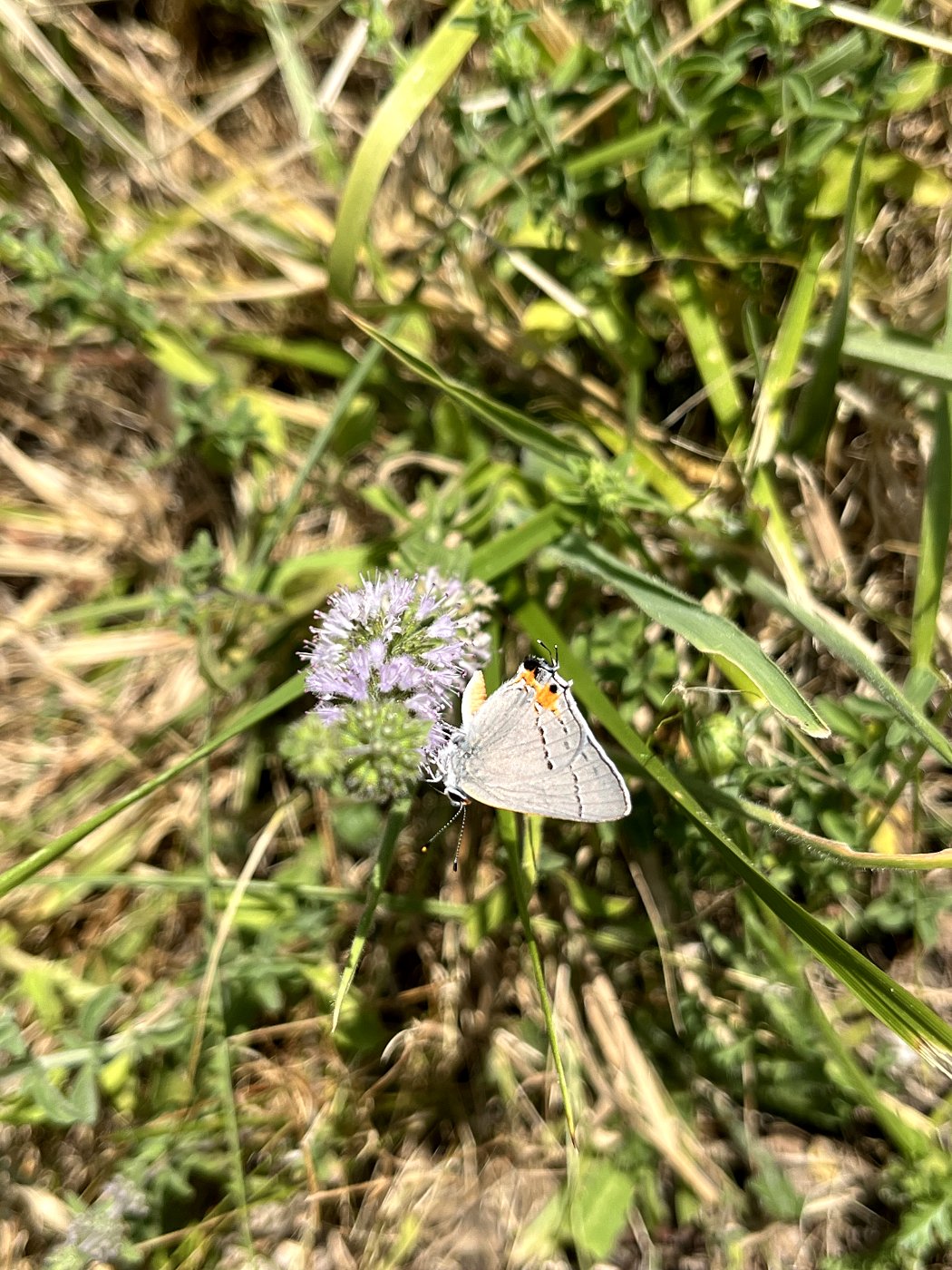
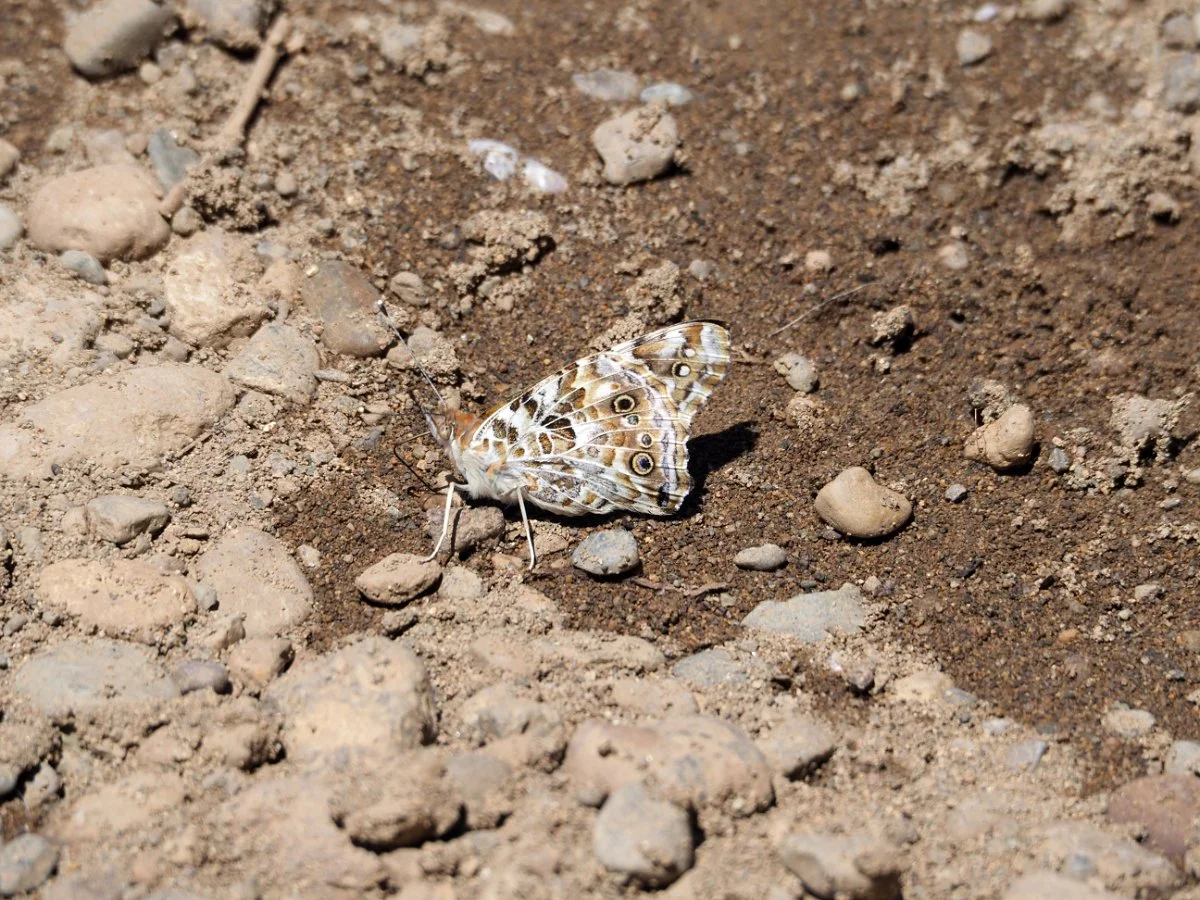
Gray hairstreaks are another butterfly that typically lands and folds its wings closed behind its body when at rest. The color of the underside reminds me of a gray clay landscape with a dusting of pale blue reflecting from the clear, summer sky.
The base of its hindwing is singed with two black dots with a warm burst of orange reminiscent of small flaming embers and are known as false eyespots. In addition, there are a set of tails extending outward like antennae. When this butterfly landed, I observed that it would rub its hindwings back and forth as if mimicking antennae moving. These eyespots are used to evade predators. The predator will hopefully go for the eyespots on the hindwing and the butterfly escape with its life and tattered wings.
The hindwing and forewing both have rows of black mounds tipped with white. It looks like a family of skunks walking along together in a line. This black and white combination also shows up along the outer edge of the wings and the stripe pattern on the antennae.
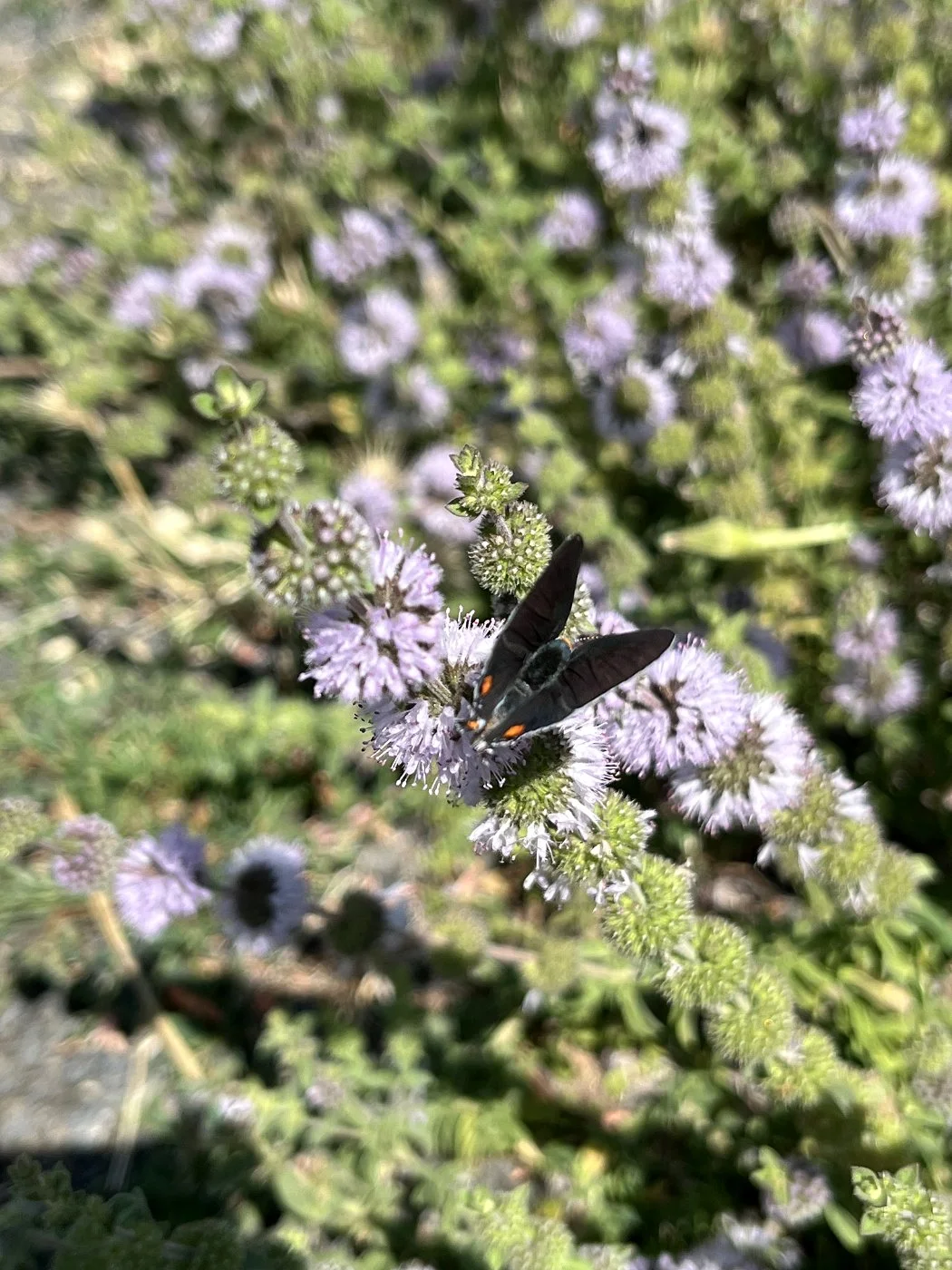
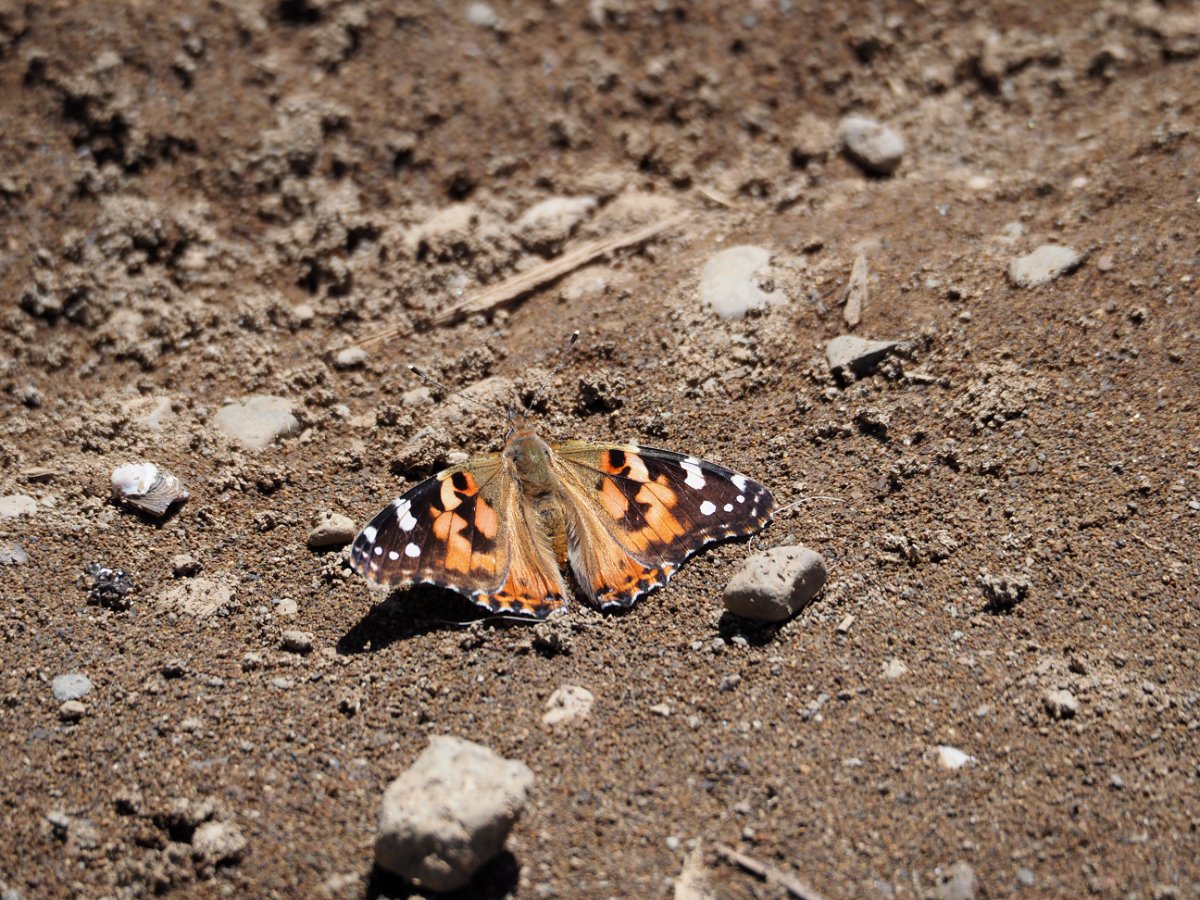
If this butterfly fans its wings open, you will glimplse a dark gray which really lights up the orange spots on the hind wings.
The sexes can be differentiated by color of the abdomen. The male’s abdomen is orange and the female’s is gray.
On Art Shapiro’s Butterfly Site he says: “This is one of the most polyphagous butterflies known, recorded on host plants in many families. Its most frequent hosts in our area are mallows, including the weedy species of Malva; legumes, including Spanish Lotus (Lotus purshianus), Bird's-Foot Trefoil (Lotus corniculatus), White Clover (Trifolium repens) in lawns, Alfalfa (Medicago sativa) and many others;and Turkey Mullein (Eremocarpus or Croton setigerus, Euphorbiaceae).” In the Butterflies of Lane County pocket guide it lists the host plants as: “Pea, Rose, and Mallow families; and oaks, pines.”
This butterfly flies late March to mid-October with peaks in May and July. I hung out with this butterfly and took these photos on July 15 when there were lots of pennyroyal blooming. I hope you are enjoying your summer and finding time to be out in nature. Thanks for reading my blog.
Resources
Shapiro, Art. “Strymon Melinus | Art Shapiro’s Butterfly Site.” Ucdavis.Edu, 2026, https://butterfly.ucdavis.edu/butterfly/strymon/melinus. Accessed 16 Aug. 2026.
I also referenced the pocket guide Butterflies of Lane County by the Eugene-Springfield NABA Chapter compiled by Marta Makarushka.