Common Merganser

Lately, two males and one female common mergansers have been swimming around on the river at Mt. Pisgah. They are sizable birds at 24-25 inches in length. The male has a long, whitish body with a breast tinged a rosy peach. It has a black back and green-black head. Its bill and feet are red. The female and immature have a gray body with a crested, rufous head that contrasts with a white chin and chest.

Common Mergansers spend the breeding season in northern forested habitats near large lakes and rivers. They are year-round along the Willamette river and are frequently seen at the arboretum. They usually nest within a mile of water in natural cavities or ones made by woodpeckers. So, forests along the river must be preserved in order to mature into trees large enough to allow for a suitable nesting cavity.

Common Mergansers have 1 brood, a clutch size of 6-17 eggs, and an incubation period of 28-35 days. After Common Mergansers are born, the leave nest cavity after a day or two. Even though they are flightless, they fearlessly leap out of the nest cavity (which can be up to 100 feet off the ground), land on the forest floor, and head for the water. From the beginning, they are able to catch all of their own food and start by diving for aquatic insects. Amazingly, they switch over to catching fish at about 12 days old. These bold and independent chicks are still small and vulnerable and will stick close to their mom for protection.

The Common Merganser’s diet consists mostly of fish, and their bills have sharp serrations for grasping this slippery prey. They also eat aquatic invertebrates (including insects, mollusks, crustaceans, and worms), frogs, small mammals, birds, and plants.

They are found throughout a large part of North America. Check out the range map on All About Birds by The Cornell Lab.

See you out there!

Dark-eyed Junco

The Dark-eyed Junco is a small hooded sparrow about 6-6.5 inches. It has a rounded head, usually a whitish belly, and a stout, pale bill. It has distinguishing white outer tail feathers that flash as it flies. Dark-eyed Juncos vary across the country. Peterson lists five main subspecies groups: “Oregon” Junco, “Pink-sided” Junco, “Gray-headed” Junco, “Slate-colored” Junco, and the “White-winged” Junco.

The “Oregon” Junco is generally the most widespread species in the West and the one I commonly see at the arboretum. The male has a dark hood, brown back, and buffy sides. The female and immature are duller and have a lower contrasting gray hood. These earth tones are excellent camouflage and improve your awareness of nature. If I am not paying attention, it is easy to walk up on Juncos foraging along the trail and flush them into the underbrush.

In winter, they form small flocks. At the arboretum, I regularly count a group of around 50 birds together. They stay in constant contact with each other as they forage and move through the landscape. Their communication sounds are fairly subdued, so keep a keen ear out. Peterson describes their vocalization call as “a light smack.” They also have “clicking or twittering notes.”

For me, Juncos are warm-hearted, peaceful little birds. They can be fairly tolerant of my presence if I am quiet, move slowly, or sit still. I always look forward to hearing their gentle, trilling song in the spring. At the moment, you don’t have to go far to find them. I regularly see them foraging on grass seeds in the parking lot or the meadows just beyond the White Oak Pavilion.

Nature is an inexhaustible source of wonder. I look forward to seeing you out there.

Resources
Dark-Eyed Junco Overview, All About Birds, Cornell Lab of Ornithology. https://www.allaboutbirds.org/guide/Dark-eyed_Junco/overview. Accessed 11 Feb. 2023.

Peterson, Roger Tory, et al. Peterson Field Guide to Birds of Western North America. 4th ed, Houghton Mifflin Harcourt, 2010.

Mallards

A pair of mallards have been paddling around and exploring the wetlands this winter.

Male Mallards have a dark, glossy-green head, white neck ring, chestnut-brown chest, gray body, orange feet, and a yellowish bill. They also have a noticeable black tail curl at the rear part of their bodies. Females and juveniles are mottled brown with orange-and-brown bills. Both sexes have a white bar on both sides of a blue speculum patch in the wing. You can see it in the photo of the female searching for food below the surface.

Mallards dabble to feed. You will often see them in shallow water tipped forward with their hind quarters in the air as they reach for submerged plants and animals on or near the bottom. They will also forage on the top of the water and along the shore.

Interestingly, all of the quackings you hear coming from mallards are made by females. The males don't quack. Instead, they make quieter sounds that Peterson describes as “yeeb or a low kwek.”

Mallards are powerful flyers. Migrating flocks of mallards have been estimated traveling at 55 miles per hour (All About Birds).

Also, they can launch directly into the air from the water and don't need to run across the surface to reach takeoff speed. To achieve lift-off, their first wing beat pushes against the water's surface. This is handy in places like the wetlands out at the arboretum, which is dense with vegetation.

This mallard pair is fairly tolerant of my presence if I slowly and quietly walk out onto the bridge. They are so peaceful to watch as they swim around.

Nature is an inexhaustible source of wonder. I look forward to seeing you out there.

Resources
Ehrlich, Paul R., et al. The Birder’s Handbook: A Field Guide to the Natural History of North American Birds: Including All Species That Regularly Breed North of Mexico. Simon & Schuster, 1988.

Mallard Overview, All About Birds, Cornell Lab of Ornithology. https://www.allaboutbirds.org/guide/Mallard/overview. Accessed 26 Jan. 2023.

Peterson, Roger Tory, et al. Peterson Field Guide to Birds of Western North America. 4th ed, Houghton Mifflin Harcourt, 2010.

Sibley, David. What It’s like to Be a Bird: From Flying to Nesting, Eating to Singing -- What Birds Are Doing, and Why. Alfred A. Knopf, 2020.

Anna's Hummingbird Courtship Dive

I have been seeing the male Anna’s hummingbird performing his courtship out at the arboretum and in my backyard.

The display begins as the male rises up into the sky above the perched female. Then he dives down, swoops past, and rises above her. When he completes the arc, he will hover, face her, and sing a squeaky song. At the bottom of the dive, he makes a high-pitched chirp which is made by air whipping through his tail feathers. Look closely, and you can see him whizzing by towards the middle of the video.

If the female is receptive to all of the male’s courting, she will lead him toward the nest site, where she will perch. The male will then hold his body horizontally and fly back in forth in short tight arcs above the female. I have not seen this second phase of the courtship, and I am imagining that will mate at this time.

Males and females don’t form pairs. The Birder’s Handbook has its mating system labeled Promiscuity. This is defined as males and females mating more or less indiscriminately. With Anna’s hummingbirds, only the females care for the young. The Anna’s hummingbird nests that I have seen being built were created by the female.

It is interesting that all of this is taking place in the middle of January. I am not sure if they will try to nest this early, and I haven’t seen any nests being constructed. Perhaps the male is setting up his territory and trying to attract females for the future. That said, Anna’s hummingbirds are some of the first nests that I find in spring. I’ll keep you informed if I come across more about when they start to nest in our area.

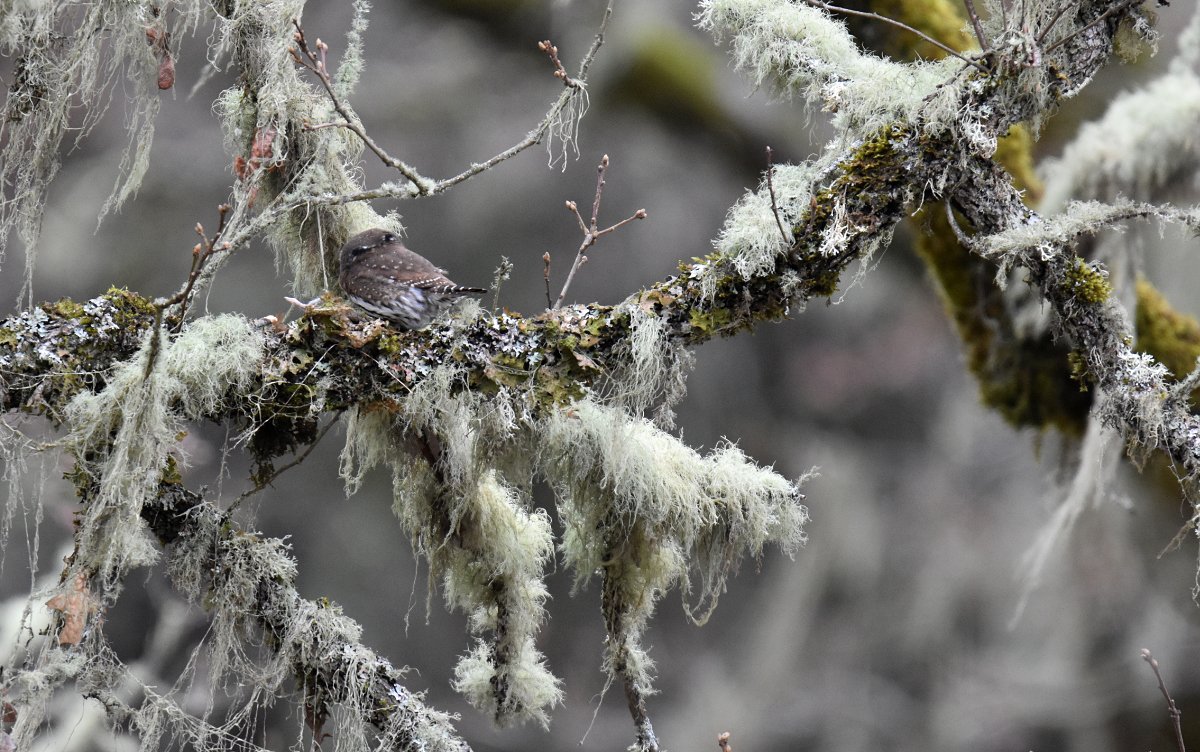
Northern Pygmy Owl

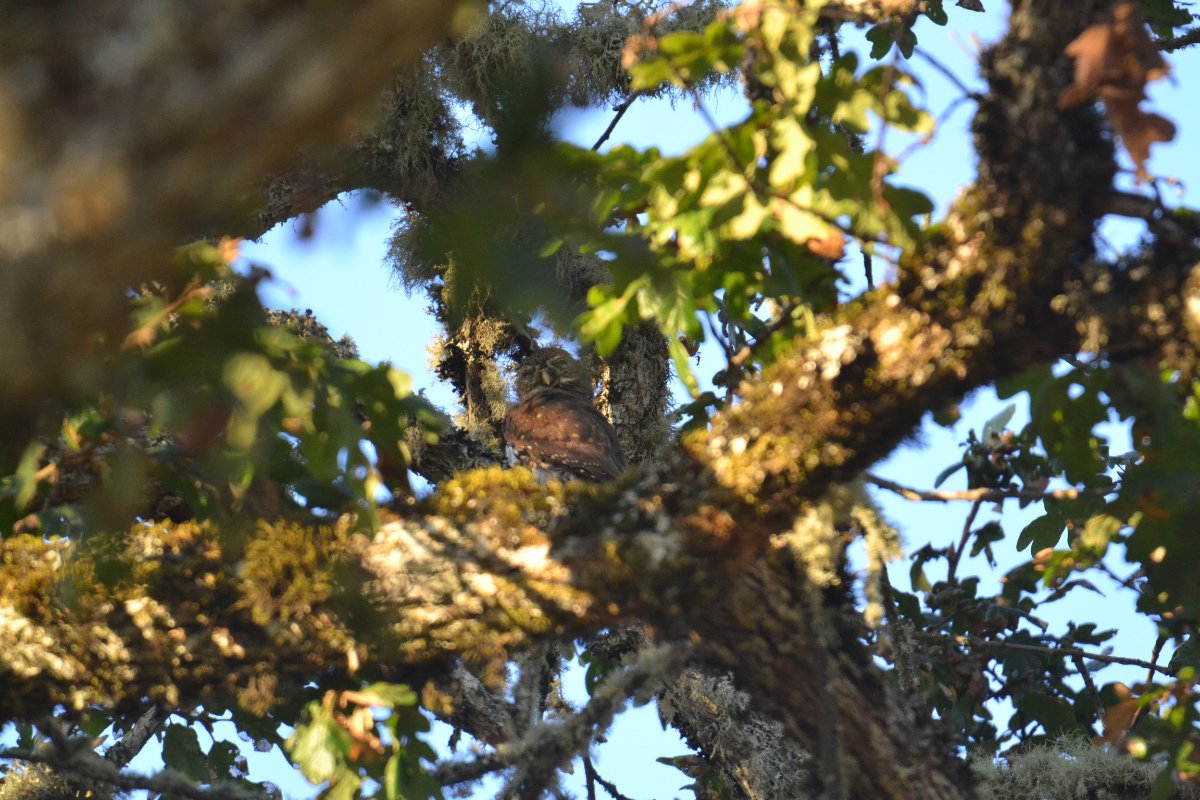
I was standing at the corner of the main meadow just above the barn. Up to that point, the day had been quiet. So I was happy to see a nice flock of juncos foraging around a favorite poison oak bush of theirs. Mixed in were some ruby-crowned kinglets, and some chickadees and white-breasted nuthatches were rambling through the oak trees nearby. I was trying to take a photo of a ruby-crowned kinglet when suddenly the juncos erupted into strong alarm calls as they retreated to the poison oak bush. The chickadees and nuthatches were incessantly alarming as well. There is a predator around! I watched for about 10 or 15 minutes but didn’t see anything moving. I cut through the edge of the meadow down to the barn and walked down the main path to check in with the nuthatches. That is when I noticed a small bird silhouetted against the pale, winter sky—the Northern Pygmy Owl.

Peterson states that this small owl at 6.75-7 inches tall. For comparison, the American Robin is listed as 10 inches. This owl may be small in stature, but it is a fast, adept hunter.

It perched facing out in the meadow and was scanning in all directions. Suddenly it swooped down across the meadow and landed on a lower branch of another oak tree about 20 yards away. I walked down to hopefully get a better look at it, and I saw that it had caught a small songbird. I couldn’t believe it! I watched it as it flew, and I still missed it catching what appeared to be a junco.

I was able to capture a couple of photos before it flew away. In the second photo, a notable field mark of “eyes” on the back of the head are visible.

As I was watching it from its first perch, I saw it cough up a pellet. I went back after it flew off and luckily found it on the ground.

I was grateful to have a glimpse at this amazing bird, a great bird to start off the year. Have a Happy New Year. I hope that you have a great year of birdwatching. See you out there.

Golden-crowned Kinglet

The golden-crowned kinglet returns to the arboretum every year to spend the fall and winter months. This beautiful little bird always warms my heart when I catch a glimpse of it on a cold winter’s day.

They are pale olive above and gray below, with a black-and-white striped face. The males have a yellow-orange crown patch which is often concealed. During the breeding season, the male will flare his orange patch when chasing off male intruders in his territory. The females are similar and only have a yellow crown patch.

This is a tiny bird. All About Birds lists its length as 3.1-4.3 in. To help locate this bird, listen for the call notes that males and females give to stay in contact with each other. Peterson describes it as a “high, wiry see-see-see.” Another helpful hint to help find the golden-crowned kinglet is that it travels around in mixed flocks. Out at the arboretum, you will see it palling around with chickadees, nuthatches, bushtits, ruby-crowned kinglets, and brown creepers.

The golden-crowned kinglet mostly eats insects, insect eggs, and spiders. I see it glean insects everywhere on the tree—the bark, leaves, moss, and lichen. It will also hover to capture prey under leaves or hawk for aerial insects.

Under “Cool Facts,” All About Birds has this miraculous bit of information: “The tiny Golden-crowned Kinglet is hardier than it looks, routinely wintering in areas where nighttime temperatures can fall below –40° Fahrenheit.”

Nature is an inexhaustible source of wonder. Hope to see you out there.

Resources
Golden-Crowned Kinglet Overview, All About Birds, Cornell Lab of Ornithology. https://www.allaboutbirds.org/guide/Golden-crowned_Kinglet/overview. Accessed 15 Dec. 2022.

Peterson, Roger Tory, et al. Peterson Field Guide to Birds of Western North America. 4th ed, Houghton Mifflin Harcourt, 2010.

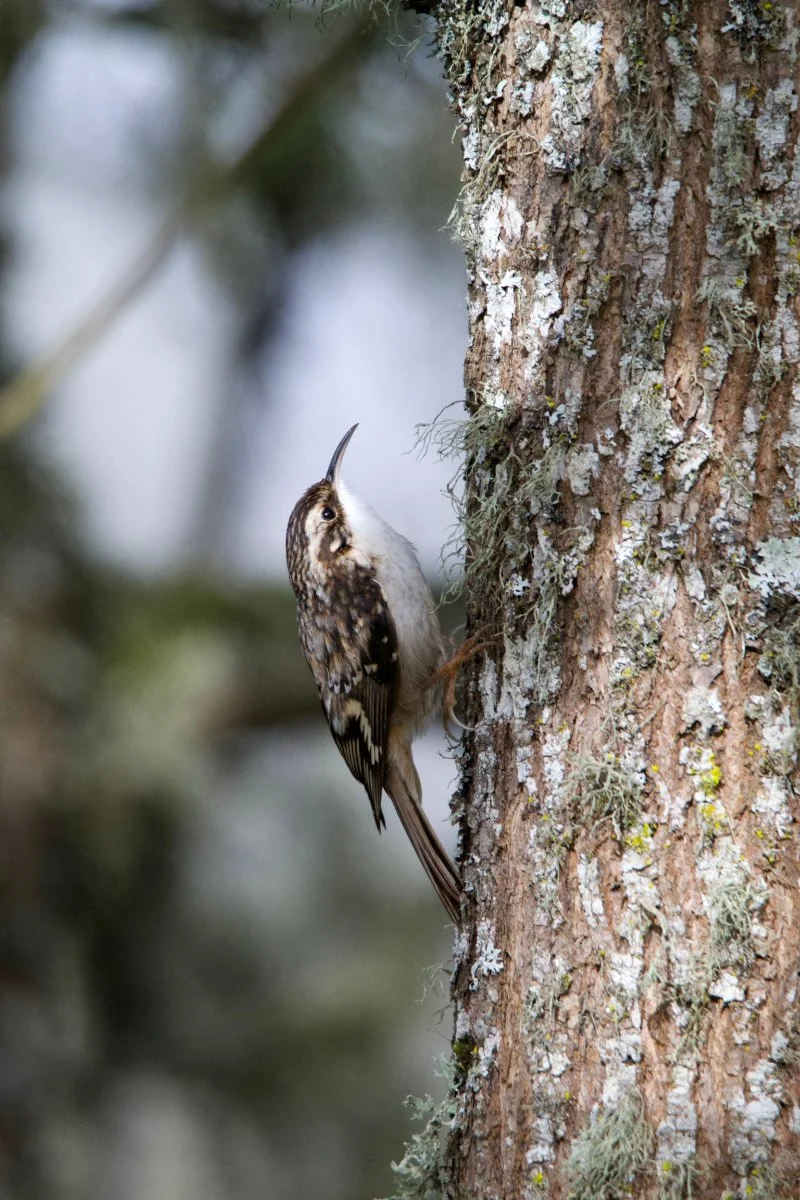
Brown Creeper - Review

The brown creeper is a gentle little bird with a cheerful spirit.

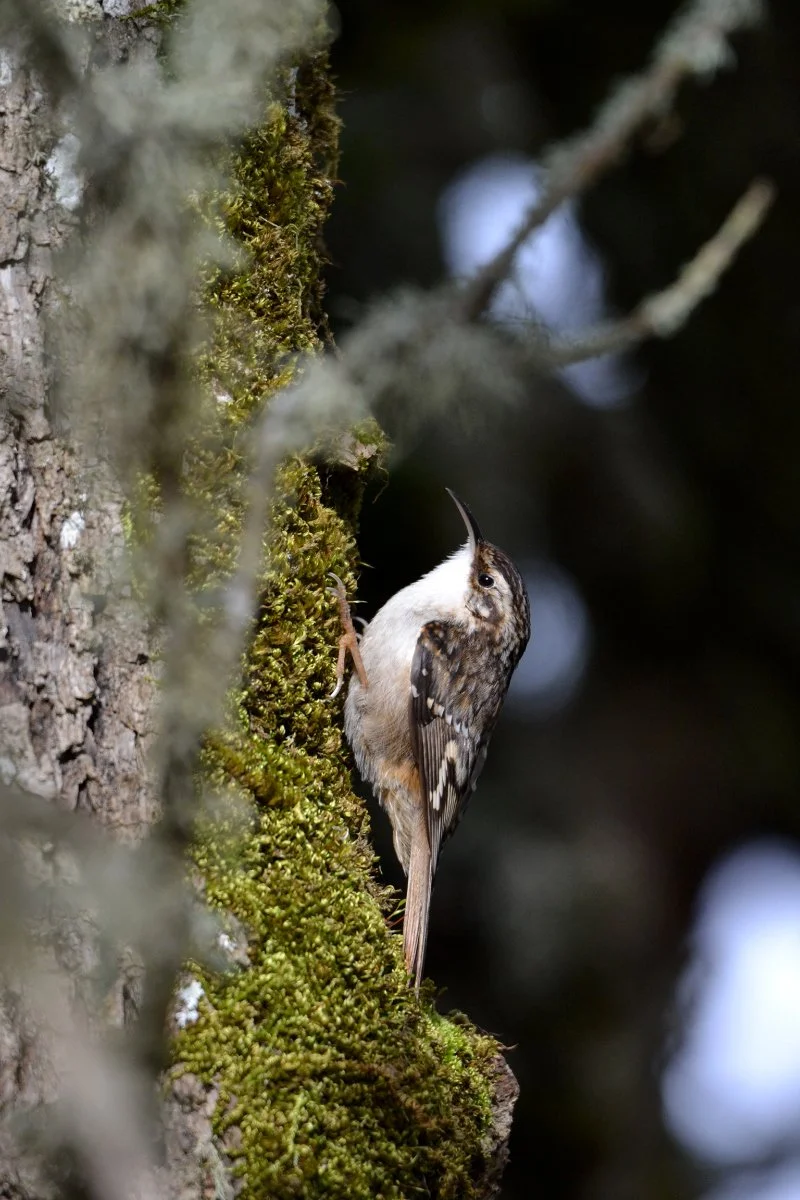
It likes to "creep" and circle up the tree trunk and onto the limbs as it searches for food. Once it climbs up into the middle or top part of the tree, it will fly back down near the base of the same tree, one nearby, or onto a lower limb.

It has a slender, slightly curved bill that allows it to probe into bark crevices, thick carpets of moss, and under lichen. It has stiff tail feathers to brace itself as it forages, similar to woodpeckers. Its diet mainly includes insects, insect larvae, spiders, and spider eggs.

The brown creeper has exceptional camouflage. The top half of its body has a beautiful, mottled pattern that resembles dappled sunlight. The Kaufman Field Guide to Birds of North America says the brown creeper is "like a piece of bark come alive." Its underside is white and relatively concealed, mainly because it hugs close to the tree as it explores.

To help locate this tiny bird, listen for its call and song. The male and female will give call notes to check in with each other. Peterson describes it as "a single high, thin seee, similar to quick three-note call [see-see-see] of Golden-crowned kinglet." They have a cheerful song that Peterson interprets as "a high, thin, sibilant see-ti-wee-tu-wee or trees, trees trees, see the trees." I have also heard fellow bird watchers aptly characterize it as "trees, trees, trees, beautiful trees." To listen, click here (All About Birds by the Cornell Lab).

They usually build a nest between the tree's trunk and a piece of peeling bark of a dead or dying tree. The frame of the nest is a layer of twigs and strips of bark. The nest cup consists of materials like finer plant fibers, feathers, and hair. Insect cocoons and spider egg cases hold the nest together and anchor it to the tree.

Brown creepers are a year-round resident at the arboretum. They can be a little easier to find now that the deciduous trees have mostly lost their leaves, opening up the tree canopy. Small songbirds like to create mixed flocks during the winter, so look for brown creepers hanging out with chickadees, bushtits, and nuthatches.

Nature is an inexhaustible source of wonder. Hope to see you out there.

Resources
Brown Creeper Life History, All About Birds, Cornell Lab of Ornithology. https://www.allaboutbirds.org/guide/Brown_Creeper/lifehistory. Accessed 28 Nov. 2022.

Brown Creeper Sounds, All About Birds, Cornell Lab of Ornithology. https://www.allaboutbirds.org/guide/Brown_Creeper/sounds. Accessed 28 Nov. 2022.

Kaufman, Kenn, et al. Kaufman Field Guide to Birds of North America. Houghton Mifflin, 2005.

Peterson, Roger Tory, et al. Peterson Field Guide to Birds of Western North America. 4th ed, Houghton Mifflin Harcourt, 2010.

Robin's Coloration

I have often heard the coloration of the robin’s breast described as red. In Peterson’s field guide he describes it as a “brick red.” It is not red like the flaming red crest of a pileated woodpecker, for example. The robin’s breast is more orange, which as we know, is a color we can create by mixing red and yellow pigments together. So, on the color wheel, the robin’s red breast is more in the secondary color yellow-red (orange) range not the pure primary red.

In this photo you can see that the robin’s breast matches and blends in well with the warm oranges and browns of the fall leaves.

Honestly, I’m okay with calling it red. It’s easier to write catchy songs like “When the Red, Red Robin Comes Bob, Bob, Bobbin' Along.” I need a little spring in my step as I walk around in the chilly days of the coming winter.

Natural Talent

Again, I found myself watching a Bewick’s wren hop, tumble and leap between the branches. Suddenly it popped out onto this twig and posed as if it was the completion of its acrobatic routine. It stuck the landing! With the dappled afternoon sunlight in the background, I quickly snapped a photo and silently cheered its wonderful performance.

Blend in with Nature

I aspire to be the bird in the photo. Flitting through the understory, staying close to the earth. Exploring all of the sensations—the leafy, green fern fronds, the soft, spongy moss, the humid scent of the soil, and the sounds of insects rummaging through fallen leaves. Peering out through windows in the vegetation as I merrily skip in and out of view, in constant awe of what new wonders could be awaiting me.

“Few people have the imagination for reality.”
—Johann Wolfgang von Goethe

Bewick's Wren

Meet the Bewick’s wren. It is a year-round resident that feels right at home in the thickets and shrubby areas in the open country of the oak savanna landscape of Mt. Pisgah arboretum.

It has a brown back and wings, and its underside is gray and white. A distinguishing feature is its bold, white eyebrow stripe. Its tail is long, black-barred, tipped with white spots, and is often cocked upwards. Its bill is fairly long, pointy, and slightly downcurved.

It is a spirited, acrobatic bird. It tumbles, hops, and bounds its way through the landscape as it forages for food. It effortlessly flits from limb to limb in the underbrush, clings to the sides of trees, and hangs upside down as it explores. Most of its diet is “the eggs, larvae, pupae, and adults of insects and other small invertebrates (All About Birds).”

Its lively character also comes through in its song, which I can hear from a fair distance. Here is Peterson’s description of its voice: “Song suggests Song Sparrow’s, but thinner starting on two or three high notes, dropping lower, ending on a thin trill; calls a sharp vit, vit and buzzy dzzzzzt.” Click here to go to All About Birds to listen.

This is a great bird to get to know. If you walk slowly and quietly, it is quite tolerant of your presence. Also, it is easy to observe because It usually forages less than 10 feet off the ground. So you don’t get a kink in your neck scanning up in the tree canopy for it.

Nature is an inexhaustible source of wonder. Hope to see you out there.

References
Bewick’s Wren Life History, All About Birds, Cornell Lab of Ornithology. https://www.allaboutbirds.org/guide/Bewicks_Wren/lifehistory. Accessed 9 Nov. 2022.

Ehrlich, Paul R., et al. The Birder’s Handbook: A Field Guide to the Natural History of North American Birds: Including All Species That Regularly Breed North of Mexico. Simon & Schuster, 1988.

Peterson, Roger Tory, et al. Peterson Field Guide to Birds of Western North America. 4th ed, Houghton Mifflin Harcourt, 2010.

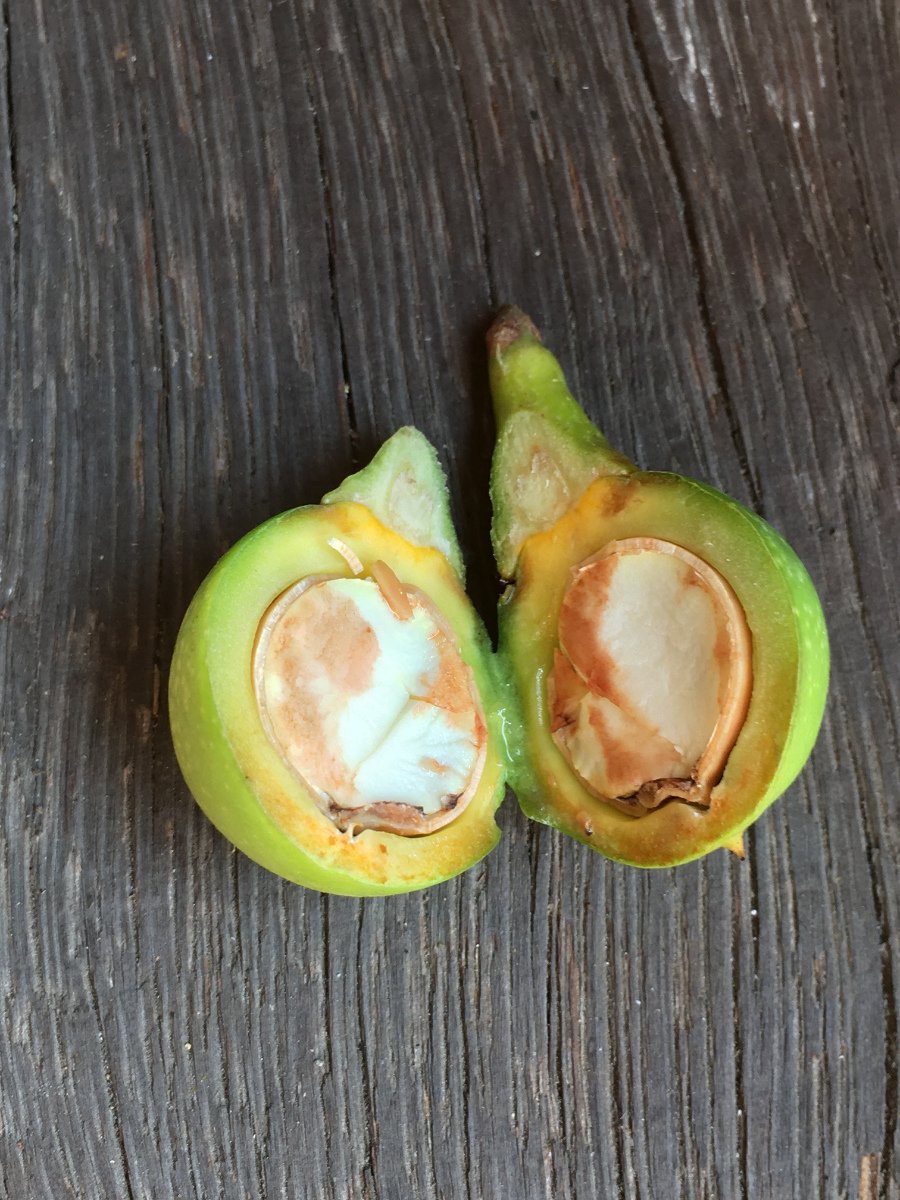
Steller's Jay & California Bay Laurel

Last weekend I heard the familiar sound of Steller’s Jays squawking, and I went over to have a look. I saw them hopping on the ground and through the limbs of the bay tree out by the barn. Not long after I arrived on the scene, one flew off with one of the green fruits of the tree. It flew down to the ground, buried the fruit, and quickly returned for another one. Another jay had found one on the ground and had managed to extract the seed from inside. It was on a lower limb breaking off bits and eating them. They were mostly gathering the fruit and flying away to cache them. There are quite a few trees that have sprouted up nearby from ones that weren’t retrieved. Steller’s Jays stash many seeds throughout the year and it seems highly possible that they would forget where they buried some of them. Also, if the jay should die sometime during the winter, the unrecovered, buried seeds could sprout thus dispersing the plant.

Leaf Gall Smorgasbord

Chickadees have an intimate knowledge of the trees. They never stop investigating every nook and cranny of a tree. They will explore the very top of the tree and everything in between to the base. I will even see them on the ground around it.

The other day I was watching a flock of them eating heaps of these leaf galls. Every single leaf that I could see on this oak tree had galls on the underside. Within a matter of seconds, a chickadee would pluck one, hold it with its feet, open it, and eat the small larva inside. I can’t even imagine how many insects one chickadee consumes in a day.

August Jackson at the arboretum just put together a small brochure of Mount Pisgah oak gall wasps. It is at the kiosk just before you walk across the bridge into the White Oak Pavilion. It has great photos. Check it out.

Great Horned Owl

The wind is gently sweeping across the hillside. It swirls around sturdy trunks of trees in a murmur. Its current is slow and soft as it flows through carpets of mossy limbs. Leaves lightly brush together. Shrouded in a cloak of quietness, the Great Horned Owl listens to the song of the forest.

The last rays of sunlight are slanting through the evening sky. Dragonflies are darting back and forth over the meadow. Leaves whirl and spin as they fall from the trees. The shadows are deepening as the night awakens. Shrouded in a cloak of stillness, the Great Horned Owl watches the day come to a close.

The rain has awoken the moss from its summer slumber forming cool, spongy beds. The shady woods are damp. The air feels refreshing to breathe. Afternoon sun breaks are a pleasant warmth on the body. Shrouded in a cloak of awareness, the Great Horned Owl absorbs the sensations of the changing seasons.

The hours of daylight are waning as we revolve into the starlight, beckoning a time of reflection. May we hold the essence of the Great Horned Owl within our spirit as winter approaches—watching, listening, and feeling nature to its fullest.

Northern Pygmy-Owl

The other evening as I was walking back to my truck I came across some chickadees and nuthatches in an oak tree. They were flitting around through the tree and their behavior and vocalizations caught my attention. They seemed nervous as they moved about the tree and they were calling to each other frequently. I watched them for about 10 minutes as I slowly moved closer to the tree. A hummingbird suddenly appeared and zoomed over to the lower part of the tree canopy. It hovered and moved back and forth as if investigating something. It then lit on a small branch nearby. I then noticed a small silhouette on a limb. I moved to better view the area and brought out my binoculars. Focusing in, I discovered a Northern Pygmy-Owl was the source of the commotion. A moment later with a burst of energy, it flew up the hillside into another oak tree. Wanting to get a photo, I followed. It took me about half an hour to locate it with the help of the hummingbird again.

This little owl can be observed out during the day. Interestingly, All About Birds by Cornell had this to say: “Most owls have asymmetrically placed ears as well as flattened facial discs around the eyes. Both of these features are adaptations that give them better hearing. Interestingly, Northern Pygmy-Owls lack these features, and this may be an outcome of their diurnal habits and greater reliance on vision.”

In my opinion, these owls are pretty fierce hunters of small birds. They are fast and fly in a similar pattern to woodpeckers—an undulating pattern of rapid wing beats interrupted by closed-wing glides. I saw one a couple of summers ago hunting around the meadow next to the White Oak Pavilion. It seemed to easily catch a couple of songbirds. I remember counting 30 birds surrounding it as it perched on a limb eating. Check out the varied diet listed on All About Birds: “Northern Pygmy-Owls mostly eat small birds, such as hummingbirds, chickadees, warblers, and sparrows, as well as small mammals, including shrews, moles, and chipmunks. However, they occasionally attack prey much larger than themselves, such as Northern Bobwhite and California Quail. They also eat insects such as beetles, butterflies, crickets, and dragonflies, as well as reptiles such as lizards and skinks.”

Note
I haven’t been able to get out as much these days. Due to the smoke from the nearby forest fire, the poor air quality has had me reluctantly sticking to home when not at work. Hopefully, the rain will come to our aid soon.

Bird Tracking

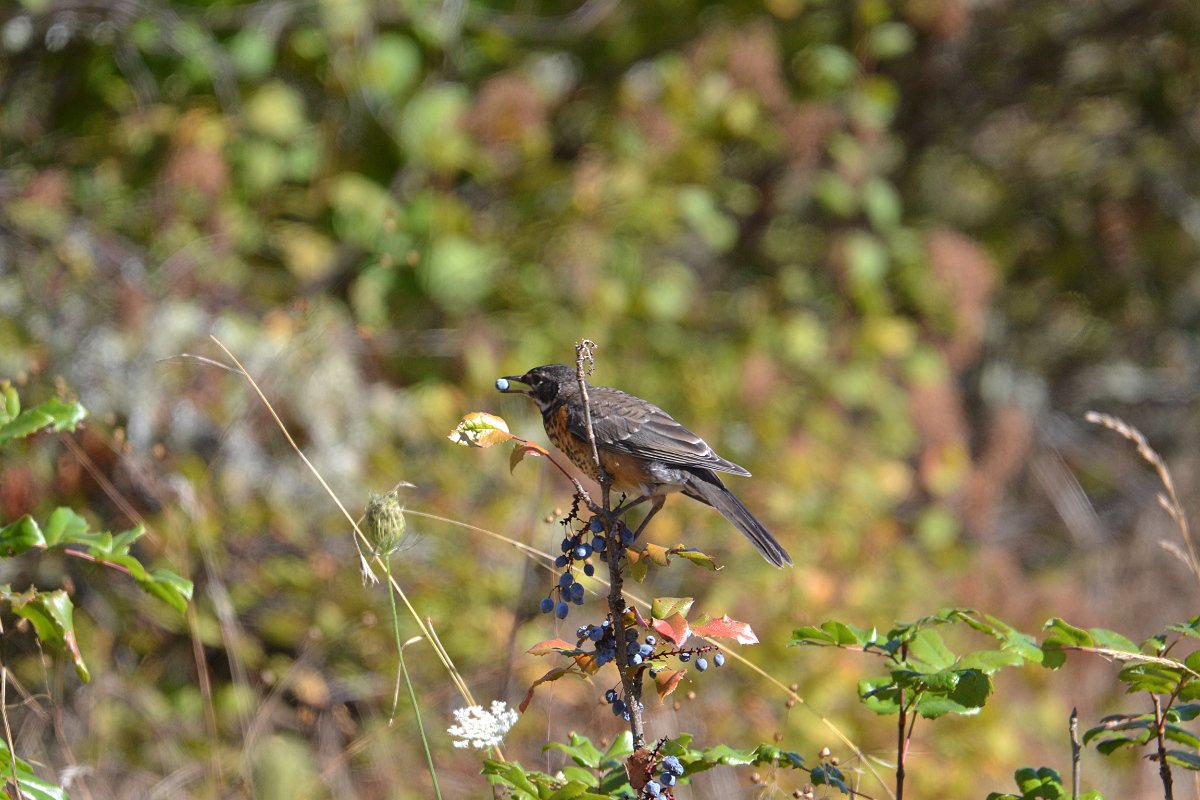
I came across what appeared to be bird poop. I started wondering what berry has these seeds. I didn’t have to look far to find Oregon grape berries. I brought one over and opened it to find what I believe are matching seeds. Over the next week or so, I would sit by patches of Oregon grape when I was walking past. I wanted to see what birds were eating them. One morning, I watched cedar waxwings and American robins swooping in and gobbling up the berries. Towhees were hoping around down low through the shrubs and on the ground. I didn’t see them eating them, but I suspect they were foraging on them too.

At this moment, I think of the book Tom Brown’s Field Guide to Nature Observation and Tracking. It is filled with heaps of great information and exercises to improve your awareness and become more tuned into the natural world. I credit this book with helping to spark my curiosity and wonder about nature.

Goldfinch & Thistle

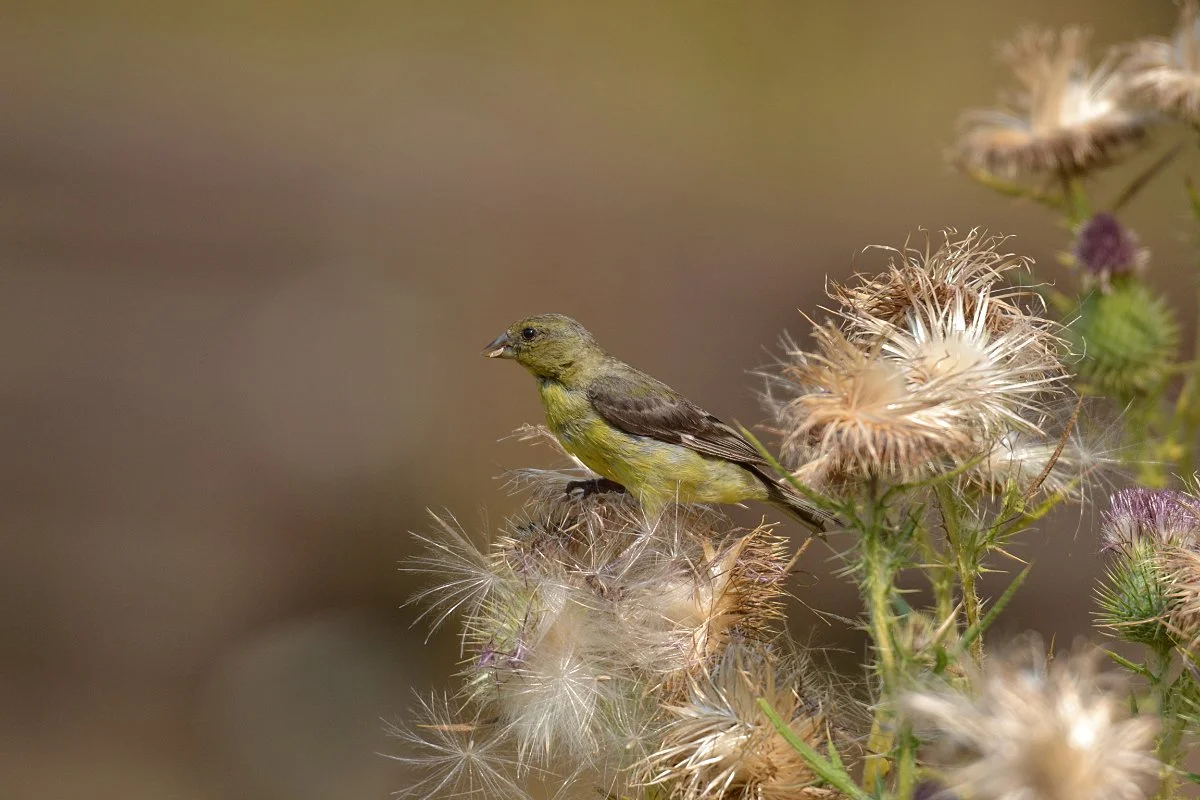
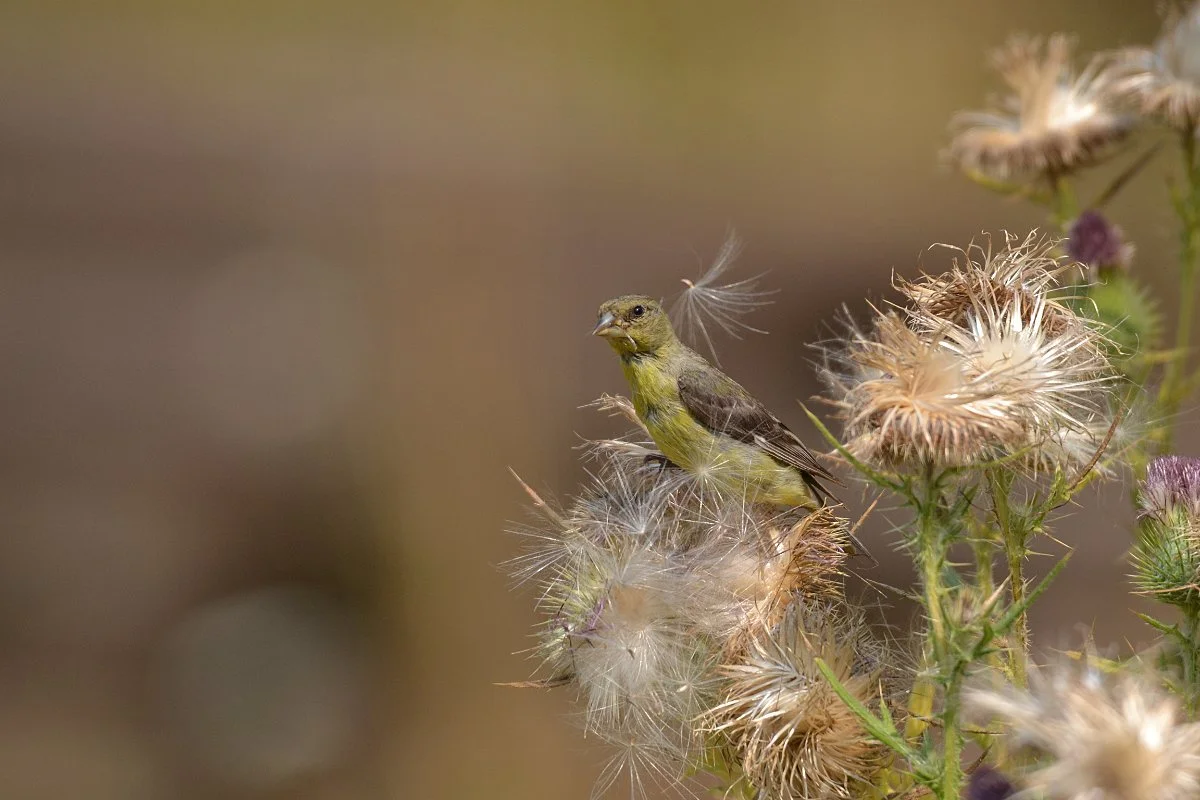
Clouds of downy thistle seeds have been billowing out onto the landscape and flying up into the sky. The seed is attached to an umbrella of feathers that enable it to float away in the slightest breeze. Goldfinches are on the scene to forage before the seeds sail away.

Goldfinches mainly eat seeds, but they will also supplement their diets with small fruits (elderberry and madrone) and tree buds (cottonwoods, alders, sycamores, willows, and oaks).

I think this particular plant is a bull thistle, a non-native plant. Non-native plants can be invasive, but I had to admire the cool seed head left behind after the seeds were released. It reminded me of a straw hat that Van Gogh might have painted.

In the birdseed business, Niger seeds are sold as a popular goldfinch food. Early marketing labeled this plant seed as a thistle. People wanted to capitalize on the fact that goldfinches love thistle seeds, which Niger seeds aren’t. They are a native plant to Ethiopia, Eritrea, and Malawi. They are also grown in India. You may also see the plant labeled Nyger or Nyjer on the bag of bird seed.

I wanted to mention this because I feel that it is better to grow native plants and create more habitat for birds to forage. I feel these types of small changes can have huge impacts on restoring a balance in nature. When we use native seeds, we not only create habitat, we avoid spending energy importing seeds from far away to put in our bird feeders. In addition, Niger seeds are not going to be as nutritious because they are sterilized by heat before being shipped. I am sure this is to help prevent germination and spoilage of the seed.

Common Merganser

Recently, I have been delighted to see a small group of common mergansers on the river. The male’s breeding plumage is striking. He has a white body that sharply contrasts with a black back and dark green-black head. His bill and feet are red and his breast is tinged with a rosy peach. The female and immature mergansers are gray-bodied and have a rufous head with a short crest. Their chest and a patch under the chin are white. From late summer to mid-autumn, males wear a nonbreeding plumage that looks very similar to female plumage. So at the moment, they all look fairly alike.

I usually see them paddling upstream and enthusiastically diving for food. They dip their heads just under the surface of the water as they swim and scan for prey. When they dive, they give a slight leap to help launch themselves underwater. When one bird dives, the others usually follow. They normally dive for less than 30 seconds, but they can stay under for up to 2 minutes! Their diet consists mostly of fish which are, of course, slippery. To help catch and hold them, they have serrated bills. Sometimes I see one surface with a fish in its bill, and if it isn’t quickly gobbled down, a chase often ensues.

They can also be seen relaxing on rocks or on a log out in the river. That said, there always seems to be one vigilantly standing guard for any predators. I also have seen them merrily floating downstream, looking around, and to all appearances, just taking it easy.

Find a spot by the river to quietly sit and listen to the water gurgling, the wind blowing through the cottonwoods, and hopefully, you will be blessed to see a flock of mergansers paddling around on the river.

Nature is an inexhaustible source of wonder. Hope to see you out there.

References
Common Merganser Life History, All About Birds, Cornell Lab of Ornithology. https://www.allaboutbirds.org/guide/Common_Merganser/lifehistory. Accessed 14 Sept. 2022.

Peterson, Roger Tory, et al. Peterson Field Guide to Birds of Western North America. 4th ed, Houghton Mifflin Harcourt, 2010.

Messenger of Beauty

I saw a bird
quietly alight on a branch.
Sunlight filtered through
the forest canopy
gently washing over
its body of soft feathers.
It turned and tilted its head,
listening and watching.
It awakened me
out of my thoughts.
I heard the rustling
wind through the trees and
the clapping of grasshopper wings
in the meadow nearby.
I felt the warm, dry summer air
blowing against my skin.
I caught the sweet scents
of the earth wafting by
in the breeze.
Thank you little bird for
helping me tune in
to the moment and
the natural world around me.
May your visits to the arboretum
be filled with messengers
that deliver you beauty, harmony
and inspiration.
Peace.

Morning of Blue

The morning river is cool. It flows in blues and grays. It is soft and quiet. The air is gentle. It soothes my eyes and skin and my breath. I am awake, alive in its stillness. I want to wade through the dawn, mindful and respectful, a heron.