Ash-throated Flycatcher

Walking along the creek trail the other evening I found an Ash-throated Flycatcher bebopping through the oak trees. This hip little bird has a slightly bushy head and occasionally whistled sprightly little notes as it merrily foraged in and out of the branches. As it swooped between perches, I caught glimpses of the cinnamon color on the underside of its tail. When it landed, its two faint, whitish wing bars and pale, yellow belly became more visible.

It lives in semiarid country with dry scrub and open woodlands of oak, pinyon pine, juniper, mesquite, etc. There is only the occasional sighting of this bird here at Mount Pisgah. According to the range maps, this part of the Willamette Valley appears to be the upper part of its range west of the Oregon Cascades. A testimony to their suitability for dry habitats is that they don’t need to drink water. They get it all from the food they eat.

Its diet consists mostly of insects and spiders that it catches in midair or gleans from foliage. It will supplement its diet with small fruits such as mistletoe berries found in the oak trees throughout the arboretum.

The bird activity has slowed down at the arboretum as we get into the middle of summer and the nesting season wraps up. It is best to get out early in the morning before it gets hot or go out in the evening as the day cools down. Good luck and happy birding.

Resources
Ash-Throated Flycatcher Life History, All About Birds, Cornell Lab of Ornithology. https://www.allaboutbirds.org/guide/Ash-throated_Flycatcher/lifehistory. Accessed 19 July 2024.

Peterson, Roger Tory, et al. Peterson Field Guide to Birds of Western North America. 4th ed, Houghton Mifflin Harcourt, 2010.

Black-headed Grosbeak Nest

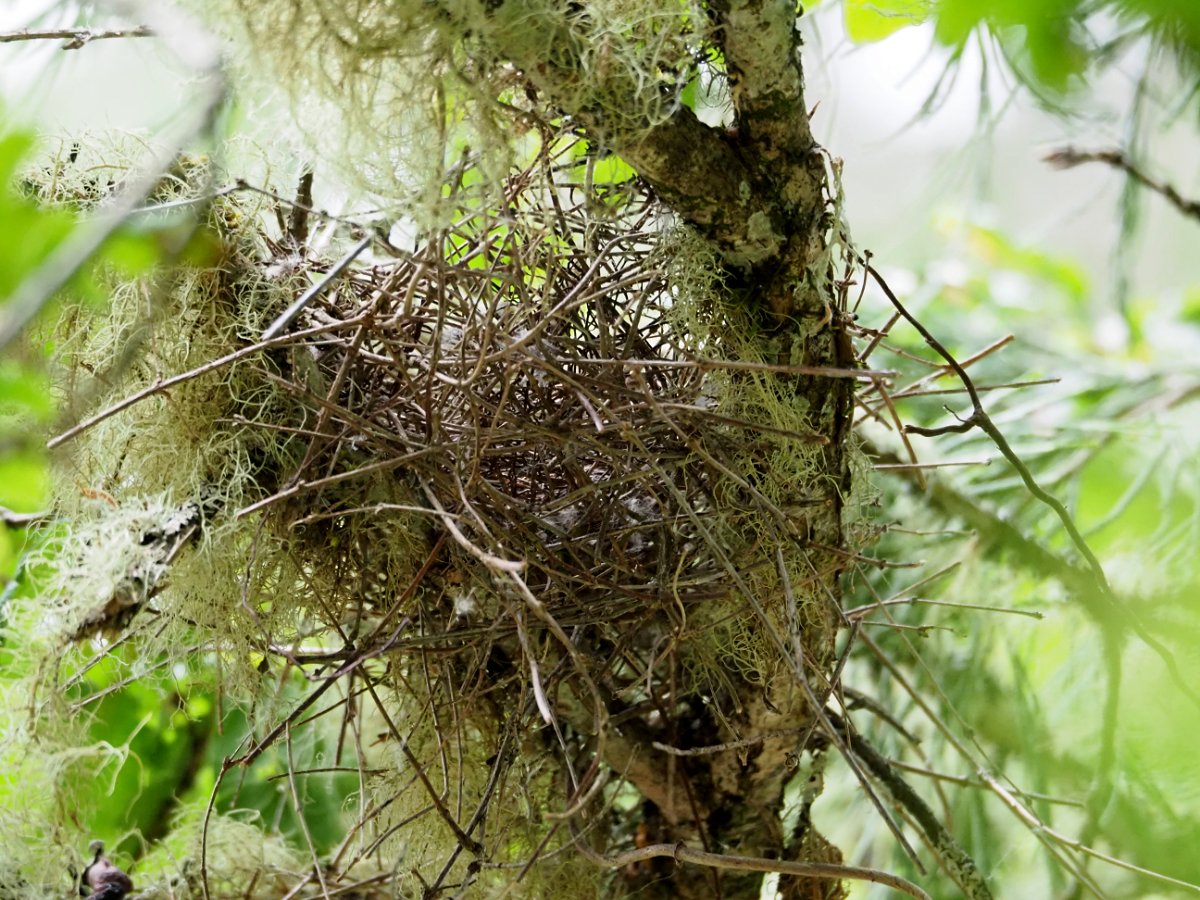
A pair of black-headed grosbeaks successfully raised two babies in this nest. It was right above a trail and low enough that as I walked under it I could have reached up and touched the bottom of the nest. The grosbeak parents were always cautious when approaching the nest. They usually waited nearby for a moment before flying up to the nest. When they decided to go to the nest, they swooped in quickly. The babies reached up with open mouths to receive food, but I didn’t hear them make any begging calls. They were always quiet or at least quiet enough to where I couldn’t hear them.

I took these photos primarily to show you how airy the nest is. When I walked under it and glanced up, I was always amused that I could see the birds. That said, this nest is sturdier than it looks. This twiggy conglomeration usually stays in the tree for a year or more. Even after this winter’s devastating ice storm that took down so many trees and branches, I saw a grosbeak nest in an osoberry shrub that was still there. It seems remarkable considering how loosely constructed they appear to be.

Nature is an inexhaustible source of wonder. I look forward to seeing you out there.

Western Wood-Pewee Nest

I found a Western Wood-Pewee nest that was low enough on a limb where you could watch it and see what was going on. I called Patrick at the arboretum and we met to look at it through his scope. He can attach his phone to the scope and we took these photos. Thanks Patrick!

It was fun watching the parents feed nestlings. The babies would open their bills wide and stretch their heads as high as possible. After they were fed, they would lay their heads down on the side of the nest and rest. The three babies are already filling up the nest. The parents have to perch on the side, wiggle their way over them to sit on the nest, and still can’t completely cover them. The babies were so beautiful with the morning sunlight illuminating their down feathers.

All About Birds by The Cornell Lab writes: “The female builds a dense and compact nest out of grasses, plant fibers, bark, and plant down. She uses spiderwebs to bind the nesting material together and camouflages the outside of the nest with mosses, bud scales, and insect skins. She lines the inside with fine grasses and feathers. It takes her anywhere from 3 days to 2 weeks to complete the nest, which measures about 3 inches wide and 2.5 inches tall.”

This is a fun bird to watch and get to know. Happy birding and I hope to see you out there!

Indigo Bunting

The indigo bunting,
an ethereal blue flame
flickering in the sun,
delivers a message.
Along the waistline
of the earth
there is a swirling naval
from where imagination,
creativity,
wonder and love
gush out
of the belly of Mother Earth.
You don’t need to go
looking for it.
You are connected to it
through your heart,
through nature.

Yellow-breasted Chat

In the south meadow, a bird is making a cacophony of sounds. Its repertoire of vocalizations is a mishmash of whistles, hiccups, zings, whirling toots, clacks, and squawks bustling with merriment. It sounds like a mini carnival has rolled into town.

Meet the yellow-breasted chat. I say “meet” if you are lucky enough to see it. It mostly stays tucked away in the underbrush as it sings away right in front of you. Lately, it has been hanging out in an island of vegetation consisting of an ash tree, a thicket of blackberries, a cluster of willows, and dense snowberry shrubbery.

I am considering setting up a booth in front of its little haven and calling it Find the Birdie. I’ll wear a bright yellow suit with a dapper top hat. Step right up folks and find the birdie. Zip-zurple Toot. He’s in there somewhere. Burp Whirdle Peep. He could be down low in the willow. Pop Crackle Gulp. Or maybe a little higher up in the canopy of the ash. Caw Chortle Cluck. Try your luck. It’s only a buck!

Luckily, I caught a glimpse of it as it briefly popped into the open and as if to take a bow in recognition of its vocal performance. It’s a beautiful bird, and it was well worth the time and effort to see it. I hope you are enjoying the spring. Happy Birding!

Chickadee Fledgling

I heard a bird begging and saw a couple of black-capped chickadees zipping about scouring the understory of plants looking for food. I found the fledgling nearby quietly sitting on a branch looking at its new, beautiful world. If a parent came near, it would start begging and open its mouth wide ready to receive nourishment. I like the photo that I captured below showing the parent briefly pausing as it turns to fly away in search of more food. It looks like the unshaven, disheveled dad who’s a little weary from caring for his kids. His eye looks a tad puffy from lack of rest and seems to be looking at me as if to say, “Put down the camera and help me find some caterpillars!” The fledgling is lovingly turning towards him as he flies away. One of the things that always comes to mind when I see a fledgling chickadee is that it is one of the few times I see a chickadee sit still on a branch. These action-packed birds never seem to stop moving, but a fledgling will often perch in the same spot for a bit and maybe nap a little. Happy birding!

Downy Woodpecker Feeding Babies

Mount Pisgah is a peaceful place that also experiences a fair amount of noise pollution. The rushing sounds of the interstate nearby can easily be heard. There are farms just across the river with tractors and other equipment buzzing. There is vehicle traffic in and out of the park with the bustling of people and their devices.

Yesterday I was sitting up on the hillside, so I could hear many different sounds of nature and civilization. To the south, I could hear a continuous sound mixed in with the hum. After listening to it for a while I decided it was in the park and went to investigate further. I was intrigued by how continuous the sound was. It was fairly faint and I wasn’t sure if it was nearby. Maybe it was obstructed by the hillside or trees or maybe facing away from me. I came around to the other side of the hill and the sound got a little stronger. I was fascinated by how constant it was. I decided to sit down and listen. After about 10 minutes, I caught out of the corner of my eye a bird flying up to a tree for a moment and then it flew away. What!? That continuous sound is begging birds! The tree cavity was facing away from me, and once I positioned myself around the other side I could just get a glimpse of the entrance and hear the birds clearer.

I listened and watched for a bit. I was amazed at how nonstop the begging of the baby birds was and the parents were coming and going constantly. It must be so exhausting to keep up with feeding them. It was a good reminder of how much energy birds expend to raise a family. Plus they have to be constantly looking over their shoulders to make sure a predator isn’t nearby. They must be frazzled by the end of the day.

Spotted Sandpiper

It’s morning.
I am sitting by the river on a small gravel bar.
Sunlight brushes across the tops of the cottonwoods.
A light, upstream breeze is blowing in from the ocean.
The air smells sweet and freshly laundered.
In front of me, a thicket of willows
lightly sweeps back and forth
in eddies of wind.
The willows grow from an anchor of stones—
a cobbled bed, smoothed
over centuries
by elemental friction.
A shallow sheet of water covers
this abraded bed.
A gentle current channels
its way through small, quiet pools.
It is a refuge.
It’s abundant with creatures visiting
to drink water, bathe, forage, and nest.
One of my favorites is the spotted sandpiper.
During breeding, the white canvas
of its winter breast
becomes dotted with a patchwork
of inky, brown spots
giving it its name.
It has a curious behavior
of bobbing its tail up and down.
I imagine it on a playground
with kids delightfully teetering on its body.
It loves to hop about the rocks
and wade through the water.
It will make visits over to me
if I am still.
Sometimes it will travel along the river.
It flies low over the water
and mixes short, rapid wingbeats
in with small glides.
I lose sight of it sometimes,
but I can hear the clear, simple
high-pitched notes it sings
as it wanders and explores.
I look forward to it returning every year
and spending time here.
I never tire of watching it
and being in the presence of
its peacefulness and elegance.

Cedar Waxwings Eating Twinberries

I was walking around the south meadow and remembered to go check on one of my favorite plants, the twinberry. It received significant damage from the ice storm, and I was concerned how well it might recover. It leafed out beautifully at the beginning of spring, and I felt reassured as it flourished with plenty of yellow blossoms. I knew the berries were probably ripening, so I cautiously approached the area hoping to see some birds eating them. Before the shrub came into view, I could hear the high-pitched whistling of cedar waxwings. When I slowly rounded the corner, I found about a dozen waxwings and one robin devouring the berries. Many of the berries were accessible by perching on a nearby branch, but some were just out of reach. I enjoyed watching them launch upwards, hover underneath a berry, and pluck it. I came in just the nick of time because it wasn’t long before most of them were gone.

Afterward, they moved over to a thicket of osoberries next to me and started gobbling them up. I am always amazed at the appetite songbirds have. They are so small and seem to be eating an incredible amount of food. Later on, I watched cedar waxwings sweeping back and forth across the river eating copious amounts Mayflies. It takes a lot of energy to live out there! Thankfully the arboretum has a healthy ecosystem with plenty of food to support them. I planted a couple of twinberries last year. I am looking forward to them becoming established and providing more habitat and food.

Juvenile Robin

I watched three baby chipmunks chasing each other around and curiously investigating the lush, spring landscape. One of the chipmunks scurried onto a small branch over the creek and stopped next to a sleeping juvenile robin. The robin was so still and well-camouflaged that I hadn’t noticed it. I’m always surprised by how well they blend in, especially if they are quiet and motionless. I have seen two nests of robins that had three fledglings each that have recently left the nest. From each nest, I have only seen one juvenile robin being fed. I don’t know what happened to the others, but they are not around begging and being fed.

In the photo below, one of the fledglings is being fed. Notice that the adult robin’s eye is slightly cloudy. I recently wrote about the nictitating eyelid, and you can see the adult using it to protect its eye during feeding.

Oriole Collecting Nest Material

The Bullock’s orioles have arrived at the arboretum. They are medium-distant migrants, most of them wintering in western Mexico. A few individuals may be resident in coastal southern California. On the range map, it looked like the Santa Barbara area down to San Diego.

They are starting to build their nests and often look for man-made materials such as rope fibers, baling twine, fishing lines, etc. I have seen nests next to rivers where at least fifty percent of the nest is constructed of these materials. During the setup for the wildflower festival, I saw them removing fibers from the ropes used to tie down the tent canopies. Two of the nests I have seen built this year have orange twine from the hay bales woven in.

The Peterson Field Guide to North American Bird Nests wonderfully describes the nests of orioles as: “Nests are pensile (hanging and attached only at the rim) or semipensile (with additional attachment at the sidewalls) and can be loosely separated into two categories: those that are classically pendulous and socklike, typically longer than wide with a narrow top, and those that are like a shallow, open gourd, the opening of which is often fairly wide and more broadly secured, in part due to the span of the fork or branches to which the rim is fastened. Nests of Bullock’s, Baltimore, and Altamira Orioles fall into the first category: Altamira nests are the longest of any species in N. America.”

The nests I see at the arboretum are constructed mostly of grasses and lichens with other bits of string, ribbons, twine, etc. utilized. The nests are lined with soft materials such as feathers or the cottony filament that disperses the seeds of cottonwoods and willows.

Happy birding! See you out there!

Resources
Bullock’s Oriole Range Map, All About Birds, Cornell Lab of Ornithology. https://www.allaboutbirds.org/guide/Bullocks_Oriole/maps-range. Accessed 21 May 2024.

McFarland, Casey, et al. Peterson Field Guide to North American Bird Nests. Houghton Mifflin Harcourt, 2021.

Nictitating Membrane

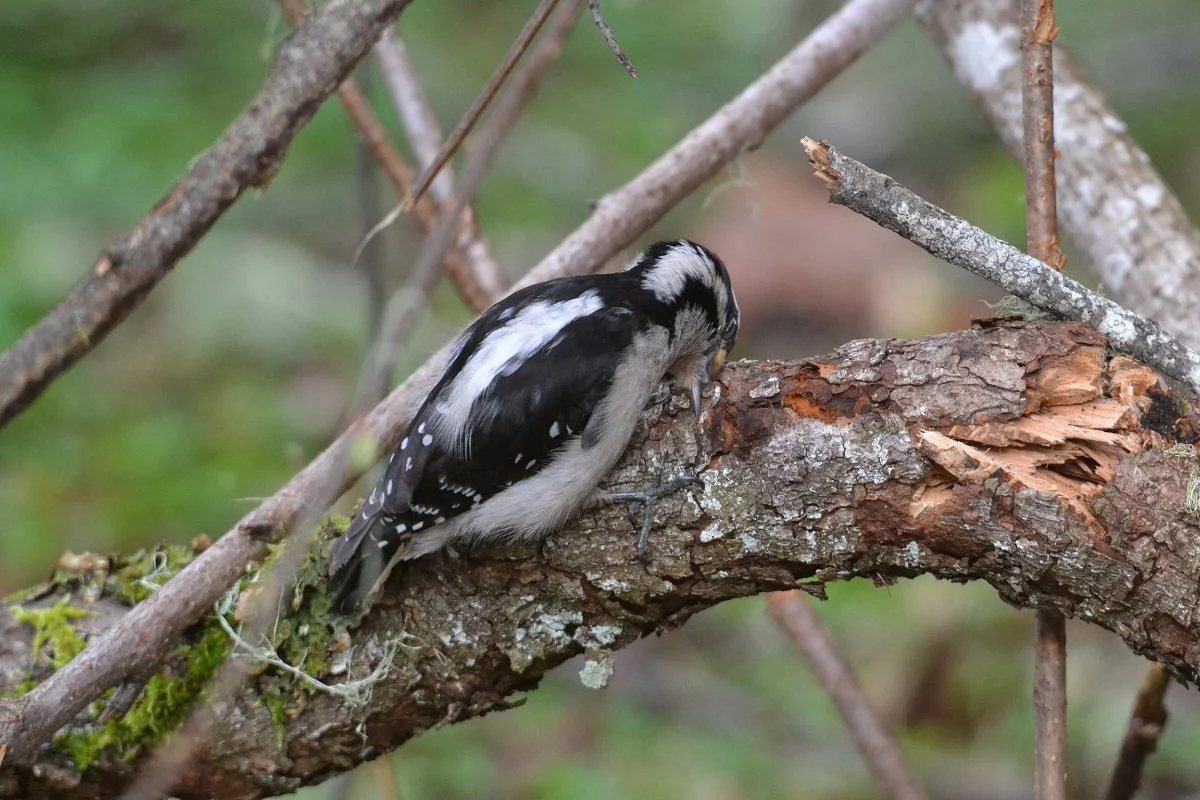
Birds have an upper and lower eyelid to protect their eye. They also have a thin, translucent covering called a nictitating membrane that functions as a sort of third eyelid. It sweeps across horizontally from the front of the eye next to the bill towards the back. This membrane helps to clean, moisten, and protect the eye. You can see this downy woodpecker using it to shield its eyes from possible flying debris while striking the branch as it searches for food. I have also seen a bird use this membrane to cover its eyes while feeding its young or scratching its head.

This membrane also helps keep a bird’s eye safe while underwater. I have an old binder of seminars called Bird Biology by the Cornell Lab of Ornithology that says, “In certain aquatic birds such as loons, cormorants, diving ducks, and alcids [auks, murres, and puffins] the nictitating membrane has a special central, window-like area that acts like a contact lens over the cornea.” It’s like they have built in goggles. The world of birds is fascinating!

Nature is an inexhaustible source of wonder. I look forward to seeing you out there.

Stay Inspired

The incalculable diversity that continuously evolves in the life of a forest is unimaginable. As the life of this tree’s story unfolds from a sprout to a decaying snag, a vast amount of creatures, big and small, will have interacted with its being. At this moment, a Western Screech Owl finds a place to keep warm, dry, and safe. It finds a sanctuary to listen to the flowing river as it rests.

We have to leave parts of nature unimpeded and free to express her spirit so that future generations will sit in awe of her beauty and be inspired to be loving stewards of the earth and each other.

Downy Woodpecker

There are limbs and piles of debris lying around throughout the arboretum since the ice storm. Many birds are hopping through them and using them for cover and searching for food. I enjoyed watching this Downy Woodpecker investigate some of the fallen dead branches.

In the first photo, it appears that both feet briefly left the limb as he struck it. Like in the previous post, a bird’s movements happen in the blink of an eye, so I feel some actions are only observable by capturing them with a photo. It is interesting to see him seemingly throw his whole body into it as he forcefully struck the limb.

As he chipped away the bark, I occasionally saw him trying to pull off pieces of bark to get underneath. He was so determined as he tugged on them.

As he went along, he circled the whole branch. While clinging underneath, he easily moved along as he poked and searched for food.

This bird has a great spirit and is fun to watch. Happy birding!

Bewick's Acrobatics

The other day I was snapping a few photos of a Bewick’s Wren singing. When I got home and looked at the photos, I saw this one. It is out of focus, but it captured the wren launching from the branch and doing an interesting maneuver. It was twisting its body to where its feet are towards the sky as it looks downward as it flies to a lower perch. I can’t figure out why it would flip over like this as it took off. Maybe it flipped over and did a full twist. I don’t know. Little birds like wrens and kinglets dart so quickly through the branches that they might do tricky, acrobatic moves like this all the time. These movements happen so fast that you aren’t able to notice them. Maybe he was showing off for a female that was watching nearby.

According to my dad, Founder of the Odell Society of Weiner Stand Hijinks and Oddball Medicolegal Terminology of Unexplainable Ailments, he might have the “Hygolican Flips!”

Accipter Action

When out birding it can be tough to distinguish between a coopers hawk and a sharp-shinned hawk. They are hawks that can whiz by you before you get a good look. I believe this one to be a Cooper’s Hawk that has caught a Northern Flicker. I put the measurements of the three birds below so you could compare them. The following data was taken from All About Birds by The Cornell Lab.

Measurements: Coopers Hawk
Male Length: 14.6-15.3 in (37-39 cm)
Female Length: 16.5-17.7 in (42-45 cm)

Measurements: Sharp-shinned Hawk
Both Sexes: Length: 9.4-13.4 in (24-34 cm)

Measurements: Northern Flicker
Both Sexes: Length: 11.0-12.2 in (28-31 cm)

In the photo, it appears to me that the hawk is considerably larger than the flicker. The Cooper’s Hawk has a more squared head than the Sharp-shinned Hawk which has a smaller, rounder head. Both birds can be seen out at the arboretum. Most of the time I hear the alarm calls of songbirds to clue me into the presence of a Cooper’s or Sharp-shinned hawk. It is amazing to watch the speed and agility of these birds as they navigate through the landscape in pursuit of prey.

I am putting a link to an informative page by The Cornell Lab that compares the two hawks side by side. Click here.

Good luck and happy birding.

Sunning

Birds need to care for their feathers. They are important for such functions as flight, attracting mates, camouflage, regulating body temperature, and keeping dry.

On warm, sunny days out at the arboretum I will occasionally catch a Steller’s Jay or an American Robin performing an interesting behavior called sunning. This maintenance behavior isn’t completely understood but seems to be largely associated with removing parasites, such as lice, living on their skin and feathers. Studies have shown that exposing the feathers to direct sunlight can allow them to heat up enough to kill some of the lice. In addition, lice might move to escape the heat possibly making it easier to clear them away during preening, which often follows a session of basking in the sun.

While scientists continue to unravel this mystery of sunning, one thing for sure is that we will all continue to marvel at the beautiful diversity of the colors and patterns of bird feathers.

Nature is an inexhaustible source of wonder. I look forward to seeing you out there.

Resources
Hot, Bothered, and Parasite-Free: Why Birds Sun Themselves | Audubon. 27 Feb. 2020, https://www.audubon.org/news/hot-bothered-and-parasite-free-why-birds-sun-themselves.

Sibley, David. What It’s Like to Be a Bird: From Flying to Nesting, Eating to Singing -- What Birds Are Doing, and Why. Alfred A. Knopf, 2020.

White-breasted Nuthatch

The white-breasted nuthatch is one of my favorite birds, and its curious, carefree spirit is an essential part of the oak savanna habitat of the arboretum. I always look forward to hearing its vocalizations and watching it hop and skip around on a tree.

It has an interesting behavior of moving headfirst down a tree as it forages. It will often pause and tilt its head back to have a glance at its surroundings. In David Sibley’s book What It Is Like to Be a Bird he says this about how nuthatches move around a tree:
”They do not use their tail for a brace when climbing—just their two feet clinging with sharp claws. The hind toe is particularly important for clinging, and it’s relatively large and strong. Usually they position one foot above the other so that the lower foot acts as a brace while the upper foot clings to the bark. This allows them to move easily up or down the trunk and at all angles on branches.”

It primarily eats insects, insect larvae, and spiders. They have pointy bills for probing into bark furrows and beds of moss and lichen growing on the tree. It also eats nuts and seeds. They love to retrieve bits of acorns from the parking lot that have been run over by cars. It will wedge a piece of acorn in the bark of a tree to hold it while it breaks off pieces to eat or will stash it for later. I also see it collect seeds like Douglas-fir.

Peterson describes its voice as: “Song a rapid series of low, nasal whistled notes on one pitch: whi, whi, whi, whi, whi, whi or who, who, who, etc. Notes of birds in interior West higher pitched and given in rapid series. Call a distinctive nasal yank, yank, yank; also a nasal tootoo.

This is a fun bird to watch and get to know. I posted about this bird a couple of years ago and wanted to repost it. I hope to see you out there.

Resources
Peterson, Roger Tory, et al. Peterson Field Guide to Birds of Western North America. 4th ed, Houghton Mifflin Harcourt, 2010.

Sibley, David. What It’s Like to Be a Bird: From Flying to Nesting, Eating to Singing -- What Birds Are Doing, and Why. Alfred A. Knopf, 2020.

White-Breasted Nuthatch Overview, All About Birds, Cornell Lab of Ornithology. https://www.allaboutbirds.org/guide/White-breasted_Nuthatch/overview. Accessed 15 Feb. 2024.

Happy New Year

Happy New Year!

I feel that is always good to ring in the new year with the dark-eyed junco. They have a gentle spirit and are often at the entrance to welcome you to the arboretum. May we all be more gentle with each other and with nature as we journey together into 2024. May your time in nature be peaceful and rejuvenating. I look forward to seeing you out there.

Ruby-crowned Kinglet

The rain-saturated reefs of mosses and lichens growing throughout the arboretum soften my eyes and quiet my mind. The ruby-crowned kinglet scribbles a path through the canopy. Its body bounces from limb to limb in a ricochet of darting straight lines and cursive swoops. Overstuffed with joy, a stitch loosens across the top of its head slightly opening a seam. I catch a glimpse of a flare, a brilliance, an illumination. Unravel the threads and let the coins spill out of your purse. Reveal your hidden treasure, a sleeping ember waiting to catch a breath of air and ignite your ruby crown!