Spotted Towhee Eating Poison Oak Berries

Poison oak grows throughout most of the ecosystem at Mt. Pisgah Arboretum. The other day I watched a spotted towhee eating the berries. I was curious to see if it was listed in their diet on All About Birds by The Cornell Lab. Check out what they listed: “In the breeding season, Spotted Towhees eat mainly insects including ground beetles, weevils, ladybugs, darkling beetles, click beetles, wood-boring beetles, crickets, grasshoppers, caterpillars, moths, bees, and wasps. Other leaf-litter arthropods such as millipedes, sowbugs, and spiders are taken as well. They also eat acorns, berries, and seeds including buckwheat, thistle, raspberry, blackberry, poison oak, sumac, nightshade, chickweed, and crops such as oats, wheat, corn, and cherries. In fall and winter, these plant foods make up the majority of their diet.” It is amazing to realize the varied diet of some birds.

Most of the time the spotted towhee will be on the ground foraging. It will do this little backward shuffle with both feet to clear away debris on the ground. This will uncover/flush insects or reveal seeds underneath. Watching a towhee forage, I am fascinated by the amount of food that it finds on the ground. Most of it is gobbled up before I can see what it was or it is too small. It’s also fascinating to realize just how much time they have to spend looking for food. Especially at this time of year, most of my birdwatching is observing birds forage for food. If you want to have birds in your yard like the spotted towhee, it is necessary to grow native plants and leave the leaf litter and other plant debris on the ground to create a habitat for them to forage. Happy birding!

Sporophytes

I recently read Robin Wall Kimmerer’s book Gathering Moss. It is a fascinating tale of the life of mosses and it sent me out into the world with a new awareness.

In the photo, there is a cushy bed of moss. In this species, thin red stalks growing out have green capsules on the end that contain spores. These structures are known as the sporophytes and are the result of sexual reproduction. When the spores mature, they will be released, hopefully finding a suitable place to land and grow.

Here’s a small, general overview which I mostly gleaned from the book, but I also watched several videos and perused some articles on the internet. After finishing the book, I decided to go back and start rereading it from the beginning. I also need to invest in a magnifying lens because the world of mosses is miniature.

Depending on the species, mosses can either have separate male and female on leafy shoots or they can have both the male and female on the same shoot on different stems. The sexual organ is usually at the tip, hidden in a cluster of leaves. The female structure is called the archegonium and the male structure is called the antheridium. For the sperm to reach the egg, it needs to be transported through water. That can be accomplished by several ways. The water collected between the leaves of the moss can act as an avenue for the sperm to swim to fertilize the egg. Rain splashing onto the antheridium can carry the sperm in droplets of water. Also, droplets of water containing sperm can cling to tiny creatures living in mosses and as they move around, they can aid in transporting the sperm to the egg.

Robin mentions in her book that she has seen birds eating the sporophytes. I captured a couple of photos of a junco hopping around on a limb, and it appears to be foraging on them.

Juncos

I was watching a small flock of juncos move across the landscape. They were down on the ground hopping and flitting about in the grass. Here and there one would pop up into this poison oak bush and eat some berries.

I love these little, winter flocks that gather at the arboretum. For me, they have a peaceful and calming presence. They embody the serenity of winter—a compass pointing to a gentle quietness as life slows down in the waning light and cooling temperature. Plant me in the earth among the decaying leaves and dry flower stalks. Let roots anchor my body and transport the elements into my spirit. Let juncos spend the cold winter nights nestled in the thicket of my warming embrace. I’ll provide them refuge from the wind in the canopy of my coat. Seeds will spill from my pockets onto the ground, and they will joyfully dance around my feet in the rain filling their bellies. We will become old friends as we weave our lives together—a companionship made of gratitude, kindness, and harmony.

White-breasted Nuthatch Caching Acorn Pieces

As I enter the arboretum, I hear the call of the white-breasted nuthatch as it merrily explores its world among the trees. Lately, I have seen it flying down to the road in the turnaround loop at the entrance. Acorns that have dropped onto the road are being broken open as vehicles drive over them. The nuthatches are picking up the pieces and caching them. It is interesting to watch them choose a spot to hide the acorn chunk. They will seemingly audition a few hiding places before finally settling on a spot. Besides looking for the best-protected area to ensure that its morsel of food stays unspoiled, I also imagine it might do this if it thinks it has been seen hiding its acorn that could potentially be taken by another animal. I saw this one stuff it in a couple of different places under a carpet of mosses before it finally decided on a crevice under a broken limb. After it wedged the bit of acorn in the crack, it collected some moss and stuffed it in to further protect and conceal the acorn. I love watching these birds. For me, their calls ringing across the landscape are an integral part of the spirit of the arboretum.

Flickers Rivalry Dance

I was on the arboretum bird walk this month and watched a couple of flickers performing their display that is used for courtship and territorial defense. In early spring or summer during courtship, they will face off in this display usually while a prospective mate watches. Since it is October, I imagine these two were engaged in territorial defense. The Cornell Lab’s All About Birds describes this display thus: “Two birds face each other on a branch, bills pointed upward, and bob their heads in time while drawing a loop or figure-eight pattern in the air, often giving rhythmic wicka calls at the same time.” They would also fan their tail feathers. The flicker on the right seemed slightly bigger and slowly backed the other one out to the end of the branch. The smaller flicker eventually flew around its rival to a nearby vertical limb. The other flicker followed and they continued their dance circling the limb.

Resources
Northern Flicker Life History, All About Birds, Cornell Lab of Ornithology. https://www.allaboutbirds.org/guide/Northern_Flicker/lifehistory. Accessed 25 Oct. 2023.

Chickadees Eating Honeysuckle Berries

I heard the sound of chickadees calling and walked up the path to see what they were up to. They were in a mixed flock of birds that included white-breasted nuthatches, red-breasted nuthatches, brown creepers, ruby-crowned kinglets, golden-crowned kinglets, dark-eyed juncos, bushtits, Townsend’s warblers, Steller’s jays, and a varied thrush. There was a frenzy of activity from the ground all the way into the upper part of the canopy.

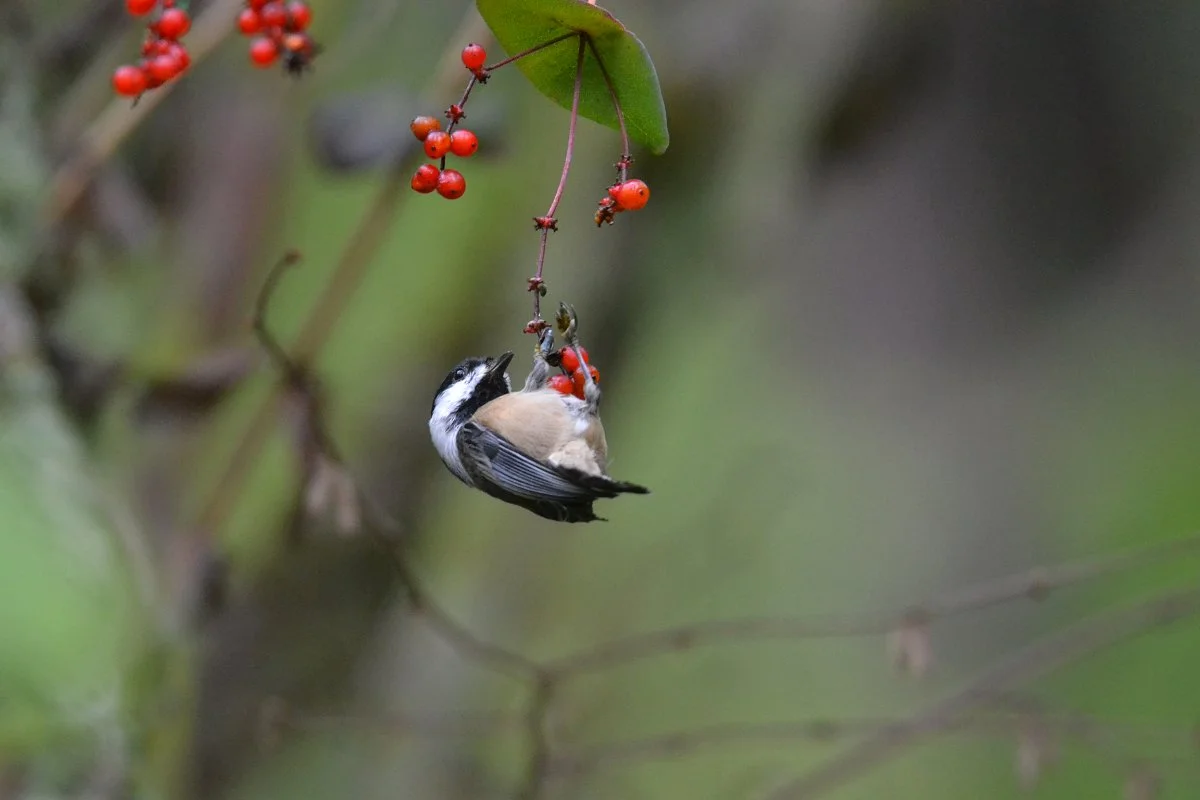
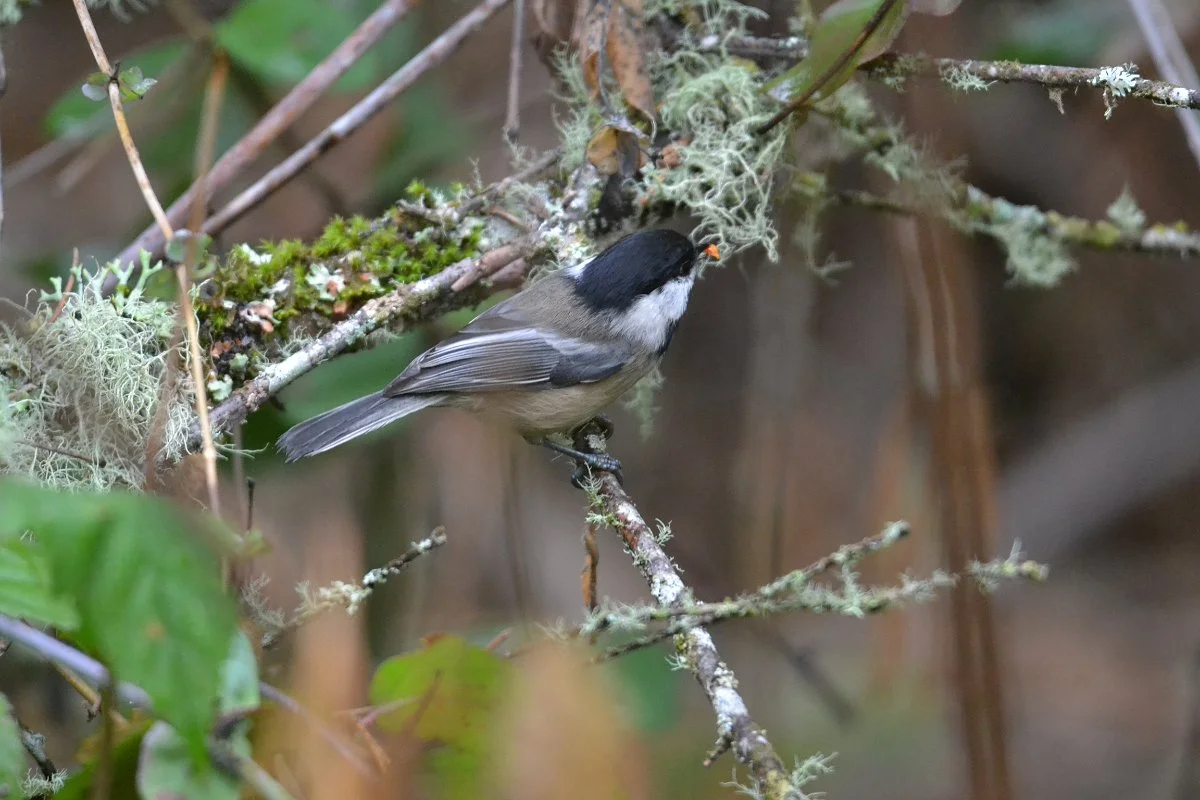
The chickadees were eating the bright red honeysuckle berries! (They were also gleaning insects out of the lichen and moss on the tree branches, and eating poison oak berries. Check out the post - 09/26/23.)

The chickadees mostly swooped by or briefly hovered to snag a berry. On occasion, they would grab onto the end of the vine and pluck a berry off. Once they had the berry, they would fly over to a branch to eat it. Afterward, I would see them taking off with one of the seeds up into the tree and returning fairly quickly for another berry. Perhaps they were stashing the seeds somewhere in the tree to eat later.

It was difficult to get these photos and they aren’t the best. The chickadees were so fast at snagging the berries, and it was tricky to anticipate where they were going to be. Plus my camera wants to take its time focusing, so I took a fair amount of blurry chickadee photos as they zipped away or in-focus photos of the berries after the chickadee flew off. There are loads of honeysuckle berries before and after the incense cedar exhibit. Those are good places to post up and potentially watch them eating the berries. Good luck!

More Birds Eating Red-osier Dogwood Berries

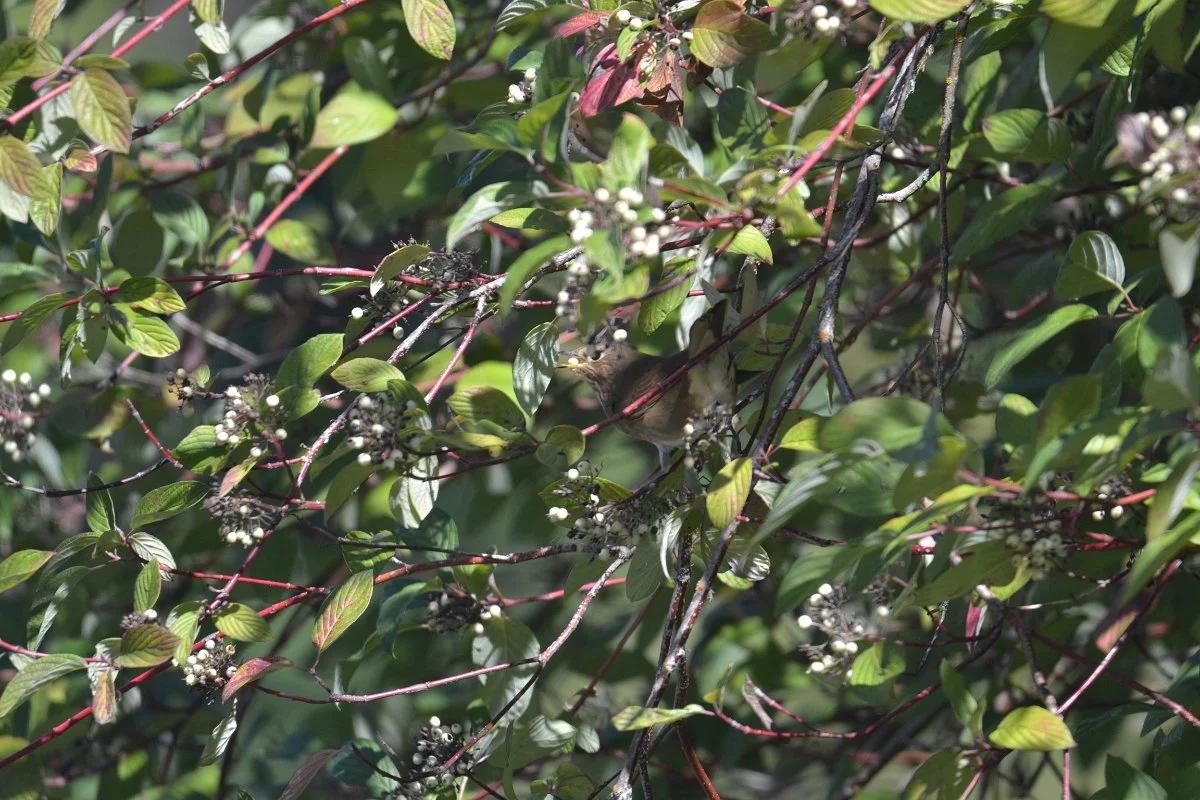
These are not the best photos, but I wanted to document and share what other birds are eating the red-osier dogwood berries. Over the past couple of weeks, I have seen warbling vireos, Swainson’s thrushes, and varied thrushes eating the berries. These birds are a little shier than the robin I took photos of eating these berries in a previous post. They tended to either eat berries more towards the inside of the bush where there was good cover, or they would pluck a berry from the outer limbs and retreat into the bush to eat it. A few times they briefly ate a few berries out where I could get a photo. I also had to stay back a little ways when taking the photos, otherwise, they withdrew back to the inside of the shrub. I am not sure what it is about this particular red-osier dogwood shrub that has drawn so many birds to it. It is definitely loaded with berries and maybe its close proximity to the water has made the berries tastier and juicier.

Curiously, there has been lots of cedar waxwings flying around in the vicinity, but I haven’t seen any of them eating the berries yet. I would think that these berries are part of their diet.

Virginia Rail Walking

I have been revisiting the wetlands to hopefully watch the Virginia rail. I have been lucky enough to see it again! It has been venturing a little farther into the open, and I got to see it walking around and foraging. One of the things I noticed is that sometimes the rail used its whole foot as it walked through the wetlands.

Most birds are digitigrade animals which means that they walk around on their toes, not the entire foot. The backward-bending joint that looks like a knee is actually the bird's ankle. The rail mostly walked around on its toes. However, it often moved or stood in a kind of crouched position and engaged its whole foot. This seems like it would provide support with balance and stability while walking on slippery surfaces. I could also see it useful when stalking, lunging at prey, or leaning forward to probe around with its bill. Additionally, the rail has long toes which helps distribute its weight when walking on soft surfaces like the muddy bottom of a marsh. I imagine that long toes with claws further aid in stabilizing and gripping slippery stems and leaves of lilies like in the wetlands.

Chickadees Eating Poison Oak Berries

When I awoke, the land was damp from overnight showers and the sweet smell of the earth filled the air. The rain has arrived just in time to herald the beginning of fall. It was a cool, cloudy morning, and I went for a walk at the arboretum. I ambled up the creek trail to the joyous vocals of the black-capped chickadees celebrating the rain’s return. They were bursting with energy as they bounced back and forth between the tree canopy and the understory. As I rounded a corner on the path, I could see that they were foraging poison oak berries. They quickly would fly down to a cluster of berries, pluck one, and fly over to a nearby branch to eat it. This patch of poison oak has lost its leaves, so it was easy to see the chickadees eating the berries. I also became more aware that the leafless poison oak blended in more with its surroundings as the chickadees circled all around me eating berries.

Mixed in this whirling eddy of chickadees along the creek trail were many other birds. Red-breasted nuthatches were looping around the trunks and limbs of trees. Two downy woodpeckers were actively pounding on dead branches. A brown creeper was hopping up a tree probing the nooks and crannies of the bark. Steller’s jays were at the top of the canopy collecting acorns. A western screech owl was sleeping in the entrance of a tree cavity. A couple of spotted towhees were scratching around in the leaves on the ground. A Bewick’s wren was bouncing around an Oregon ash looking for something to eat. It was a rollicking fall festival!

Happy fall! Happy birding! See you out there!

What Bird Is This?

I briefly watched this bird out in the wetlands as it flew around catching insects. I liked the way the light was shining behind it illuminating its rusty-colored tail. I was only able to watch it for a few minutes and then it flew back into the wetlands where I couldn’t see it. For fun, I thought it would be interesting to see what you thought this bird might be. Leave your guesses/thoughts in the comments below.

I just want to add that this small wetland area attracts so many birds. It is a real eye-opener how crucial wetlands are, no matter the size, in supporting so much diversity in wildlife.

Virginia Rail

It was early evening, and I took a leisurely walk through the arboretum. As I approached the wetlands, I heard the calls of chickadees moving through the lower part of the canopy and decided to go see what they were up to. I walked out onto the bridge in the wetlands to find them flitting around in the red-osier dogwoods. As I was watching them, a small flock of Bushtits came sweeping through and descended onto the lily pads sticking out of the water. They were excitedly gleaning insects from the surface of the leaves. As my eyes followed their acrobatic tumblings, I came across another bird at the water’s edge. A Virginia Rail was squatting on a lily pad and quietly foraging.

A Virginia Rail’s habitat is mostly shallow, freshwater wetlands but can also occupy brackish marshes near the coast. They prefer wetlands with “40–70% coverage of tall, emergent vegetation” (All About Birds). This consists of cattails, rushes, grasses, and plants like spirea, red-osier dogwood, and willow found in the wetlands at the arboretum. These areas provide great cover. Coupled with that, Virginia Rails have excellent camouflage and are mostly solitary birds, so they are often heard more than seen. With their long toes and strong legs to help them walk around on floating vegetation, they are right at home in a marsh habitat.

Their diet consists of “beetles, snails, spiders, flies, small fish, slugs, crayfish, and frogs. In the winter, they eat aquatic invertebrates as well as plant material and seeds” (All About Birds). This one appeared to be probing into the mud for food and eating bits of vegetation.

Seeing this bird is a reminder of how important it is to stay tuned into my surroundings. This encounter only lasted a few minutes, so it can be easy to miss these brief, but exciting moments. I am also reminded to be curious about places that I have been to many times because they can offer new and delightful experiences.

I hope to see you out there.

Resource
Virginia Rail Life History, All About Birds, Cornell Lab of Ornithology. https://www.allaboutbirds.org/guide/Virginia_Rail/lifehistory. Accessed 16 Sept. 2023.

Black-capped Chickadee Eating Oregon Ash Seeds

Chickadees are so curious and have such a varied diet. This morning I heard them calling from the canopy and decided to go over and see what they were doing. I found them plucking Oregon Ash samaras, carrying them over to nearby limbs, and eating the seeds. They were so adept at balancing, lining up the samara along the limb, and picking the seed out of the end. They would eat some ash seeds for a few minutes, then dart over to an oak tree to rummage around through the canopy for a couple of minutes, and then pop back over to the ash for more seeds. I am always amazed at how action-packed they are and that they never seem to stop moving.

Bushtit Eating Blackberry

I was watching a flock of bushtits move through the landscape. They fluttered and tumbled into a thicket of blackberries that were growing up through a cottonwood tree. As I peered through the foliage, I found some of them eating the blackberries. I captured one plucking off one drupelet at a time. I love its stance of one leg down grasping a tree limb and one nearly straight up holding onto the berry. I imagine the thorns of a blackberry are potentially harmful to birds. They have easily torn open my skin on more than one occasion when I was picking the berries. This one is playing it smart and showing off its acrobatic skills by finding a safe place to perch away from the thorns.

Robin Eating Red-osier Dogwood

The American Robin eats a wide variety of fruits, so it is no surprise to find them eating the Red-osier Dogwood berries. One of the shrubs next to the river had an abundance of berries, and I watched a robin eating from it quite a few times on different days. It would fly in, perch, and watch its surroundings for a moment. It would then pluck a berry, hold it in its beak, slightly toss it back, and swallow it whole. I feel like it ate around 6 - 8 berries before flying off. I found it interesting that I have only seen one robin at a time eating the berries. It is not unusual to see a group of robins in a tree devouring fruit. Also, I usually see them start to gather together this time of year. For example, in the recent post Grasshoppers - August 20, 2023, there were probably a dozen robins together out in the meadow eating grasshoppers.

White-breasted Nuthatch Cleaning Out Nestbox

I subscribe to Birds of the World by The Cornell Lab of Ornithology which is a resource found on their website that they describe as, “Birds of the World is a powerful resource that brings deep, scholarly content from four celebrated works of ornithology into a single platform where biologists and birders can find comprehensive life history information on birds. Every bird has a story. Discover them all with Birds of the World.”

When I looked up nesting of White-breasted Nuthatches there surprisingly wasn’t a lot of current information on certain topics and little information on others. The information on nest construction cited sources from 1948, 1968, and 1978. Under the section “Selection,” it only stated “Not clear which sex selects the nest site.” Under the section “Maintenance And Reuse Of Nests,” it only stated “No data but thought to reuse nests often. No information on maintenance.”

Birds of the World is a great resource but obviously doesn’t contain all the information about White-breasted Nuthatches. That’s good news. There is probably still much to be discovered about its life. The even better news is that it is a common bird found at the arboretum that I can watch, study, and enjoy. Who knows, maybe I’ll make a new and exciting discovery about its life.

A couple of weeks ago I observed this nuthatch partially cleaning out this box. A pair of nuthatches have used two different nest boxes out at the arboretum the last two summers, so maybe it is scouting out a potential nesting site for next year. White-breasted nuthatches seem like curious birds, and I see them thoroughly investigating trees. They are constantly circling branches and the trunks of trees as they forage. It is not uncommon to see one pop into the cavity of a tree to have a look around. It makes sense to keep track of potential places to seek refuge during bad weather, escape danger, nest, etc. Next spring I’ll be wondering if they decide to nest in this box. I hope to see you out there!

Sitting By The River

I sat on a gravel bar along the river one morning. I watched birds come and go for hours. Goldfinches stopped by quite often to drink from shallow pools. They dipped their bills down in the water, raised their heads up, and slightly tilted their heads back to swallow. A Robin hopped along the rocks gathering insects. Once its beak was full it would fly back to the nest. Its babies immediately reached their heads upward. Their outstretched, yellow mouths were ready to be stuffed with food. Cedar waxwings swooped back and forth over the river catching insects. Across the river, an American Kestrel was using an old cottonwood as a perch as it hunted in the farm field. A female common merganser was zigzagging across the river diving for fish. Just upstream, I could see a green heron stalking along the shoreline. Killdeer were downstream gleaning insects on the gravel bar. A lazuli bunting was singing from the willows to my right and occasionally came down to the river to drink. A pewee was calling and hawking flying insects from over the river. A song sparrow hopped about the river stones in front of me catching insects. Towards the end of my time sitting there, a pair of California Quail quietly appeared out of the willows. I don’t get to see them very often out at the arboretum. They like to stay hidden, are well camouflaged, and are easily startled. They only spent a minute or so out in the open then moved back into the willows. I could occasionally see their silhouettes as they moved through the thicket. Seeing these quail reinforced the approach to birdwatching in which you quietly sit and let the birds come to you.

Hope you are finding time to get out and do some birding this summer.

Common Yellowthroat

The Common Yellowthroat is a beautiful bird. The male has an olive-brown body with a striking, black mask that is bordered by a bright yellow throat below and a brush of white above. The female is elegant with an olive-brown body and a gentle yellow wash on her throat, breast, and under tail.

Sometimes this bird is tricky to see. It likes open areas with thick, low vegetation. It usually stays concealed as it shuffles through tall grass, thickets of blackberry, and low-growing shrubs of the meadow. It’s fond of the area past the old Quonset hut in the bristly fields of teasel I call Teaseltown. That is the plant you see it perched on in the photos.

While you patiently wait for a glimpse of this magnificent warbler, listen for its rhythmic, fluid song that Peterson describes as a “bright rapid chant, witchety-witchety-witchety-witch.

The Common Yellowthroat has a pointy bill that is excellent for gleaning all the nooks and crannies of leaves, bark, branches, etc. Its diet includes spiders and a variety of insects, such as flies, beetles, ants, termites, bees, wasps, grasshoppers, dragonflies, damselflies, moths, butterflies, caterpillars, and other larvae.

In the margin on the website All About Birds, it lists other common names which I think are interesting and fun: Mascarita Común (Spanish) and Paruline masquée (French).

Nature is an inexhaustible source of wonder. I look forward to seeing you out there.

Resources
Common Yellowthroat Overview, All About Birds, Cornell Lab of Ornithology. https://www.allaboutbirds.org/guide/Common_Yellowthroat/overview. Accessed 25 June 2023.

Peterson, Roger Tory, et al. Peterson Field Guide to Birds of Western North America. 4th ed, Houghton Mifflin Harcourt, 2010.

Canadian Geese & Goslings

I was sitting on the bank of the river. It was a quiet morning. It was slightly cloudy and the temperature was a little cool. There were bird songs filling the air. The song of the river saturated the background. A family of Canadian Geese was casually floating downstream next to the shore foraging on grass. They were graceful and calm and also keenly watchful of their surroundings for any danger. I often hear their clamorous honking as they fly along the river, but today they are quiet. They are vulnerable to predators. It takes about 10 weeks for a baby to mature and be able to fly. It is nice to see them nesting out here. In my time observing nature over the past few years at the arboretum, I don’t recall seeing them breeding. That said, there is so much life occurring here, and I know that I miss infinitely more than I discover.

Cool Bushtit Nest

Check out this cool bushtit nest. It is attached to some old teasel flower stalks from last year. I have only seen bushtits build nests on trees and shrubs. I am surprised how sturdy these flower stalks still are after enduring a rainy winter and spring. The common teasel is an invasive plant that is native to Europe and temperate Asia. It has swallowed up a sizable area out in the south meadow and is a tough plant to remove from an ecosystem once it has established itself, like what you see at Mt. Pisgah. Anyways, it was cool to see bushtits attaching a nest to old flower stalks. It got me thinking about whether or not there are native plants that could fulfill this role of having old flower stalks being used for building a bird nest on. I like that bushtits are creative and resourceful.