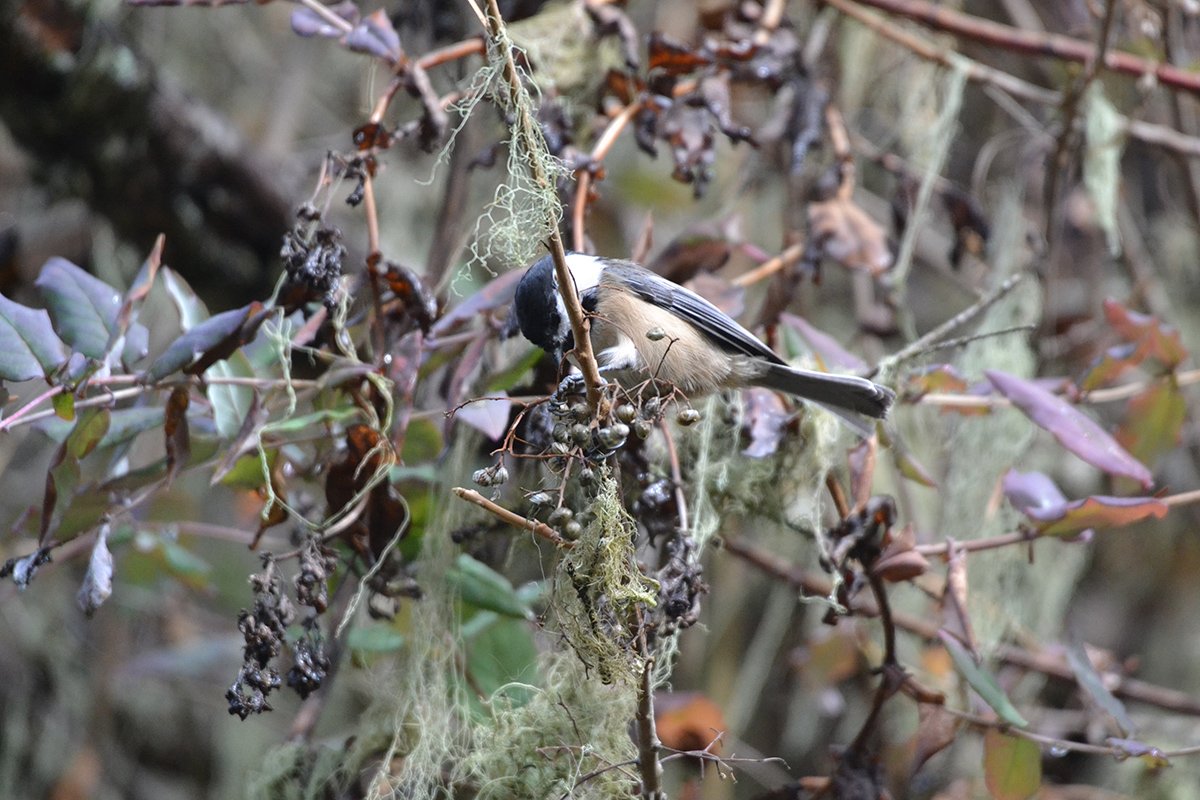
Bushtits Eating Poison Oak Berries

About a week ago, I posted about poison oak berries being an important food source for birds because the hardy berries will linger on the plant into the winter months. Up to that point, I reported that I had only seen chickadees eating the berries.

On Saturday, I was watching a flock of bushtits performing their acrobatic routine through the landscape. The next thing I know, they had descended on a patch of poison oak and started eating the berries. I was delighted to have observed another bird eating them.

It was fun to watch them cling to the plant in all sorts of ways as they ate the berries.

Red-tailed Hawk

"Nothing makes the earth seem so spacious as to have friends at a distance. They make the latitudes and longitudes.”

Letter
Thoreau to Lidian Emerson
May 22, 1843

Happy New Year

May you find time to be in nature to absorb its serenity and carry it with you back into your daily life.

Poison Oak Berries

As I was walking around today, I saw that some of the poison oak berries are still lingering around.

I realized that I had started writing this post about a month ago, and somehow it got buried under a pile of other ideas.

During the fall when I took this photo, I frequently saw chickadees foraging poison oak berries. Supposedly their are a number of different birds that eat the berries, but I only have observed chickadees consuming them. I will see juncos on the ground around thickets of poison oak shrubs, but I am unable to see if they are eating the berries that have fallen on the ground.

I read in a few places that the berries are full of important nutrients for birds, but there weren’t any specific vitamins, minerals, etc. listed. I’m sure that they at least provide a source of energy, because the action-packed chickadee will know what is best for fueling its motor to keep it zipping around the landscape.

The chickadees appetite for poison oak berries has an unfortunate consequence, especially for people like me who are quite allergic to the plant. The seeds can be spread throughout the landscape as they pass through the chickadee’s digestive system.

Spotted Towhee

A familiar sound at the arboretum is the rustle of leaves of spotted towhees foraging. They hop backward with both feet to sweep away the leaf litter in search of food. Their diet consists of insects, spiders, seeds, acorns, and berries.

Towhees stay in the security of dense shrubs or right along the edge where they can quickly retreat to safety. Additionally, their spotted pattern and earth-tone coloration make them well camouflaged.

They have an interesting call note that you can often hear as they communicate with one another. Peterson describes the sound as a “catlike gu-eeee?.” Personally, their call reminds me of the mysterious, prehistoric past when dinosaurs roamed the earth. I amusingly imagine a baby pterodactyl calling for its mom.

Their songs are more friendly and sweet-sounding. Peterson describes it as a “chup chup chup zeeeeeeee” or a “drawn-out, buzzy chweeeeee.” Click here to go to the Audubon website to listen to their songs and calls.

Birds also communicate nonverbally. When watching spotted towhees you will often see them flicking their tail feathers open. In a flash, white patches on their outer tail feathers are revealed. On Cornell’s website All About Birds, this behavior indicates that the bird is being disturbed or alarming to signal potential danger. This could also be a way for them to silently check in with their companion nearby without having to call to them and possibly reveal their location.

Nature is an inexhaustible source of wonder. Hope to see you out there.

Hooded Merganser

I have seen a few hooded mergansers paddling around the edges of the river out at the arboretum lately.

Both males and females have a distinct, fan-shaped crest that they can raise and lower. Its hooded silhouette is a good identification clue from a distance.

The male has a white patch on the crest, a white breast with two black bars, a white wing patch, and rusty brown flanks.

The female has a gray-brown body and a brown crest. She blends in well with the surrounding earth tones of the vegetation on the river’s edge.

Their diet consists of small fish, aquatic insects, crustaceans, amphibians, vegetation, and mollusks. They have a slender, serrated bill that makes it optimal for grasping their prey.

Hooded mergansers nest in cavities of live or dead trees that are usually close to water. Therefore, it is important to have older, mature trees with sizable trunks which have either developed a natural cavity or have one excavated by a woodpecker.

Black Phoebe Returns

The black phoebe has a black breast that softly fades into a white belly. The rear of the crown ends in a slight peak, and it has a slender, pointy bill.

To further help identify the black phoebe, you will see it continuously bobbing its tail up and down. Also, the one out at the arboretum regularly vocalizes. Peterson describes their voice as, “Thin, strident fi-bee, fi-bee, rising then dropping; also a sharp slurred chip.”

Their diet is almost entirely insects, and interestingly, they will occasionally catch small fish at the surface of the water. Phoebes are usually found near water like the bank of the Willamette River or the lily pond out at the arboretum where they will find a rich source of insects.

It forages from a small perch where it will quickly swoop out, snap an insect out of the air and quickly return to its spot. Its perch is usually no more than about seven feet off the ground or over the water. That said, I routinely see it sitting on top of the barn or the adjacent silo catching insects.

As you can imagine, parts of many insects are indigestible. Phoebes eat most of their insects whole and leave the chewing up to the gizzard. Naturally, there are sturdy pieces that aren’t easy to break down. These pieces build up in the gizzard where they are formed into pellets to be regurgitated. Phoebes can cough up small pellets just like owls!

Over the last 3 or 4 years, I have seen a black phoebe spending the fall and winter months at the arboretum. I wonder if it is the same individual. The map in Peterson Field Guide to Birds of Western North America shows that the Willamette Valley is the northern part of their range. A note on the map states that their range is expanding northward.

Oregon Junco Camouflage

With all the newly fallen leaves, the earth-tone colorations of the Oregon junco blend in well with the surroundings. Even as they hop, skip, and jump around in the leaves foraging for food, it is easy to flush them off the ground if you aren’t moving slowly and paying attention. They are also well camouflaged as they explore the branches in the tree canopy.

They stay in constant contact with each other as they move through the landscape. Their communication sounds are subdued, so you must keep a fairly sharp ear out. Peterson describes their vocalization call as “a light smack.” They also have “clicking or twittering notes.”

Robin Eating Madrone Berries

Yesterday I could hear robins making clucking noises in the upper part of the parking lot, and I went to investigate. They were chasing each other around the tree tops and calling to each other. I’m not sure what all the excitement was about, but I did see robins occasionally visiting the madrone tree to eat a berry. I was expecting them to start gobbling them up like they did with the dogwood berries, but they didn’t. They seemed to be testing them out to see if they were ripe enough for their taste. After about 15 minutes the robins moved on, but I have a feeling they will be back.

I am only hearing and seeing robins up in the trees around the arboretum. I haven’t noticed them foraging on the ground for a few weeks. With all of the recent rains, I am sure there are lots of yummy worms to be found underneath the newly fallen leaves. Most animals vary their diet. As the seasons change, food sources become more or less available or unobtainable. I’m sure the robins know what is best to eat to have a well-rounded, nutritious diet.

Barred Owl

The other evening I watched a barred owl zigzagging down the creek trail corridor hunting for food. It would sit on a perch about 10-20 feet off the ground and scan the area with its eyes and ears. When it zeroed in on its potential prey, it silently drifted out over the meadow and pounced.

Barred owls prey on a variety of animals. On the National Audubon Society website they list their diet as: “Mostly small mammals. Eats many mice and other small rodents, also squirrels (including flying squirrels), rabbits, opossums, shrews, other small mammals. Also eats various birds, frogs, salamanders, snakes, lizards, some insects. May take aquatic creatures such as crayfish, crabs, fish.”

The barred owl is an elegant, magical creature with a distinctive hooting rhythm that is interpreted as, “Who cooks for you? Who cooks for you-all?” Click here to listen on the All About Birds website by The Cornell Lab.

Their original range was the mature forests of the eastern North America. During the past century they expanded westward across Canada and down into the Northwest and California of the U.S.

The expansion of its range has brought it into contact with the spotted owl of the West, because they share a habitat of older growth forests. As a result barred owls have been displacing or occasionally hybridizing with spotted owls. This interaction, along with loss of habitat, increased the decline of the spotted owl’s population. I won’t expand on this story here, but I recommend researching more about it.

Nature is an inexhaustible source of wonder. Hope to see you out there.

Bushtits

Bushtits are busily moving about the landscape in small foraging flocks. It is common to see around 20 in a group, and I have counted as many as 40 together. They are loosely strung along a small area looking for insects on the foliage and limbs of trees and shrubs. They have joyful spirits and acrobatically bounce around often clinging upside down from leaves and branches. Their ability to zip every which way finding tiny insects and spiders is dizzying and makes getting a photo challenging.

Peterson aptly sums up this bird’s movement as, “travels in straggling talkative flocks.” They are in constant contact with each other through quick call notes that Peterson describes as “insistent light tsits, pits, and clenks.” This chattiness makes them fairly easy to locate. In addition, you’ll often find them in mixed flocks in the fall and winter with other small, song birds like chickadees and kinglets. So be on the lookout and keep an ear out for them too.

Bushtits only weigh 4-6 grams and with all the acorns laying around, I wondered how the weight of an acorn compared to the weight of a bushtit. I gathered various sizes of acorns and weighed them. Starting from the smallest on the left and moving right, the weight of each acorn is 2, 4, 6, 8 and 10 grams. Can you believe that!?

Nature is an inexhaustible source of wonder. Hope to see you out there.

Peterson, Roger Tory. Field Guide to Birds of Western North America. 4th ed. New York, Houghton Mifflin Harcourt, 2010.

Gobbling Up Dogwood Berries

Yesterday robins, spotted towhees and golden-crowned sparrows were gathered around the dogwood tree in the island of the drop off loop at the front of the arboretum eating the tree’s bright red berries.

The robins were eating the most. First, they would pluck a berry and adjust it in their beak, seemingly testing it for edibility. If it felt right they would toss it back and swallow it whole. If it didn’t feel right, they would drop it and get another one.

On the ground there were golden-crowned sparrows foraging. They would pick up the dropped berry and break off a small piece to eat.

The towhee would also break apart the berry and eat it in small pieces. It was also getting them out of the tree like the robin. It would either eat in the tree or it would fly off to the ground nearby to eat.

At the rate the berries have been consumed over the last couple of days, I imagine they are not going to last much longer.

Turkey Vulture

Turkey vultures are a regular site at the arboretum. They can be seen slowly soaring along the river corridor or catching updrafts and circling the hillsides as they search for recently dead animals.

Turkey vultures are skilled soarers. They have a long, broad wings that are raised slightly upwards forming an open V-shape. They have a distinctive flight pattern—they constantly teeter from side to side adjusting to air currents. Using their sense of sight and smell, they like to fly low over the landscape as they search for food.

Turkey vultures are beautiful, mysterious creatures. They will soon be drifting south, as they don’t spend the winter here. I always look forward to their return as spring approaches.

Black-capped Chickadee & Speckled Oak Gall

While the Steller’s jay is busily exploring the oak tree canopy collecting acorns, the black-capped chickadee is investigating the speckled oak galls on the underside of leaves.

As it forages for these galls, you will see it acrobatically clinging to the oak leaves. Sometimes it will open the gall while hanging on to the leaf. Other times it will pluck the gall off the leaf and take it over to a nearby branch to extract the larva.

I took one of the galls over to a picnic table and cut it in half. The gall reminds me of a ping-pong ball—it is round, light and the shell is paper thin. On the inside there are white, electric fibers radiating from the center where the small larva is encased. The larva will emerge from this small encasing when it is ready and eat the inside of the gall for food.

Small groups of chickadees are roving through the landscape at Mt. Pisgah exuberantly opening these little packages and eating the yummy larva inside. To help locate them, listen for their chick-a-dee-dee-dee call. You might also hear them whistle the notes fee-bee-ee or fee-bee of their song.

Nature is an inexhaustible source of wonder. Hope to see you out there.

Steller's Jay Harvesting Acorns

As I walk into the arboretum at the White Oak Pavilion, I am greeted by the sounds of falling acorns. Acorns are a sturdy nut with some gravity as they fall. As they drop through the tree, I can hear them brushing against the oak leaves. They bounce off the ground with a hearty thud or strike the metal roof of the pavilion with a resounding pop. I have had a couple come close to thumping me on the head as I went underneath one of the oaks. Hopefully my hat will lessen the blow.

Accompanying the orchestra of falling acorns is the shook shook shook shook vocalization of the Steller’s jay. They are busily selecting acorns and caching them for the winter. They will usually make a small hole in the ground and tuck the acorn inside by pounding on it a few times. Afterwards they will cover it with debris, such as leaves or sticks. Obviously they try to be discreet when stashing their food. If they feel that they were seen while hiding their food, they will return to retrieve and relocate it. This behavior has happened with me as I have attempted to photograph them burying an acorn.

In David Sibley’s book What It’s Like To Be A Bird he has this fascinating detail about acorns and nutrition: “One significant challenge of eating acorns is that they have high levels of tannins, which bind with proteins and makes them unavailable. Acorns are high in fat and carbohydrates, but, eating acorns alone, jays lose weight rapidly because tannins lock up more protein than the birds get from the acorns. If a bird has access to other sources of protein—enough to make up for what the tannins remove—then acorns in moderation can be a valuable part of the diet.”

Nature is an inexhaustible source of wonder. Hope to see you out there.

Sibley, David Allen. What It’s Like To Be A Bird. New York, Knopf, 2020.

Downy Woodpecker & Mullein

Downy woodpeckers can often be seen on the flower stalks of mullein this time of year. The yellow flowers steadily open throughout the season starting at the bottom and moving upward as the stalk grows. So you can see flowers blooming on top of the stalk, fuzzy green seed pods along the middle and older pods turning brown at the bottom. The woodpeckers are opening the pods and extracting small larvae inside that appear to be eating the seeds.

As I investigated a couple mullein stalks, I found they were attracting a surprising number of insects and spiders. I encountered a goldenrod crab spider, a daddy-long-legs, grasshoppers, aphids, weevils, caterpillars, honey bees, native bees and wasps all on a couple plants. My guess is that the woodpecker is taking the opportunity to sample a few of them along the way.

Red-breasted Nuthatch Collecting Seeds

Sitting in the shade of a ponderosa pine listening to the river flow, I heard the faint murmurings of the red-breasted nuthatch. The pine cones are beginning to open in the warm, late-summer sun and the nuthatch is on the scene to start collecting seeds for the winter. After retrieving a seed, it flew over and stashed it in the furrowed, mossy bark of a bigleaf maple. It merrily went about filling its larder for most of the morning.

Occasionally, it would take a break and forage for food - pine seeds, insects, spiders and other arthropods. All About Birds by Cornell Lab summed up their foraging behavior nicely: “Red-breasted Nuthatches move quickly over trunks and branches probing for food in crevices and under flakes of bark. They creep up, down, and sideways without regard for which way is up, and they don’t lean against their tail the way woodpeckers do. Flight is short and bouncy.” I will add that you will often see them facing downward, pausing to tilt their head upward to survey their surroundings.

Listen for the sound like a small tin horn as the red-breasted nuthatch toots and squeaks on its joyfully spirited way through the landscape.

Nature is an inexhaustible source of wonder. Hope to see you out there.

Resources:
https://www.allaboutbirds.org/guide/Red-breasted_Nuthatch/lifehistory

Wood-Pewee Fledged

I saw two of the three wood-pewee fledglings nearby along the river in a willow shrub. The parents were dashing by and feeding them in what seemed like a fraction of a second. This fledgling sat quietly on this small branch and patiently waited. I watched it for about a half an hour, and I never heard one peep out of it. Usually fledglings will vocalize with a begging call to be fed, but it can also get the attention of predators. Perhaps this little fledgling has already had a close call and has decided to sit and wait silently.

Last Nest of the Summer?

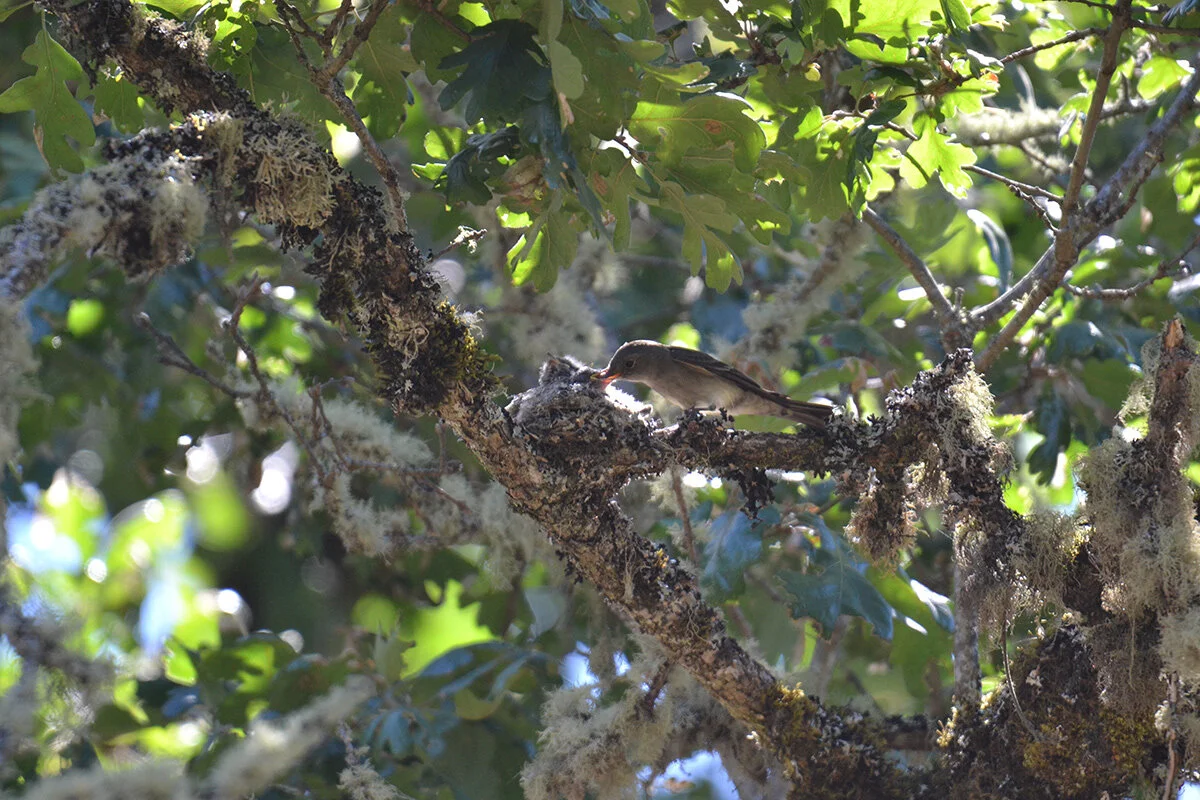
The Western Wood-Pewee has been, in my experience, the last bird nesting of the season out at the arboretum. That said, there was a robin’s nest nearby where the fledglings just left the nest within the last week. The baby pewees look as if they are going leave the nest any day now. They are fluttering their wings, preening their feathers regularly and perching on the side of the nest. There are three in the nest which seems crowded and hard to believe when you look at the size of the nest.

The parents stay close by to the nest. They could easily be back at the nest at a moments notice if a predator, such as a Steller’s jay, gets too close. The parents perch on small, exposed tree branches as they watch for insects flying by. They will swoop out in a small loop to catch an insect, and they will often return back to the same spot as if an invisible rubber band snapped them back.

The babies have insatiable appetites, and the parents are returning every couple of minutes to stuff food in their bright yellow bills. I can hear the babies almost constantly calling out from the nest to be fed.

I am sure the parent pewees welcome the closing of the day to get some well deserved rest.

Eurasian Collared-Dove

There is often a pair of these doves around the entrance to the arboretum. They have a black crescent around the nape of their neck that is prominently visible against their light, chalky-gray bodies. When they are perched or walking around on the ground, you can see that their wing tips are slightly darker than the rest of the wing.

They mainly forage along the ground for seeds, and they will also eat berries and insects.

This bird was accidentally introduced into the Bahamas in 1974 and by the 1980’s they had made their way over to Florida. Since then they have spread across the United States, except the Northeast where only a few strays have been recorded. In reading about them, I didn’t find anything reporting negative impacts on the populations of native birds.

Cool fact from All About Birds:
”The Eurasian Collared-Dove’s species name, decaocto, comes from Greek mythology. Decaocto was a servant girl transformed into a dove by the gods to escape her unhappy treatment; the dove’s mournful cry recalls her former life.”