The past few days, chilly mornings have evolved into pleasantly warm afternoons. As I entered the arboretum, I was greeted by the melodic notes of the song sparrow. The sun sure felt good, and a song was well suited for the moment. Thanks.
Winter Gems
This bird’s common name is Steller’s Jay. Its Latin name is Cyanocitta stelleri. When I searched for the translation , I found that the name Cyanocitta is a combination of the Greek words kuanos, meaning "dark blue", and kitta, meaning "jay".
I love watching this beautiful bird. I caught it here, quietly perched on a branch in the sun observing its surroundings. Lately I have watched them busily collecting acorns and burying them in the forest. They have strong legs and can often be observed hoping around the branches of a tree.
Steller’s jays can be very vocal birds. Peterson’s field guide describes it this way: “Loud shook-shook-shook or shack-shack-shack or wheck-wek-wek-wek or kwesh kwesh kwesh; harsh jjaairr and many other notes. Frequently mimics hawks.” Try making these sounds.
Anna's Hummingbird
As I entered the arboretum, I saw a male Anna’s hummingbird performing his steep J-shaped dive. I watched him dive and circle back up to his starting point four or five times. He then perched on a branch towards the top of a tree where he began vocalizations and displaying his iridescent, gorget feathers. I soon discovered the female perched on this small branch in front of me. The male continued his displays, and I took a few photos as she perched there so still. When I looked at the photos at home I noticed that her eyes were closed in a bunch of photos. In The Sibley Guide to Bird Life & Behavior, David Sibley writes, “The female may appear mesmerized, often closing her eyes and becoming frozen in position during the shuttle displays.” Sibley also writes, “Hummingbirds do not form pair bonds; they come together only to mate. Males therefore set up territories where they will encounter females, while females claim territories with good nesting sites.” I am left wondering why all this is happening in December.
Vocalization description:
The Cornell lab says, ”Anna’s Hummingbirds have a distinctive song that is long for a hummingbird (10 seconds or more). It's a series of buzzes, then a clearer, more tuneful whistle, followed by more emphatic chip notes; then the bird may repeat the whole set of buzz-whistle-chip sounds.” Click the link to listen.
https://www.allaboutbirds.org/guide/Annas_Hummingbird/sounds
Click on images to enlarge.
Mistletoe Berries
As I started out on a walk yesterday at the arboretum, I noticed some birds fluttering around In the oak trees by the parking lot at arboretum. They were in the trees just above the office. As I walked up there to take a closer look, I saw that they were western bluebirds. As I watched them, I noticed that the mistletoe was loaded with berries, and they were excitedly feasting on them. I hadn’t noticed the berries on the mistletoe, and I was grateful to the bluebirds for pointing them out.
Listen for the call of the western bluebird. Peterson describes it as a “short pew or mew.” Cornell Lab of Ornithology describes, “The most common call is a soft, quavering kew that may be given from a perch or in flight and is often given several times in succession.”
Click here to have a listen: https://www.allaboutbirds.org/guide/Western_Bluebird/sounds
Ready and... Action!
Ruby-crowned Kinglets are one of my favorite birds. Over the past couple of weeks they have migrated back to the area.
I see them in mixed flocks with golden-crowned kinglets, chickadees, bushtits, nuthatches and brown creepers. They are very energetic, zipping from one branch to another gleaning insects. I will often see them hover in place underneath a leaf or branch of a plant as they catch an insect.
I will often hear their call note that Peterson describes in his field guide as a husky "ji-dit”. Even now I will occasionally hear them sing a line of their song. It is such a sweet, warbling whistle. Peterson describes it as, “several high notes, lower notes, and a chant, tee tee tee-tew tew tew — ti-didee, tididee, tididee.”
I managed to get a photo that wasn’t completely a blur of this high-spirited, enthusiastic creature.
Feathers
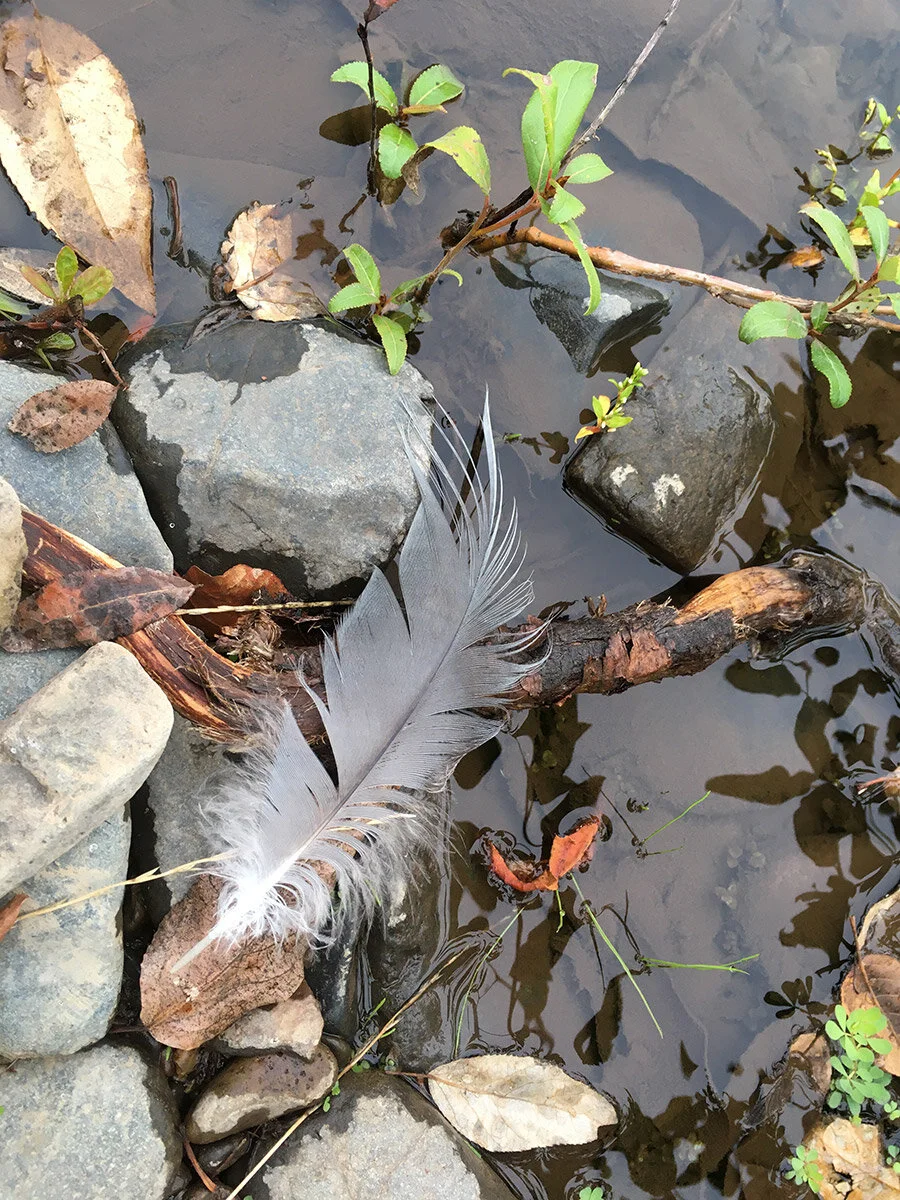
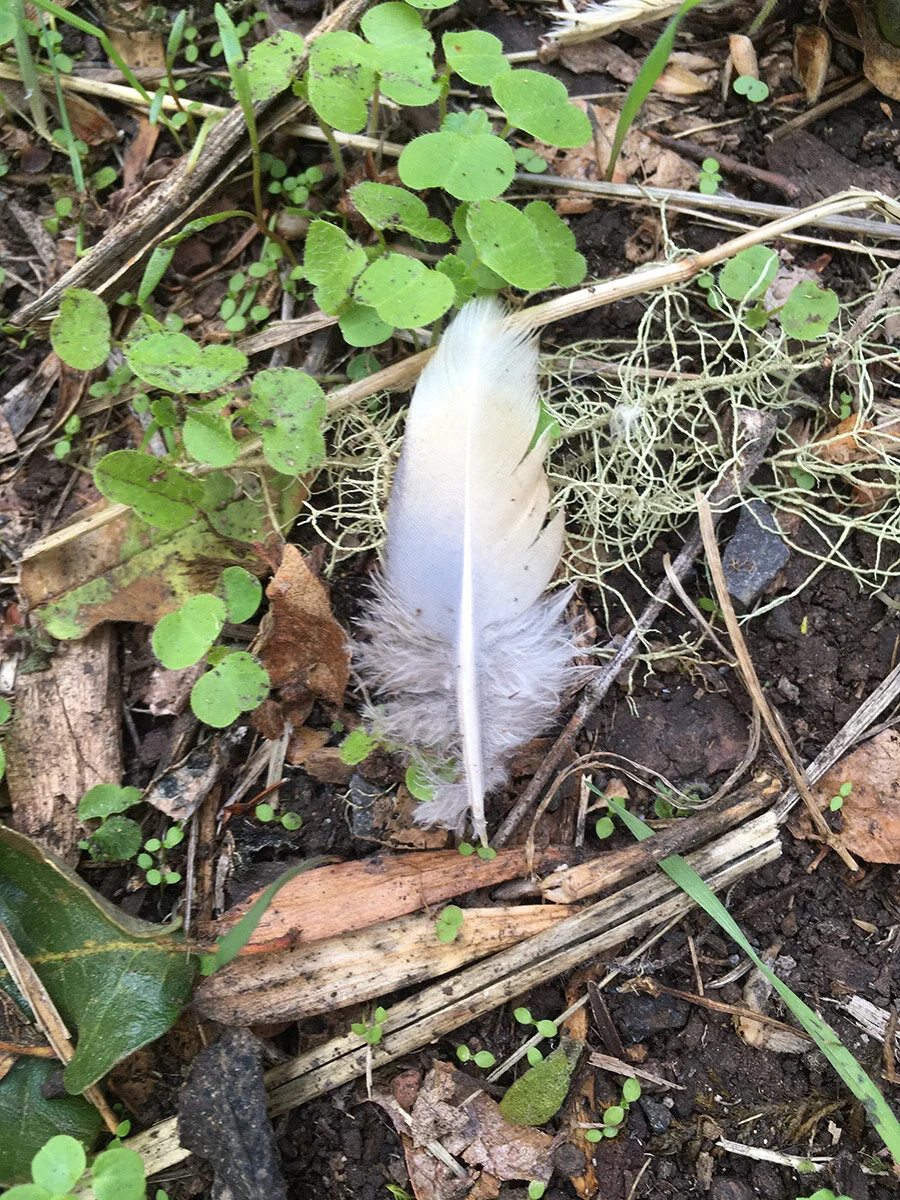
Mt. Pisgah is a great place to go bird watching. Occasionally, I’ll get lucky and find a feather. They come in all shapes, sizes, and colors. They can have patterns on them too. Birds have different types of feathers on their bodies and each type of feather has a specific function. For example, wing and tail feathers help with flight. It is always interesting to try and figure out what type of feather I have found and maybe, what bird dropped it there.