Gall Wasps Galore

Check out how many galls are forming on the underside of this oak leaf! They remind me of brightly colored candy sprinkles you would use to decorate a cupcake for a kid’s birthday party.

While holding this leaf up to take a photo, it was noticeably heavy from all these galls and it seemed like it could easily become unattached from the additional weight. The top of the leaf was still dark green, so all of these galls didn’t seem to be affecting the leaf’s ability to photosynthesize.

As you can see, two kinds are forming. The Pinched Leaf Gall Wasp looks like a basket or small pastry pinched shut at the top. They can vary in color from tan to red. The other one is a saucer-shaped gall with a brown bump in the middle. That one is identified as an Undescribed Plate Gall Wasp #8. The galls are small and I imagine the wasps that emerge from them are only a couple of millimeters long.

I took this photo where a few small oak trees are growing along the edge where the forest meets the meadow. Many of these young oaks were adorned with leaf and stem galls. I’m not sure why the wasps chose to lay their eggs on these oaks. For some reason they found this area a more suitable location than the oaks out in the meadow where I saw far fewer.

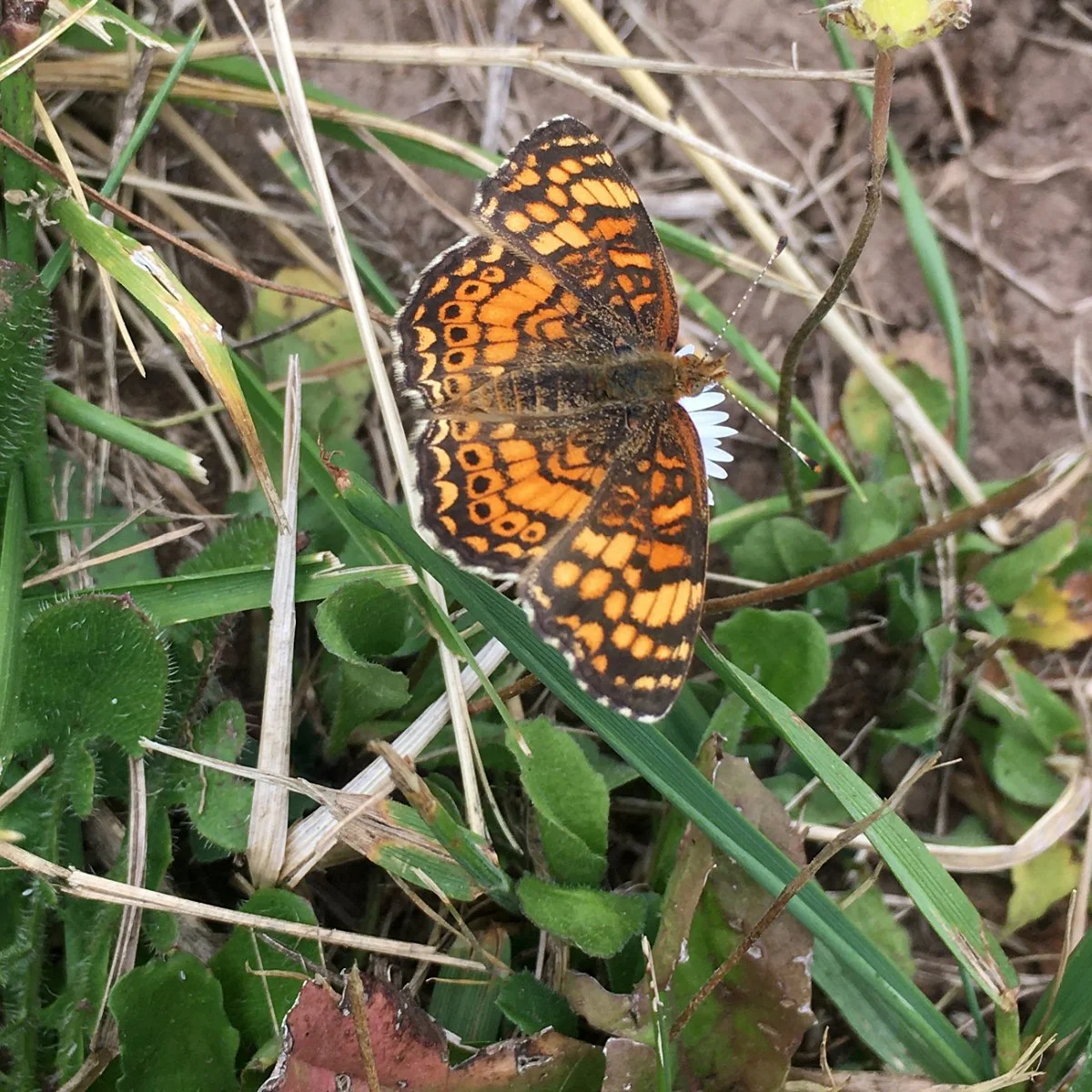
Bijou the Emerald Dragon

Inside the darkness of the earth,
there is a molten inferno of stones
coursing through her veins.
It is surging with each
beat of her heart.
The rhythmical pulse is
drumming—a percussive mallet
forging armored suits
of emerald.
It is where dragons are born.
They rise out of the
fiery core of the planet
into the watery environments
on the surface.
An igneous jewel darting
through sun rays,
dazzling
in the summer sky.

Ode to Butterflies

There’s a map of sorts—
a dreamscape
that tumbles out
of a box of celestial crayons
when you are born.
It’s a bewildering tangle
of squiggly lines
drawn by the flip-floppy flight
of butterflies.
The only person
who can read it
or follow it
is the squealing,
summer-soaked child
with a berry-stained mouth
and skinned knees
spinning in circles
under the bright
blue sky
with a compass
that points to
laughter and delight
in every direction
that lives
inside of you.

Petrophila Moths

This is a tiny moth and moths can be hard to find because they are well-camouflaged and like to stay hidden during the day. I usually see moths when I accidentally disturb them from the side of a tree, in the grass, etc. Last year while I was on an insect walk Karen Richards showed us these extraordinary moths flitting along the river.

If you can see where one lands and slowly go over to it, you will see how beautiful its coloration and markings are. Its wings fold over the back of its body like an elegant cape with shimmering sequins ringed by black at the base with a little fringe below.

These moths have an amazing life cycle. Read what the BugGuide said about Petrophila confusalis: “Adult females enter the water, up to 4 meters deep, to oviposit (200 - 300 eggs), carrying a plastronlike layer of air as a source of oxygen that sustains them from 4 to 12 hours. After ovipositing they die in the water. Some females only submerge partially, without fully breaking the water tension, and deposit eggs shallowly over several days.”

This little moth is a reminder to me to slow down and notice the small creatures. They are beautiful and can have miraculous stories. I hope that you are enjoying your summer.

Resource
Species Petrophila Confusalis - Confusing Petrophila - Hodges#4780. https://bugguide.net/node/view/39602. Accessed 29 June 2024.

Looking Closer

It was a nice quiet evening at the arboretum. I was standing at the edge of the meadow just south of the pavilion trying to get at an angle where I could get a look at an oriole nest. I got a little distracted when a couple of goldfinches flew down into the grass in front of me to eat some seeds. As I watched them, I became captivated by the colors and shapes of all the grass seeds in the meadow. As I explored the ones in front of me, I noticed that they had insects on them that looked like grass seeds. Their bodies mimicked the shape of the seeds and their antennae looked like the spike coming off the top of the seeds. I was fascinated at how well they blended in and resembled the seeds. You can also see the long tubular mouth part called a rostrum used for piercing and sucking out plant juices, probably from the grass. As I was trying to take a photo of one, it reared back and appeared to be extending its ovipositor into one of the seeds to lay its eggs. I became absorbed for quite a while in the grass and found many more creatures living there. It is easy to become distracted by the abundance of life bustling about in the warmth of summer. I did eventually circle back and find the oriole nest. The parents would occasionally fly down into the meadow in search for food, and I imagine found some of these insects to take back to their hungry, begging babies.

I uploaded this photo into iNaturalist and it suggested that this was a plant bug in the genus Megaloceroea in the Miridae family.

Incense Cedar Gall

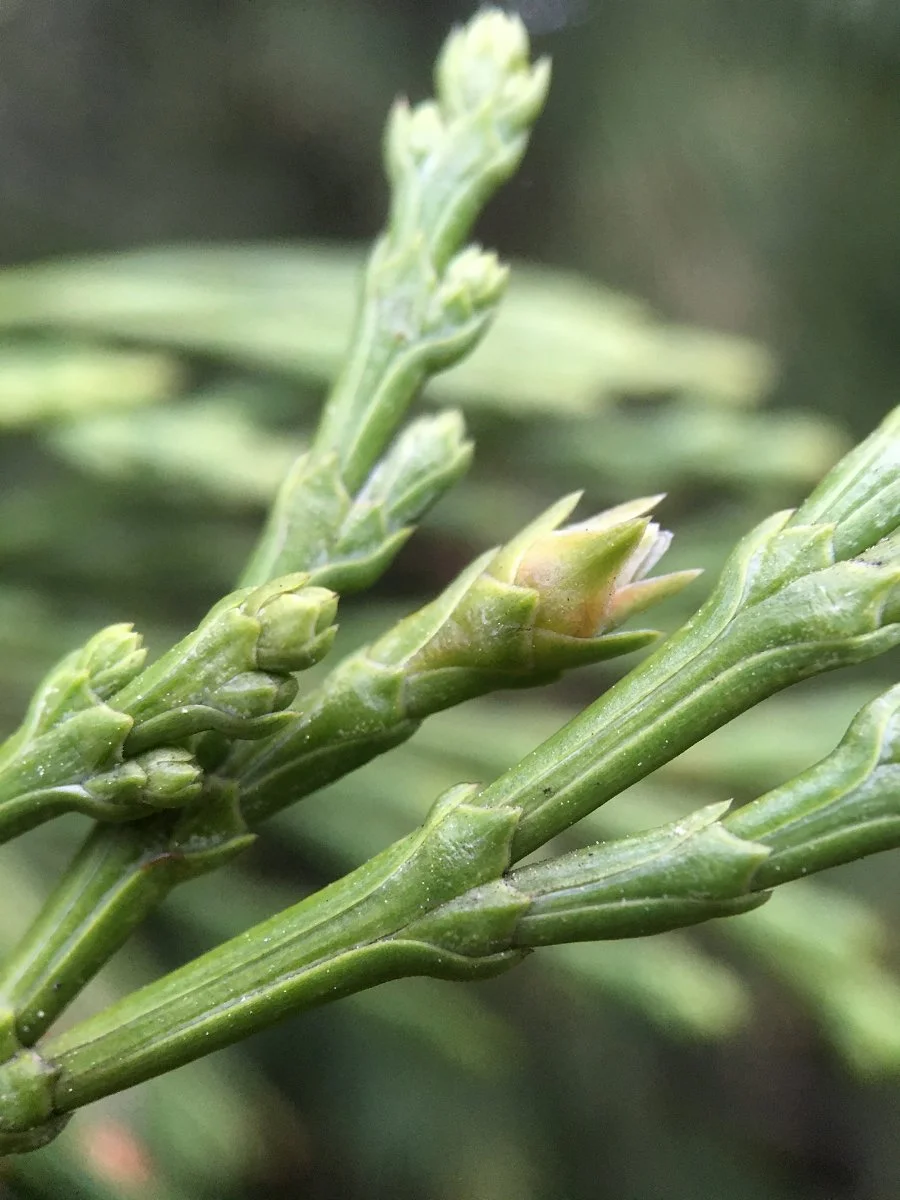
Amidst the confusion this year of trying to figure out the female flower of an incense cedar tree, I discovered what initially appeared to be a cone developing is actually a gall. I was tipped off that this growth was different because I came across an incense cedar with developing cones. I immediately realized that they were not the same.

I was walking around with a friend at the arboretum and we decided to cut one of these growths open and see what it was like inside. When we cut it in half, it was fleshy and green inside, and there wasn’t an insect or larva inside. Thinking that there had to be something inside, we cut one of the halves in half to further investigate. We found a tiny, metallic green wasp cradled inside! I mean this insect was tiny. I took a heap of photos to try and show it to you. They mostly turned out fuzzy because the insect was so small. I couldn’t zoom in close and get a photo with decent resolution. The one below is the best one of them.

I am fascinated by the world of galls, how they form, the variation of their colors and shapes, and the diversity of wasps. It is such a mysterious world to me. It seems like a whole other level of awareness to tune into these tiny creatures and observe their life cycle. It reminds me that there is a vast universe of life unfolding right before me of which I am mostly unaware.

I posted about a small, orange caterpillar I found at the tip of one of the branches in January (Incense Cedar Branch Tip Mystery) that I thought was one of the female flowers. Maybe these two phenomena are connected.

Hair-Stalk-Gall Wasp

Lately, I have been keeping an eye out for galls, and this is a good time of year to find them. Many gall wasps use the Oregon white oak as their host, so if you want to go hunting for galls, this is a great place to start. Many things in nature are small, especially insects like gall wasps. And honestly, I can’t identify any of the gall wasps themselves, mostly because they are so small and I haven’t spent much time trying to find them. That said, I am getting more into it and starting by finding the weird and wonderful galls created to house and protect these tiny insects as they begin their lives.

Recently, I found this tiny gall growing from an oak leaf and matched it with the hair-stalk-gall wasp found in Ronald Russo’s book Plant Galls of the Western United States. This gall grows along the margins of leaves and forms a smooth, pointed gall that grows from a thin stalk. In spring, the color of the gall starts from yellow to orange and turns beige by summer.

In his book, Russo writes, “These smooth galls are fully developed by April, with males and females emerging between April and June. Galls remain on host leaves until fall, even though the occupants have left. This would appear to be the bisexual generation of an as yet undescribed unisexual, summer-fall generation with its own distinct gall. Common.” Gall wasps are tricky. It appears that its summer-fall generation has not been observed or recorded. It’s fascinating that the second part of the yearly lifecycle of a common gall I can find at the arboretum, is still a mystery. There is so much to discover in our backyards!

Note: I want to go back and take better photos, which I hopefully can do this week, and update these.

Resource
Russo, Ronald A. Plant Galls of the Western United States. Princeton University Press, 2021.

Oak Apple Gall

Looking at August Jackson’s pamphlet Oak Gall Wasps of Mount Pisgah I find the California gall wasp (Andricus quercuscalifornicus). He describes it as “Very large, tan, ball-shaped galls on young twigs. Often remaining on twigs for a few years.” I have heard these referred to as oak apple galls and some of them certainly look like the color and shape of an apple as they begin to form. They are easy to find out at the arboretum.

I have been reading a book called The Nature of Oaks by Douglas W. Tallamy, and I just read this part of the book that talks about gall wasps. I decided to quote part of what he wrote in the book to make sure that the information was correctly passed on to you. I found this so unbelievably fascinating. Check it out.

“Most cynipid species, particularly those associated with oaks, have a complicated life history known as alternation of generations. The first generation is comprised entirely of parthenogenetic females—that is, females that can lay fertile eggs without mating with a male. That’s a handy trait to have because there are no males in this first generation. The adults and galls produced by the first generation have a morphology specific to each species. The second generation, in contrast, produces adults and galls that are entirely different from those of the first generation, and instead of just females, it yields both males and females that need to mate in the usual way to produce viable eggs. For the longest time, cynipid taxonomists thought the two generations were two different species, and you can hardly blame them; the cynipids in each generation looked entirely different from each other, as did their galls. I’m still not sure how, without the aid of the DNA analysis, taxonomists ever figured out that the wasps that looked one way in April and another way in June—and which produced vastly different galls—both belonged to the same species.

The diversity in gall size and shape is astonishing. I suppose it shouldn’t be, though; gall morphology is unique to each species, and most of the nearly 800 North American cynipids make two kinds of galls. That’s a lot of gall variation!”

Resource
Tallamy, Douglas W. The Nature of Oaks: The Rich Ecology of Our Most Essential Native Trees. Timber Press, 2021, page 61.

Lists and Guides of Mount Pisgah Arboretum.

Fimbriate Gall Wasps

Oregon White Oaks are a host for many gall wasps. The fimbriate gall wasp forms a fuzzy, red structure that looks like a flower is trying to emerge out of the leaf—it kind of reminds me of a hairy rose hip. A dictionary defines fimbriate as “Botany, Zoology. having a border of hairs or filiform processes.” I think its name could be more descriptive to include words like flaming, blazing, flaring, crimson, furry, etc. August Jackson put together a guide called Oak Gall Wasps of Mount Pisgah. About fimbriate galls, he writes, “small galls in spring on midrib of leaf bases, producing spines. Starting red then fading to brown.” The guide is available on the arboretum’s website. Find it here.

The development of galls hasn’t been completely figured out. Galls are created when the wasp lays its egg in the developing plant tissue of the tree which can be on the leaves or branches. The egg interferes with normal plant growth and creates a gall that protects the egg and provides food for the developing larva. Each gall wasp creates a unique structure that is beautiful and interesting to explore.

I think I’ll call this one the Crimson Comet Gall.

Twice-stabbed Lady Beetle

I found this interesting lady beetle the other day in the redwood grove. Its entire body is a shiny, polished black, which gives it a well-armored look and feel. Its wings each have a bold red-orange spot that is kind of blotchy and not a well-formed circle.

The different species can be difficult to tell apart. Iowa State University’s BugGuide had this to say: “Several species of Chilocorus in western North America cannot be separated by external features, along with an introduced species. C. stigma is also best included in this grouping for those on the boundary of known ranges.” I wonder how they decide on a different species, especially if they can’t be separated by external features.

The introduced Kuwana’s lady beetle (Chilocorus kuwanae) pretty much looks identical to Chilocorus stigma, a native to the U.S. and Canada. Cornell University’s College of Agriculture and Life Sciences writes: “ Spots of C. kuwanae tend to be deep red and rectangular and located near the center of the wing. In contrast, spots of C. stigma tend to be more orange-yellow, round and oriented more toward the head of the beetle.” Again, there are very subtle differences in differentiating between the two that seem like it could be difficult to tell in the field.

My focus quickly started to shift away from the quagmire of identification to wonder and appreciation of nature. Like other lady beetles, they are beautiful and beneficial insects that help maintain the balance of nature by eating other insects, such as aphids and scale insects. See you out there!

Incense Cedar Branch Tip Mystery

The male cones of the incense cedar are out by the millions, literally, and they are starting to release their pollen. The male cones are small but they are easy to see. If the male cones are out releasing pollen, then the female cones must be around too. They are not as obvious, and I used Oregon State University’s incense-cedar webpage to help me out with identifying them.

If you look at the first photo below, you can see the light brown male cones and on the end of the branch, you can see the female cones. I took a few close-ups of the female cones to show you the small compact, rosette of leaves that forms a small nodule at the tip. They start to turn slightly yellow as they form.

I decided to cut one open to see what it looked like inside. To my surprise, the first ones I cut open were slightly discolored and had a small, orange caterpillar inside. I started to wonder if this caterpillar was causing the little nodule on the tip of the branch. I eventually found one that didn’t have the caterpillar inside. It is the fourth photo below and it appears that it contains some sort of ovaries to receive the pollen. That photo was taken with a macro lens that I fit over my phone. I wanted a more magnified image, and I tried looking at the cone under a microscope in the nature center at the arboretum. They were pretty much the same as my macro lens. Plus the microscopes are fairly old and the image quality wasn’t as good as I would have liked.

I have continued to open these female cones and every one of them has contained that caterpillar. I didn’t want to pick anymore off the tree so I looked on the ground in the golden carpet of male cones that had fallen off. Mixed in are a bunch of the female-looking cones and the few that I opened had the orange caterpillar inside. So far, I have only been able to find that one cone that didn’t contain a caterpillar.

So, at the moment I still have mysteries to solve, questions to answer. What is that orange caterpillar going to become? Were the eggs laid inside the female cones or do tips with the caterpillars look similar to the female cones at this point? I also want to know why so many male cones are dropping off the tree, has all of their pollen been released already? There are so many falling off the trees at the moment, that you can see them bouncing off the ground and feel them pelting the top of your hat. Why are the tips with the female caterpillars being dropped too? Will the caterpillar survive on the ground? Is this part of its life cycle?

I’ll keep you posted when I find out anything. Nature is an inexhaustible source of mysteries and wonder. I hope to see you out there.

Winter Butterfly

During the second day of winter, there was a brief period of sunshine and warmth in the afternoon. I was down by the river sitting on a log soaking up some rays and my surroundings. To my surprise, a butterfly came fluttering over and flew around me. It also decided to perch on a log and take in the warmth of the sun’s rays.

I looked it up and decided that it was a California Tortoiseshell butterfly. On Art Shapiro’s Butterfly Site, Dr. Art Shapiro, professor of Evolution and Ecology at the University of California, Davis, states: “The ‘Tortie’ overwinters as an adult and can sometimes be seen sunning itself in midwinter on mild days.” Hooray!

Where was it waiting for this warm and sunny afternoon on the second day of winter? It must find fascinating places to shelter from the cold and rain.

It was a reminder to me to be open to the unexpected, or maybe it’s better said that I need to go out into nature without expectations.

Reference
Nymphalis Californica | Art Shapiro’s Butterfly Site. https://butterfly.ucdavis.edu/butterfly/nymphalis/californica. Accessed 29 Dec. 2023.

Antlions

Adult female antlions lay eggs singly in sandy or loose soil. When the egg hatches, the larva digs a conical pit and hides just below the surface at the bottom. When an ant or small insect falls into the pit, the antlion grabs its prey with its jaws (mandibles), pierces its body, and drags it below the surface. The hollow barbs or spurs on the jaws can both inject and suck. They inject poison to immobilize their prey and enzymes to break down the internal tissues. When the antlion finishes sucking the juices out of its prey, it will cast the insect out of the pit and wait for the next one. I found a couple of shriveled-up ants on the top of one of the cones.

Along some of the paths at the arboretum, you will find these pits, usually protected under the canopy of trees. I have often seen these pits in soil under the eave of a house or barn where it is sheltered and stays dry.

When the larvae are ready to become adults, they dig deeper into the soil and form a round cocoon made of sand and silk. After about a month, the insect emerges as an adult to mate and repeat the cycle. The adult has a long, skinny abdomen with four narrow, veined wings and resembles a damselfly. The antlion is differentiated from a damselfly by its prominent clubbed or curved antennae. Also, the antlion rests its wings back in an A-frame fashion, and a damselfly holds them together. I have been looking around to find one to photograph, but I haven’t found one yet.

To find the antlion larva, I took a spoon and scooped the ground underneath and around the pit. I didn’t want to hurt it or have it retreat into the soil if I tried to extract it directly from the pit. I put the scoop in a little sieve and gently sifted out the dirt. I was left with tiny stones, flecks of wood, and other debris. It took me a minute to locate the antlion larva because it blended in so well with this assortment of organic matter. I gently moved it onto a leaf and then onto the ground. I was surprised by how cooperative it was in being handled and photographed. I sat beside it and watched it, hoping to see it make its pit. After about 10 to 15 minutes, it slowly retreated to slightly below the surface. I waited for a little longer, but it didn’t move. I marked the spot and returned the next day to find that it had remade its pit and was waiting at the bottom. I love this insect! I hope to see you out there.

Resources
Antlion. https://texasinsects.tamu.edu/neuroptera/antlion/. Accessed 11 Oct. 2023.

“Antlion Adults.” Missouri Department of Conservation, https://mdc.mo.gov/discover-nature/field-guide/antlion-adults. Accessed 11 Oct. 2023.

Antlions | Nebraska Extension in Lancaster County. https://lancaster.unl.edu/pest/resources/antlions.shtml. Accessed 11 Oct. 2023.

Yellowjackets Investigating Willow Leaves

There is a willow down by the river at the small beach where people and their dogs go swimming. It is teeming with yellow jackets crawling on the leaves. It was slightly unnerving to stand next to it record this video and check out what they find so alluring. The undersides of many of the leaves are covered with tiny aphids. So, the upper surfaces of the leaves below them are lightly sprinkled with honeydew. My guess is that the yellow jackets are attracted to this sugary substance. It was fascinating to watch the yellow jacket’s antennae sweep the surface of the leaf as they walked around foraging. I read a little about insect’s antennae and was captivating to read how they work and see all of the different shapes and sizes. Yellow jackets perceive the sense of smell, hearing, and touch through their antennae.

Another interesting thing I observed happening was that some of the yellow jackets had difficulty flying away. After moving around on the leaves for a while gathering honeydew, they would pause for takeoff, flutter their wings a few times, achieve enough liftoff to clear the leaf, and then fall to the ground. They would then crawl around on the ground, and I kept a close eye on them to make sure that they didn’t crawl up under my pant leg. It’s kind of strange, right? What was happening to them?

I also wondered why the yellow jackets didn’t forage any of the aphids. They didn’t seem interested in them at all. Aphids seem like tender little morsels that would be easy pickings.

Fishing Spider or Wolf Spider?

I was sitting along the edge of the river turning over stones, and occasionally one of these dusky, gray spiders would come shooting out from underneath one. Most of the time, they would disappear back underneath another rock as quickly as they appeared. They are lightning-fast. They could even escape by dashing across the surface of the water to another pile of rocks. It was difficult to follow one and keep up with where it went. Turning over stones to find it again was tricky. It felt like that magician’s game where a ball is placed under one of three cups, the cups are speedily switched around, and then you have to guess which cup the ball is under. The spider seemed to never be under the rock I thought it was under. I would turn over a rock and see it bolt out from the one beside it. It would disappear under another rock as it continued to play the game and give me the slip. I was very grateful when one of the spiders finally paused out in the open for a moment and kindly allowed me to take its photo.

When researching which spider this is, I narrowed it down to two similar but different kinds, a wolf spider and a fishing spider. Let’s compare them. The first area to consider is the location where they are found. They are both terrestrial, but fishing spiders are found near bodies of water and can move across the surface of water. Another thing to notice is their legs. Fishing spiders have longer legs which helps them walk on the surface of water. Wolf spider’s legs are shorter and stocker. Thirdly, is the placement of their eyes which they both have eight. Fishing spiders have two rows of four eyes. Wolf spiders have three rows—two eyes, then two larger eyes, then four small eyes. I imagine this can be difficult to discern. Color can also be a helpful clue. Fishing spiders tend to be gray or brown with banded legs. Wolf spiders are also different shades of brown or gray and frequently have a light or dark stripe running down their backs.

My spider seems to fit the description of a fishing spider more than a wolf spider. Beyond the name or category, I love the color and pattern of this spider.

Fishing Spiders
Fishing spiders don’t spin webs to catch their prey. They roam around looking for prey or they will sit at the edge of the water, place their legs in the water, and detect the movement of insects or even small fish to catch. Fishing spiders are nursery web spiders. The female carries around her egg sac and when the eggs are near hatching, she will suspend the sac in the protection of folded leaves.

Toad Bug

I was sitting at the edge of the river seeing what interesting animals might wander by, when this little creature hopped out in front of me. At first, I thought it was a frog. I leaned over for a closer look, it hopped again, and at second glance, it still seemed like a tiny frog. I slowly moved over to examine it closer again, and realized that it was… an insect? I watched it for a few minutes, and I finally saw its legs as it crawled out onto these small pebbles. What in the world is this amazing little animal?! I just had to watch it hop again, so I nudged it with a leaf. It seriously hopped just like a frog or a toad.

Meet the Toad Bug! It has a small, oval shape. It is 3/8” long and is two-thirds as wide as it is long. It could easily fit within the space of my thumbnail. It has bulging eyes at the sides of the head and the sides of the prothorax are projecting. Its legs are yellowish with brownish bands. Its mottled dark gray color blends in well with the surrounding stones and gives it great camouflage. Its diet consists of smaller insects which there are plenty of along the shore.

Seeing this interesting creature was a reminder that I never really know what wondrous lifeforms I will encounter or the inspiring experiences I will have every time I am out in nature. I hope to see you out there.

Resource
Milne, Lorus Johnson, and Margery Milne. The Audubon Society Field Guide to North American Insects and Spiders. Knopf : distributed by Random House, 1980.

Grasshoppers

By the River
I found this grasshopper on a stone down by the river. It seems more like a rockhopper rather than a grasshopper. Maybe I’ll name it the River Rockhopper. Along with moths, grasshoppers have superb camouflage, and most often, they are hopping away as I unknowingly walk up on them. There is plenty of grass and small forbs growing in between the rocks, so it should be easy for this grasshopper to stay on or close to the rocks to hide in plain sight.


Out in the Meadow
I have been seeing lots of grasshoppers out in the meadow and they blend in well with the dry, yellow grass. This one reminds me of a grass seed head. Notice that the wings on this grasshopper are not completely developed. Robins were scattered throughout the meadow this morning. They were scurrying about lunging for grasshoppers. They were successful too. It is hard to see, but the one in the photo just caught one and has it in its beak.

Water Penny Beetle

Lately, I have been poking around the edge of the river turning over stones, watching birds, listening to the river, and whatnot. There are many aquatic animals living and hiding out underneath rocks. My latest discovery is the water penny beetle. Along with the stonefly (posted on Aug. 1), this is another animal that is an indication of good water quality. The water penny thrives in flowing, unpolluted water that is also free from lots of sediments and algae. You will find them clinging to the undersides of rocks and logs in the water because they need to stay moist, stay hidden from predators, and are sensitive to light. That said, they will come out from hiding at night to eat on the upper surface. The larvae’s diet consists mostly of algae which are scraped off using rasps on their legs. They have dome-shaped bodies with flexible plates that allow them to hug closely to the surface and hold on. They have feathered gills under the abdomen that take in dissolved oxygen from the water.

It is interesting to realize that a larval stage of a beetle can be aquatic because I usually imagine it as a terrestrial grub underground or tunneling through the wood of a distressed or dead tree.

The adults resemble typical beetles. They are black or brown, oval, and have somewhat flattened bodies. The lifespan of the adults only lasts up to a couple of weeks—long enough to mate and for the female to lay eggs. Not only is there a short window in which to find an adult, they are only 4-6 mm long. I imagine it could be kind of tricky finding and identifying one.

As always, I hope this short post sparks your curiosity to do more research, go out to find one, and make more discoveries along the way.

Resources
Bug o’the Week – Water Penny Redux – Riveredge Nature Center. https://www.riveredgenaturecenter.org/bug-othe-week-water-penny-redux/#:~:text=The%20larvae%20of%20some%20species,into%20adults%20the%20next%20year. Accessed 15 Aug. 2023.

Hammond, George. “Psephenidae (Water-Penny Beetles).” Animal Diversity Web, https://animaldiversity.org/accounts/Psephenidae/. Accessed 15 Aug. 2023.

“Water Penny Beetle Larvae.” Missouri Department of Conservation, https://mdc.mo.gov/discover-nature/field-guide/water-penny-beetle-larvae. Accessed 15 Aug. 2023.

Skippers

Skippers are butterflies that partially resemble a moth because of their hairy bodies and small, triangular wings. They have noticeably large eyes and short antennae. When they perched, they would either hold their wings flat and parallel to their bodies or open with the forewings angled above the hind wings like a plane. The yellow-orange color of the underside of their wings was so beautiful and captured the warmth of the summer sun. It allowed them to blend well with the surrounding dry vegetation. I liked the contrast between their soft, quiet bodies and the crispy, crunchy grass. I often stirred them up from the ground before I saw them. They quickly skipped through the air and lit nearby. They were friendly and gave me a feeling of levity when I was around them. If I moved slowly, they allowed me to kneel down to get a closer look. I found them drinking nectar on small flowers like the nonnative teasel that has spread out across the south meadow.

Sources
Family Hesperiidae (Skippers) | Butterflies and Moths of North America. https://www.butterfliesandmoths.org/taxonomy/Hesperiidae. Accessed 11 Aug. 2023.

Stonefly Shed

Immature stoneflies live underwater (technically they’re called naiads), then crawl onto shore to go through their last molt and become a winged adult. The final molt leaves behind a beautiful and fascinating shell called the exuviae.

The naiad feeds on plants, decaying organic matter, and other insects. The nymphal stage lasts from one to four years. The adult stage lasts only for a few weeks, long enough to mate and lay eggs.

The adults are earth tones mostly some hue of brown or yellow. They have fairly long antennae, wings that fold back along their body, and two long cerci (tail-like appendages).

The presence of stoneflies in a river system is a sign of good water quality because they require clean, well-oxygenated water. A rocky aggregate bottom with high dissolved oxygen levels is often a productive area for stoneflies.