
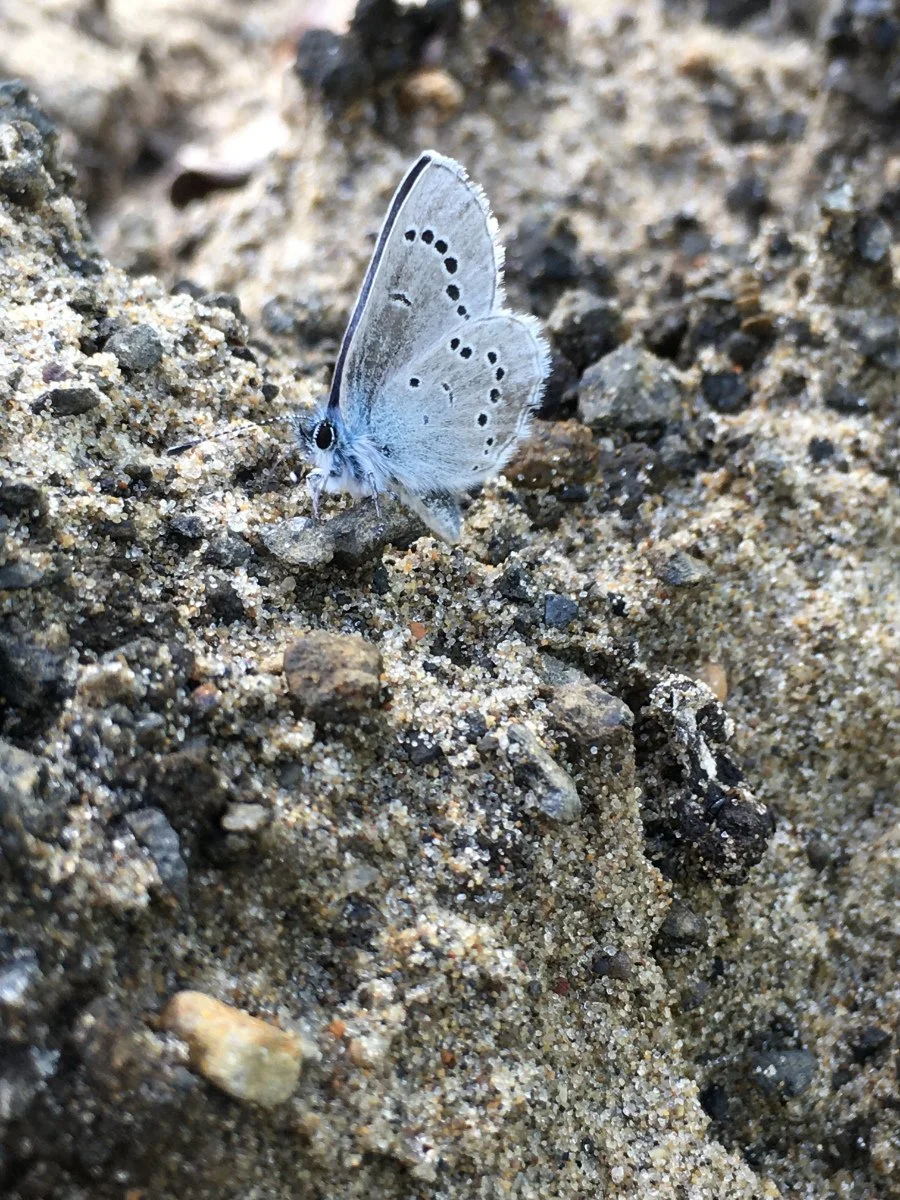
A cool, quiet blue dye
delicately tints
the ephemeral life
that lives in all eternity
softening my eyes
and lightening the path
as I walk along
collecting memories.

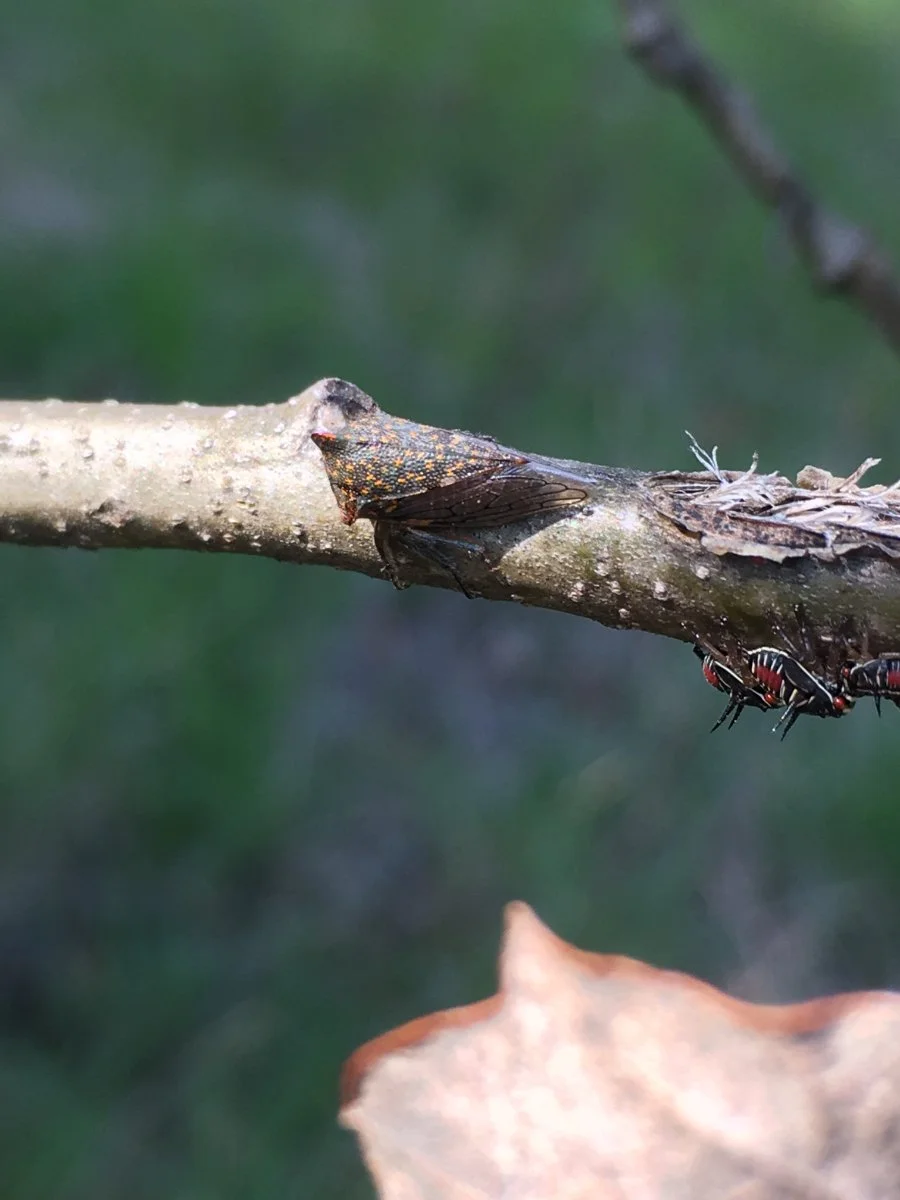
Oak Treehoppers
Once I saw these amazing creatures congregating on the end of a small twig, I couldn’t remember why I originally walked over to this particular oak tree. I called my friend Don over to have a look, and he exclaimed, “They’re Oak Treehoppers!”
The nymphs of the oak treehopper look fairly ominous. They are boldly colored black, red, and white. In addition, they have spikes on the top of their body and red eyes. As they grow and develop, they will change colors and patterns. So, I’ll be going back to check on them regularly to see how they evolve and take some photos.
Next to the nymphs was an adult treehopper. I didn’t see this adult at first because she resembled a small tree bud. The adult treehoppers become well-camouflaged as they mature turning olive-brown with yellow dots. This is the female, and she will stay around to stand guard and protect her nymph colony as they grow.
Treehoppers drink the sap of the tree.



Caddisfly Larva
While looking in the small pools in the parking lot for frog eggs, I found a caddis fly larva. It was waddling around the pool searching for algae and other organic debris to eat. It makes the most beautiful, mobile home in the larval stage.
Depending on the environment, the larva gathers plant material, leaves, twigs, sand, small rock fragments, or other detritus, to build its temporary home. It cements it together with salivary silk forming a cylindrical tube. It lives inside this camouflaged, protective casing as it develops. When it is fully grown, it closes the tube ends and pupates inside. After this stage, it will cut open the case, rise to the surface of the water, undergo a final molt, and begin flying. As an adult, it usually only lives for a few weeks. During this time it focuses on reproduction. Most species do not eat as an adult, but a few species will visit flowers for nectar.
I have a photo of the adult somewhere in my album. When I find it, I will post it.
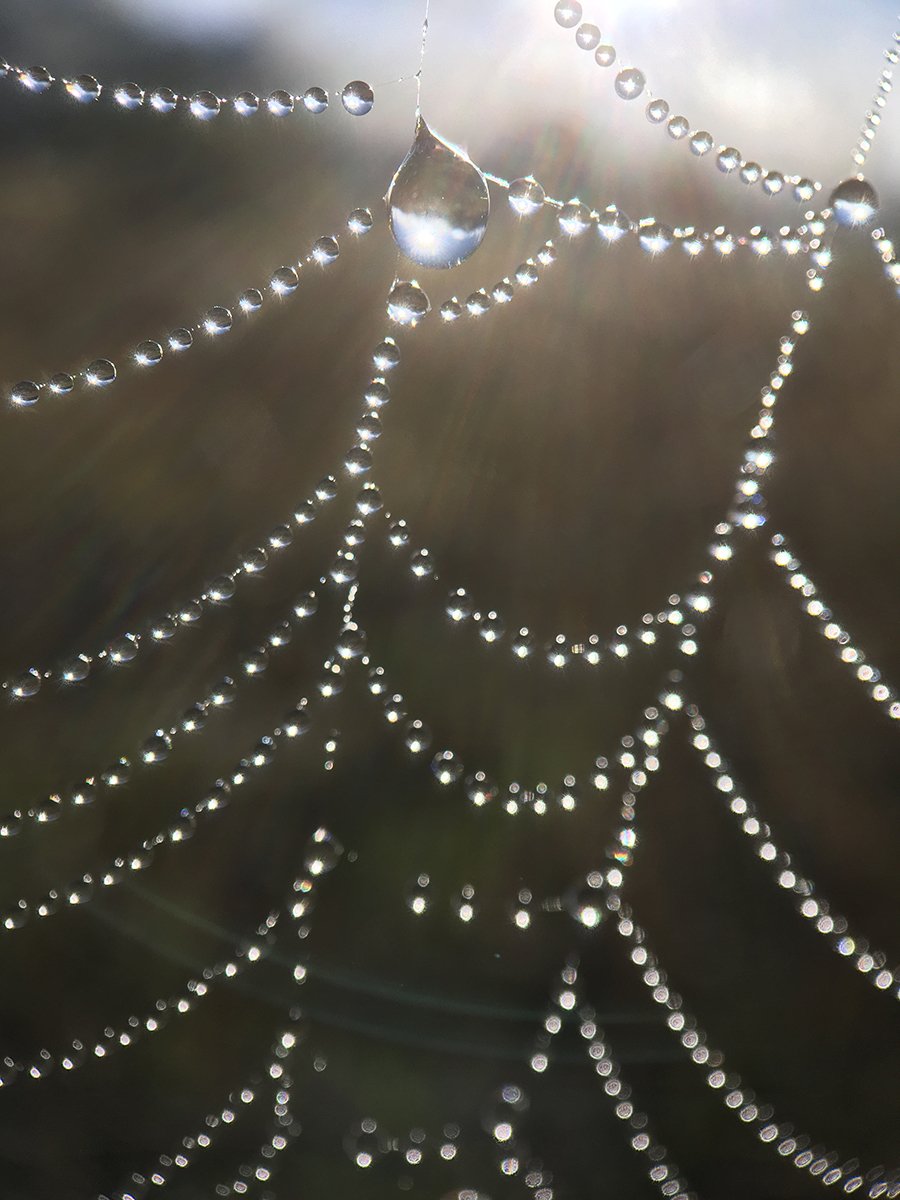
Rain Catcher
Spiders are amazing.

Pacific Ninebark Pithy Stems
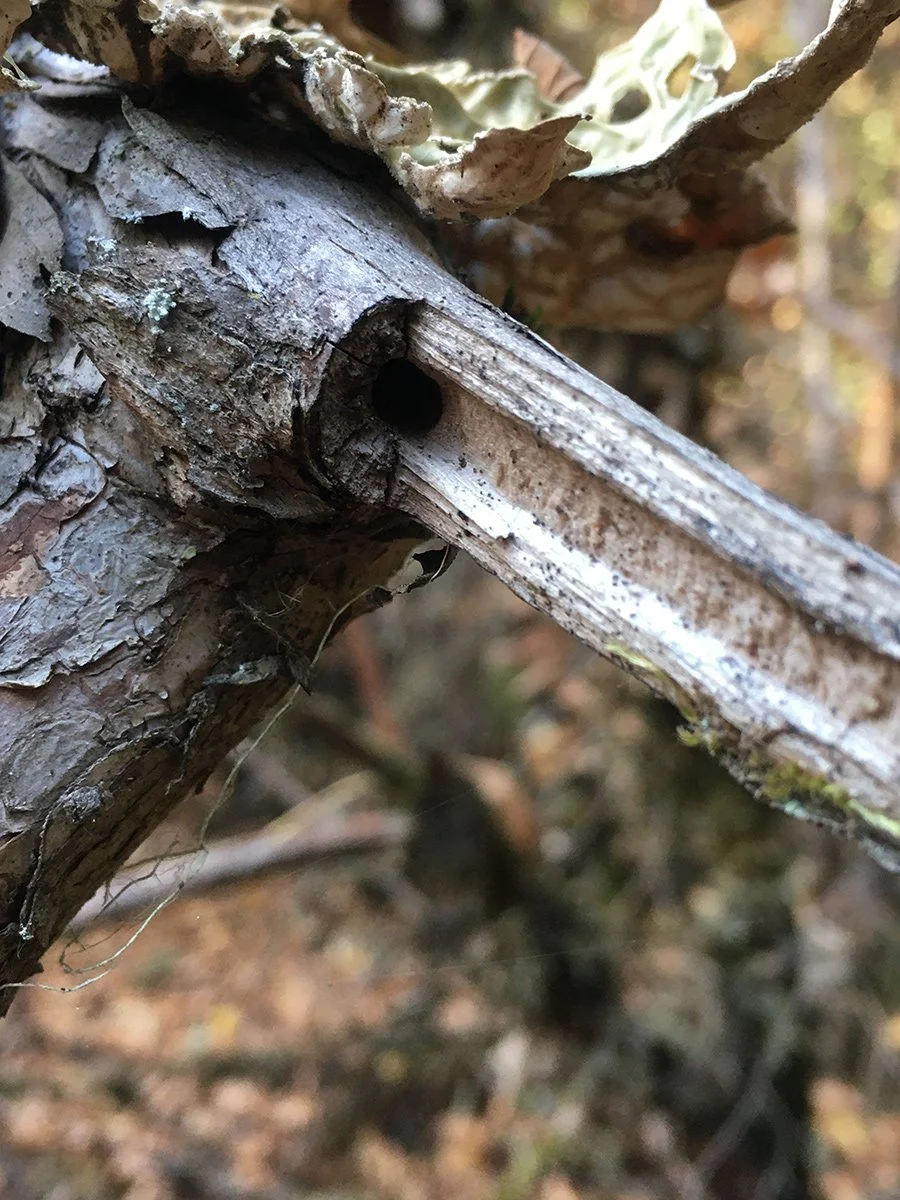
Along the lily pond trail, the caretakers of the arboretum have trimmed back branches that grow into the pathway. I noticed that pretty much all the cut branches of the Pacific ninebark have small round holes in the center of the branch. I found a broken branch that showed a pithy center that I am sure is easy and delightful to bore out. As I looked further, I noticed that there were also holes in the cut branches of the snowberry bush and the Indian-plum.
I was reminded about something that I learned from the Xerces society. It is important to leave old flower stalks in your garden landscape. Many insects and spiders will seek refuge in the stalk’s hollow stem. They will also lay their eggs in the stems for protection through winter and hatch out in spring.
I also noticed that along some of the branches there were holes that I imagine were created by woodpeckers extracting whatever tasty morsels were inside.


Tree Crickets Mating
Over the last few days, I have observed the mating of tree crickets.
The male has translucent teardrop-shaped fore wings. The female has narrow fore wings that wrap closely around the back of her body.
I have mostly found the tree crickets on blackberry canes. Where I have found them mating, the female has laid her eggs in the cane. I see that she chews through the outer part of the stem and makes a small hole. I read that she puts excrement in the hole, lays her eggs and then coats them with a secretion. I broke part of the stem open at one of these egg-laying locations. Inside there were three slender, tubular eggs.
The Himalayan blackberries have excessively spread throughout the arboretum. It is a small consolation to know that tree crickets are using the blackberry canes as a place to lay their eggs for future generations.
I also found them mating and laying eggs on a small Oregon ash sapling, as you can see in the last two photos below.




Tree Cricket Singing
The melodious songs of tree crickets can be heard gently ringing through the air at the arboretum. The notes are crisp and refreshing. Its soothing rhythm flows softly across the landscape like a gentle stream. Its reverberant sound calms the spirit. It’s magical.
Woolly Aphids
As I walked along the lily pond trail, rays of sunlight shined through the trees illuminating miniature, fuzzy orbs floating up into the sky. A woolly aphid has a fibrous, white covering. It resembles a fluffy cotton ball as it flies through the air. It is mating season, and today was the perfect day to find a mate in the warm, fall sun.
At one point, I found myself in a whirlwind of songbirds darting about foraging on the aphids. It was a mixed flock of chickadees, ruby-crowned kinglets, golden-crowned kinglets, bushtits, Bewick’s wrens, and brown creepers. They were foraging from slightly off the ground all the way up into the tree canopy.
A runner coming down the trail saw me taking photos and stopped to silently watch all of the birds. Sometimes they were only a few feet away as they flitted through the underbrush gleaning aphids off the foliage or catching them out of the air. After about five minutes, he smiled and waved as he continued on his run.

Asian Lady Beetles
I found the adult beetle, its spiny larva and the pupae on the leaves of an oak limb that hangs over the bridge that is just behind the bathroom.
Many of the larvae are attaching to the leaves and entering into an immobile pupal stage. After a few days the adult beetle will emerge.
This beetle was introduced into the United States from Asia in the early 1900’s to control aphid populations and other soft-bodied insects.
Look closely and you can tell them apart from native ladybugs. Most asian beetles have a small white marking behind the head on a part called the pronotum. It is in the middle next to the colored forewings. This forms a prominent black "M" or "W" shape on the front of their bodies.
In the fall, the asian lady beetle will find protected places to congregate and overwinter. They often find their way inside people’s homes and other buildings.


Ancient Writings
I found a charred script that was exquisitely carved on a weathered, ashen canvas. They are ancient symbols communicating a message of the inscrutable depths and layers of life. It’s a reminder of the mystery of life and the vastness of all that is unknown and unknowable.


Moth - Alfalfa Semilooper
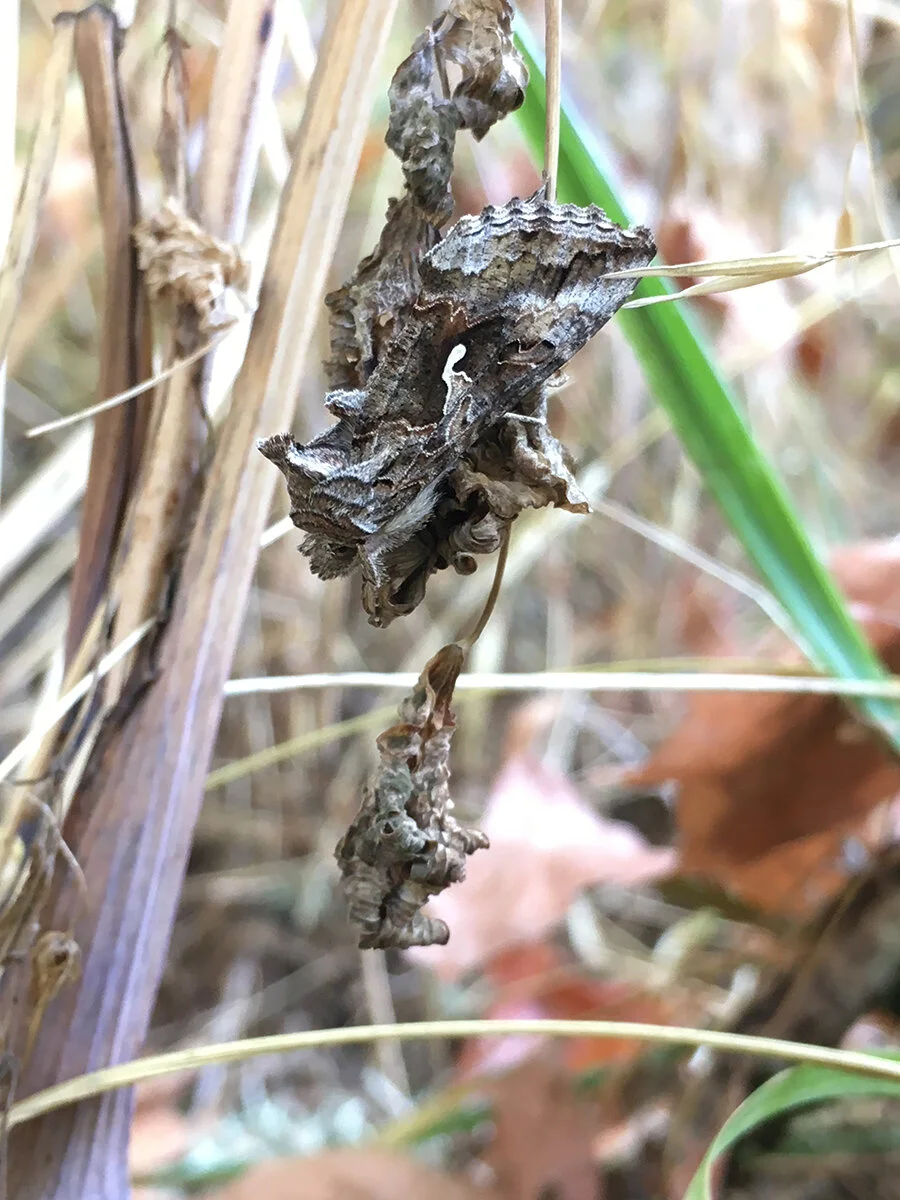
Out of the corner of my eye I saw some movement. I looked over just in time to watch this moth land on these dried leaves. I took out my camera, and when I went to take the photo, it took me a minute to find it again. Even after I took a couple a photos, my brain was still a little uncertain whether or not I had taken a picture of a dried leaf or a moth. To check, I slightly moved the vegetation that it was resting on. It slightly vibrated its wings to let me know it was there.
It truly feels impossible to put into words how incredible this moth’s texture and patten resembles dried leaves. It knows this and chooses the right place to land in order to camouflage itself. When I saw this one land, it was initially facing upward. Quickly after it lit upon the leaves, it shifted into this more downward facing position before it came to rest.
I used the following online publication to identify this moth: Lepidoptera of the Pacific Northwest: Caterpillars and Adults


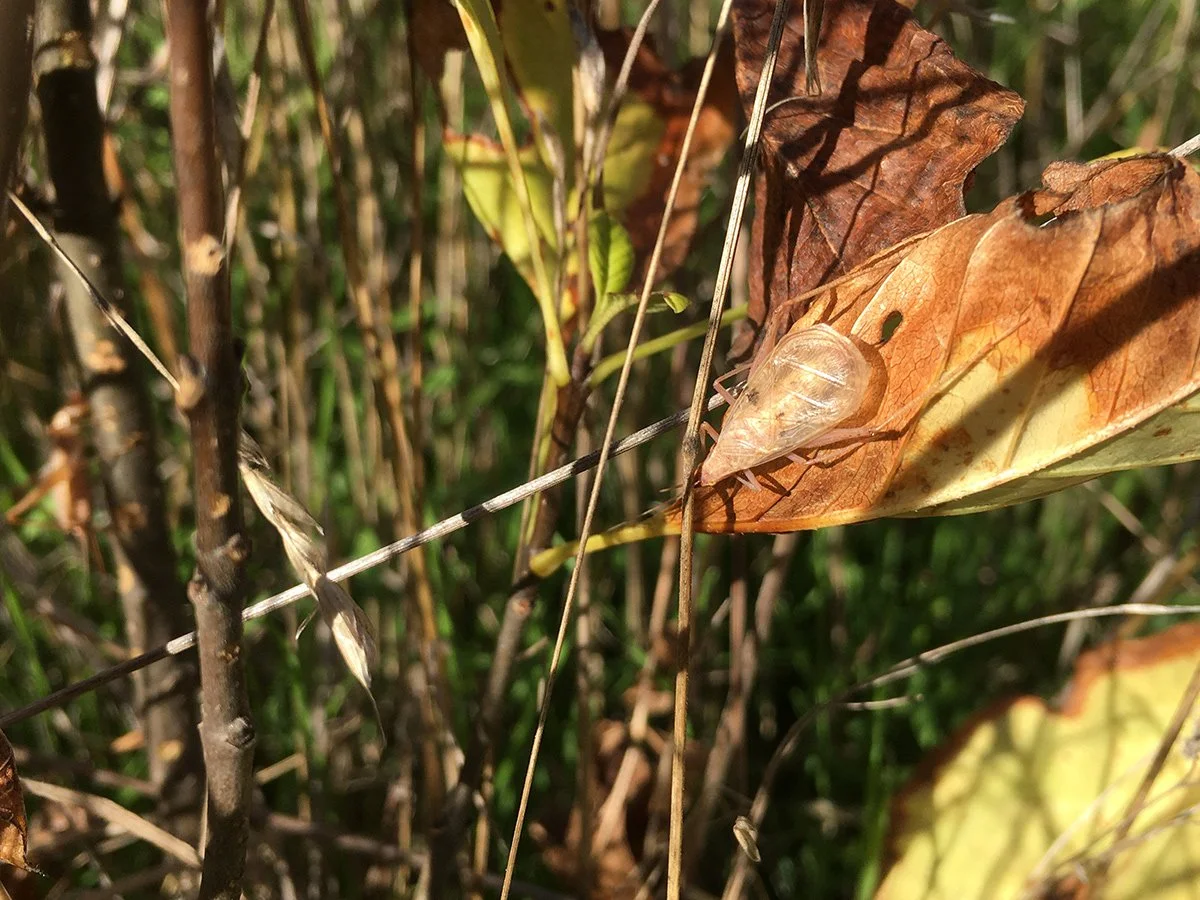
Subterranean Termite
Last night I awoke to the sounds of rain drops pattering on the dusty window sill. I opened the window and the sweet smell of the earth breathing a sigh of relief came rushing inside. I wondered about what new life would awaken out of the slumber of late summer.
As I wandered around the arboretum, curtains of rain showers continued to sweep the day. During one of the intermissions, I heard the soft, whistling calls of a flock of cedar waxwings. When I walked out to an opening by the river, I saw them swooping out and back from a small tree. As I got closer I could see a fluttering of insects slowly taking flight off the ground.
Termites were emerging from a small hole and gathering together in a small cluster. Their wings were delicate and fresh with an opalescent luminance. As they took to the air, their flight was a white, wispy dance. As they silently floated skyward, it felt like a dream. They seemed more spirit than an animate creature of this world.

Praying Mantis
While walking along the south meadow, I saw a creature launch, fluttering and flapping out of the grass. As it propelled itself through the air, it reminded me of some whirligig invented in the initial days of flight exploration. I watched as it leap-frogged its way across the landscape. It was very noticeable while flying, but as soon as it landed, it quickly blended in with its surroundings.
Well-camouflaged to their environment, mantids are ambush predators. They wait motionless or slowly stalk their prey. This creature gets its name from holding its fore legs in a prayerful pose. These legs are armed with barbs that can snare an unsuspecting insect. They strike with lightning speed, and once in their grasp, their powerful mouthparts easily pierce through the armored exoskeleton. I’ve watched them munch and crunch a grasshopper effortlessly. I read that they are voracious eaters, even going so far as being cannibalistic! The female often devours the male after mating. I also read that as they emerge as tiny mantids in the spring, they will sometimes eat each other. It is easy to see why gardeners employ these amazing creatures to help keep other critters eating their garden in balance.

California Sister
I stood out in the main meadow just beyond the White Oak Pavilion and watched this butterfly as it flew in and out of the outer branches of the oak trees.
Although it has quite a bumpy, meandering flight pattern, it seems like it has a territory. There was a breeze swirling about and small, brown oak leaves were floating and tumbling through the air. Amusingly, if one of the leaves fluttered into the butterfly’s airspace, it would swoop over to it as if to warn the intruder. Even dragonflies would be paid a visit if they came into its domain.
I loved watching the flash of its bold orange and white markings. It is a fairly quick flyer and a little tricky to follow as it weaves through the landscape. It would only light somewhere for a few seconds, which made getting a photo pretty tricky. However, it occasionally paused on these overripe blackberries for a minute or so to eat. In my research I found that rotting fruit is part of their diet. So look for a patch of blackberries along the edge of the oak savanna. This is a good place to try and get a good look at them as they momentarily pause to eat. Good luck.


Black-and-yellow Argiope
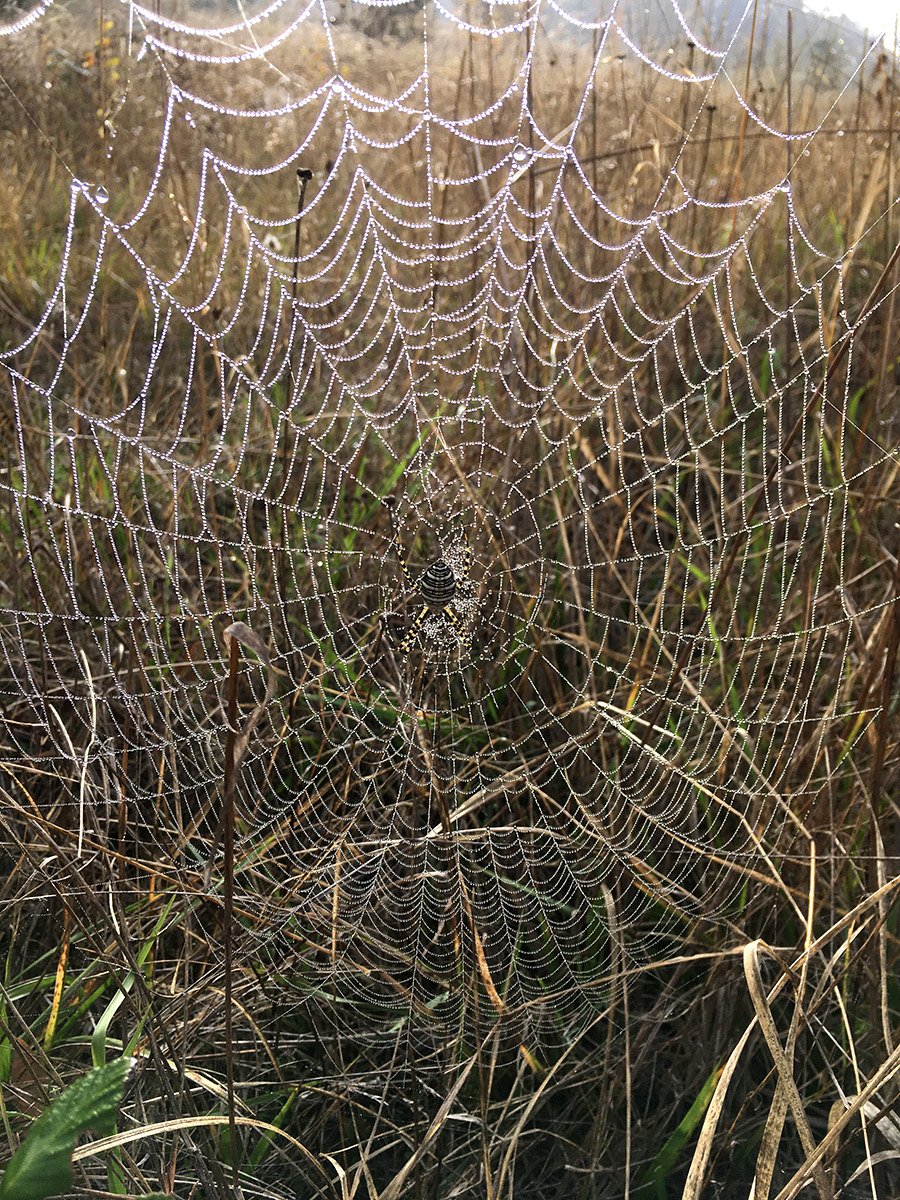
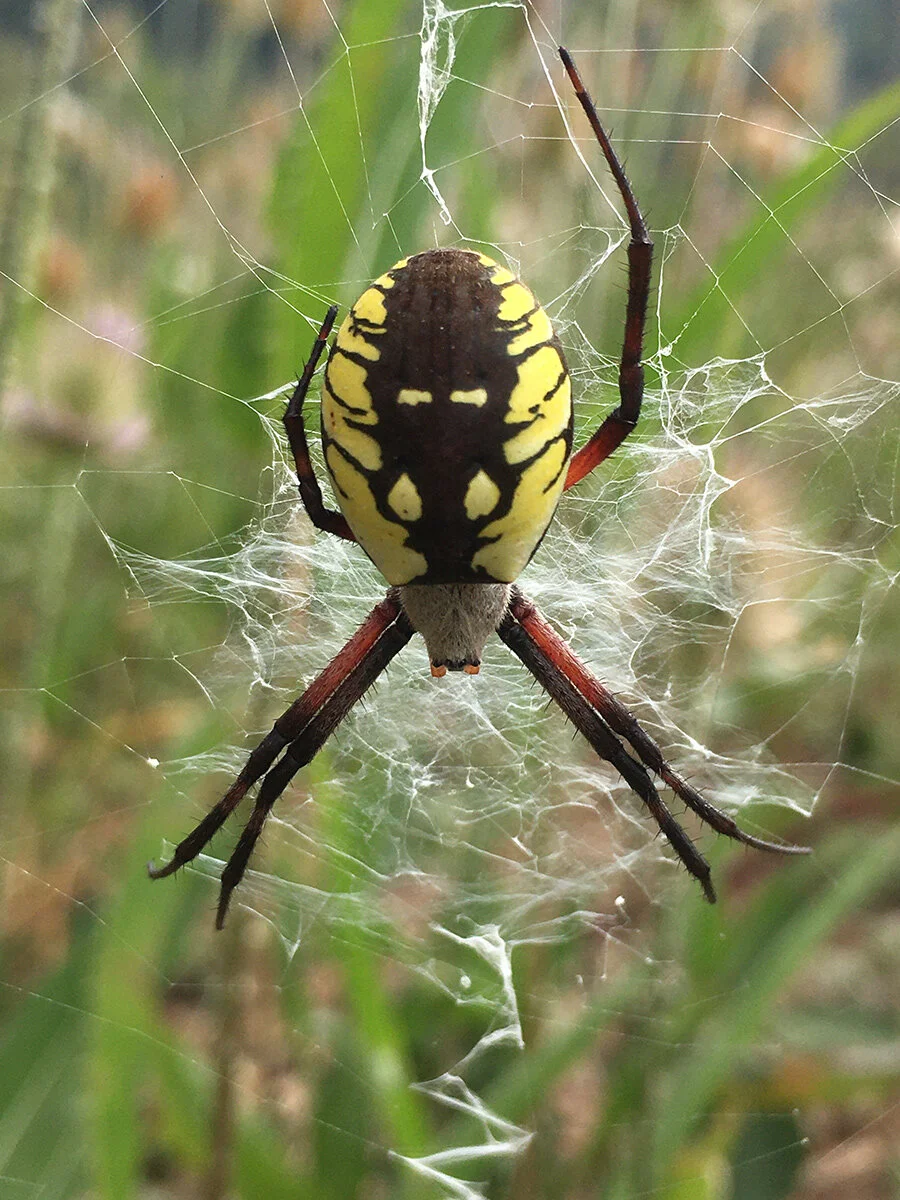
Spiders are magical creatures. They have organs called spinnerets that produce silk. This amazing material is used very creatively in the world of spiders. The most obvious use is that it can be used to build webs like the circular construction of this orb-weaver. Their silk is also used for swathing prey that gets caught in the web and to make sacs to encase the spider eggs. In a process called ballooning or parachuting, some spiders will release silk that can be caught by the wind which allows them to float into the air. I read a National Geographic article that said ballooning spiders have been found more than two miles high and thousands of miles out at sea! Spider webs are strong, stretchy, sticky and very versatile. Many birds will collect them and use them in building their nests.
The spider in the photos is the female. The males are smaller with brownish legs and less yellow coloration on their abdomens. The male seeks out a female and plucks at her web during courting. After mating, the female fills a spherical sac with a tough, brown papery covering. She attaches it to one side of the web close to resting position, then dies. Eggs hatch in the autumn, young overwinter in the sac and then disperse in the spring.
References:
Milne, Lorus and Margery. National Audubon Society Field Guide to North American Insects & Spiders. New York, Knopf, 1996.
https://www.nationalgeographic.com/animals/article/spiderwebs-explained


Velvet Ant
Confusingly, velvet ants are actually wasps. The velvet part of their name refers to their dense, hairy bodies. They are bright colors of orange, red or yellow. The females lack wings and the males are fully winged. Adults feed on nectar and water. The larvae of most species are parasites of larvae and pupae of bees and wasps that nest in the ground. Some species will parasitize flies and beetles.
They prefer open fields or pastures, and I usually come across a female out in the south meadow along the road that goes out to the river. They seem to be always moving and vigorously searching through the vegetation. They are a solitary wasp and don’t seem aggressive. That said, be warned that the female can deliver a painful sting, so be careful when observing them.


Yellow-spotted Millipede
Firstly, I thought I got a better photo of this shiny, armored creature as it moved across my path. Nevertheless, I wanted to write about it hoping its amazingness would overcome the photo until I can take better one.
The yellow-spotted millipede, Harpaphe haydeniana, is also known as the almond-scented millipede or the cyanide millipede. It is an aposematic species — the black body with bold yellow spots signals predators of its potentially harmful toxicity. When they feel threatened they will curl up into a spiral and secrete hydrogen cyanide which has the scent of toasted almonds. This is toxic to small predators, but is not dangerous to humans as the amount of cyanide is small.
They are detritivores which means they feed on the dead leaves and wood of the forest floor. I read that they eat 33 to 50 percent of all coniferous and deciduous leaf litter. As they chew, digest and excrete the leaf litter it makes valuable nutrients available to other organisms in the ecosystem.
I am looking forward to researching more about the life of this incredible organism and its importance to the health and well-being of our forests.

Dragonflies
This beautifully flaming-red dragonfly looks like it was born from the breath of fire. Darting about the wetlands, it liked to perch on the oxidizing cables of the bridge over the lily pond.
Dragonflies are amazing fliers. They seem to be darting in every direction as they sweep the landscape catching insects and/or guarding their territory.
According to the Smithsonian, dragonflies are the fastest flying Insect as they are known to travel at the speed of 35 miles an hour. Coupled with their speed is their incredible maneuverability. Each of their four wings is controlled by separate muscles which allows them to swiftly change course in any direction or hover in place.
The adults have eyes that cover most of their head which gives a great range of sight for detecting prey and predators.
Both the aquatic nymphs and the flying adults are skilled at catching insects. They are known to eat many mosquitos — the dragonfly would have been a fitting tattoo and totem animal for my dad who cursed “the bloodsucking varmints,” especially when he was fishing.

Cicadas
There are a few cicadas that can be heard buzzing out at the arboretum. Their sound evokes the long, sun-drenched days of summertime, in which, you want to while away the hot afternoons lounging in the shade by the river.
I found this small explanation on Britannica’s website about their sound: “Cicadas are able to produce these sounds because they possess an organ that is almost unique among insects, the tymbal organ. Each male cicada has a pair of these circular ridged membranes on the back and side surface of the first abdominal segment. Contraction of a tymbal muscle attached to the membrane causes it to bend, producing a clicking sound. The tymbal springs back when the muscle is relaxed. The frequency of the contractions of the tymbal muscle range from 120 to 480 times a second, which is fast enough to make it sound continuous to the human ear. Cicadas also have air sacs that have resonant frequencies comparable to tymbal vibration frequencies, thus amplifying the sound and producing that crescendo of high-pitched buzzing that is the characteristic sound of late summer.”

Speckled Oak Galls
Gall wasps lay their eggs on the underside of the Oregon white oak leaves. When the egg hatches, larvae produce a substance that induces swelling in plant tissues and forms a gall. It protects the larvae as it matures and provides food.
This tree next to the White Oak Pavilion has an abundance of galls growing on the leaves. They are yellow with red speckles and turn an amber color as they age. They have paper thin shells and glow in the late afternoon sunlight. These beautiful ornaments don’t harm the tree. Chickadees will soon start opening them and eating the larvae inside.
